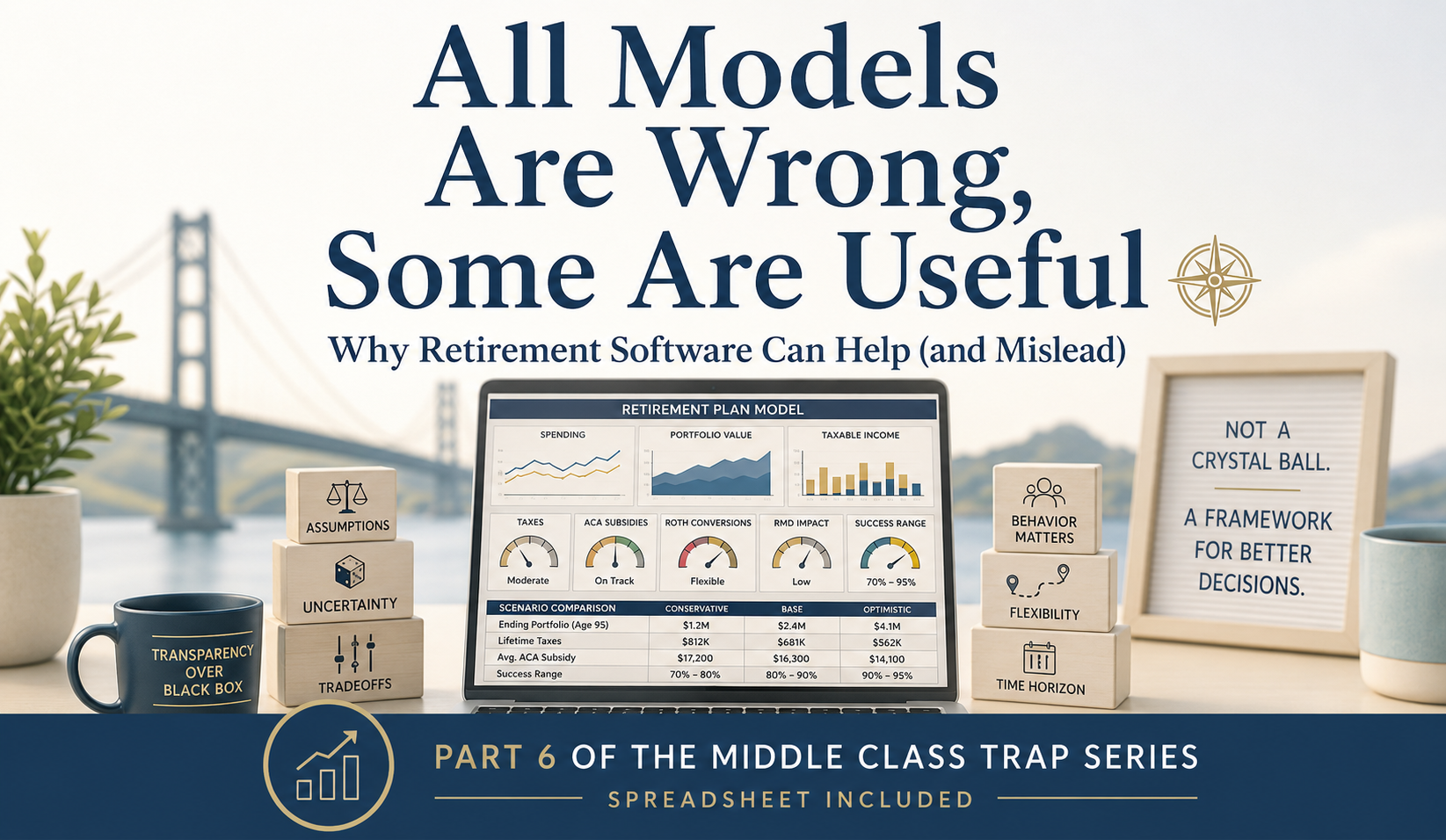

Why Retirement Software Can Help (and Mislead)
Over the last five posts, we’ve been building out a fairly detailed retirement plan for Ben and Leslie. We’ve walked through bridge strategies, ACA subsidies, Roth conversions, pre-tax withdrawals, and how the plan shifts under different return assumptions.
When you lay all of that out in a spreadsheet, the fear that our couple is “trapped” starts to fade away. That doesn’t mean Ben and Leslie’s plan is simple. There are tax rules layered on top of income limits, account balances that need to be drawn down in a specific order, Roth conversions that look optimal in one scenario and questionable in another, and ACA subsidies that can appear and disappear as income moves by relatively small amounts.
When people first see this kind of structure, it can feel overwhelming.
One way people try to resolve that feeling is by using retirement planning software. There are many tools available, and in a future post, I plan to review a few of them. These tools are genuinely useful for general planning, especially when someone is trying to answer a fundamental question like: Do I have enough to retire?
The challenge is that most retirement software compresses a massive set of assumptions into a single output. They generate beautiful charts and graphs, and they will sometimes make highly specific recommendations, like converting $200,000 a year into Roth accounts until your pre-tax account balance reaches zero.
Maybe that recommendation is right. Sometimes it is! But the more important question is simpler: Do you understand why the software is making that recommendation?
In this final post, I want to do two things:
- Share the exact spreadsheet I’ve been using to generate the projections behind this series.
- Take a step back and look at where these software models are incredibly useful, and where they tend to mislead.
What Retirement Software Gets Right
It is easy to be skeptical of retirement tools, but the reality is that most people are trying to coordinate decades of withdrawals, taxes, and investment returns all at once. That is incredibly difficult to keep straight without some kind of structure.
At a basic level, long-term portfolio and projection modeling is highly valuable. It answers the baseline question many people struggle with: Am I roughly on track or not?
Monte Carlo analysis improves on basic projections by replacing a single, flat return path with thousands of possible market outcomes. Instead of assuming markets grow smoothly, it reflects reality: returns arrive in sequences, and the sequence matters.
That output is often simplified into a single probability of success. For example: “Your assets survive 90% of simulated outcomes under moderate assumptions.” Although imperfect, that kind of output is far more informative than assuming a steady 7% return every single year.
Social Security optimization is another area where these tools add real value. Claiming decisions for couples involve complex tradeoffs between taking benefits early at a reduced amount versus delaying for a higher guaranteed payout later. Those differences are difficult to evaluate without laying them out across a full time horizon.
And then there is something purely practical: people have to actually use a plan for it to work. A software model that gets regularly revisited and updated is infinitely more valuable than a hyper-detailed custom plan that is built once and never touched again.
Where Models Start to Break Down
The underlying math used by retirement software is usually fine. The challenge is that the results often get condensed into something that looks far more final than it actually is.
This is the “black box” problem.
You enter your data, adjust a few inputs, and receive a recommendation that feels highly specific, like you have a 98% chance of success, or you should convert a precise dollar amount to Roth. But the reasoning behind those recommendations is often hidden from view.
- Is it optimizing for lifetime taxes?
- Is it managing ACA subsidies?
- Is it smoothing Required Minimum Distributions (RMDs)?
- Is it simply reacting to return assumptions?
- Or is it some messy combination of all of them?
When that logic is hidden, it becomes incredibly difficult to evaluate whether the recommendation actually fits your unique situation.
1. The Monte Carlo Limitation Nobody Talks About
Monte Carlo analysis is the gold standard for testing whether a retirement plan works. But that framing hides a massive blind spot: most implementations assume a static retiree.
A typical simulation will fluctuate markets, inflation, and returns, but it keeps the retiree’s spending fixed. In reality, humans adapt. In a weak early market sequence, retirees naturally reduce their spending and tighten their withdrawals. In a strong early sequence, adjustments go the other way. Spending may rise, conversions may accelerate, and risk tolerance shifts.
Most Monte Carlo models do not capture this. They test whether a rigid, unmoving plan survives uncertainty, rather than evaluating how a real person adapts when uncertainty shows up. Retirement is not a single decision made at age 55; it is a long sequence of ongoing course corrections.
2. The ACA Blind Spot
For early retirees, one of the most critical variables is also one of the most frequently simplified: ACA health insurance subsidies. At a traditional retirement age of 65, this is irrelevant. At age 50, it can shape the entire architecture of your plan.
In our Ben and Leslie example, those subsidies can be worth $15,000 to $20,000 per year depending on their income structure. That means relatively small decisions, like how much to convert to Roth, or which account to draw from first, can have massive, compounding effects on actual after-tax spending power.
Many mainstream tools either simplify this tax optimization heavily or ignore it entirely.
3. Why Software Often Favors Aggressive Roth Conversions
Another common pattern in retirement software is a heavy bias toward aggressive Roth conversions early in retirement.
Sometimes that strategy will work beautifully, especially if future tax rates rise, markets perform exceptionally well, and RMDs become a major tax constraint later in life. It can also make psychological sense if your goal is to reduce long-term tax uncertainty by paying the piper upfront.
But all of those outcomes depend on assumptions that are easy to treat as stable when they are actually highly volatile. If tax rates stay flat, if market returns are lower than expected, or if your spending needs change, that aggressive conversion strategy can look very different in hindsight.
Longevity assumptions quietly tilt the scales here, too. Many retirement models start with the assumption that you will live into your mid-90s. While conservative planning requires a long horizon to avoid the risk of running out of money, it creates a subtle tension with tax planning.
The exact assumption that makes your risk analysis conservative (living to 95) also makes aggressive Roth conversions look incredibly attractive. Essentially, the software is recommending that you pay real, hard cash today in exchange for a tax benefit that won’t show up for three or four decades.
The model may show a break-even point at age 92, but the real-world question is more immediate: Will your 92-year-old self actually be there to collect on the trade you are making today?
What My Spreadsheet Does Differently
The reason I built this spreadsheet is not because existing software tools are bad. They are incredibly useful, and in many cases, far more sophisticated than a spreadsheet. However, I believe transparency matters.
Instead of compressing everything into a single, automated output, this model makes the moving parts visible.
- Income flows year by year.
- Account transitions are explicit.
- Taxes and ACA subsidies respond dynamically to those flows.
- Roth conversions show up not as abstract commands, but as deliberate decisions that visibly alter the rest of the plan.
It also allows you to manually stress-test different return environments so you can see exactly how market timing and sequence affect your specific plan, rather than relying on a generalized average.
The goal is not to find a single “correct” answer. It is to make the tradeoffs clear.
How to Use the Tool
🔗 Bridge Period Google Sheet: Make a Copy to Edit Here
- Start with a simple baseline: Plug in your age, retirement timing, desired spending level, current account balances, and estimated Social Security benefits.
- Run a few scenarios: Test a conservative market path, a baseline path, and an optimistic one.
- Look for patterns: The exact dollar amount in any single scenario matters less than how the outcomes shift when your assumptions change.
As you play with the numbers, ask yourself:
- How might we use Roth conversions or a 72(t) to meet our bridge needs to 59 1/2?
- Do Roth conversions smooth out our taxes, or do they create unnecessary tax spikes today?
- Do Required Minimum Distributions actually become a major issue for us later on?
Those visible patterns will tell you infinitely more about your financial security than a single software-generated probability score ever will.
Disclaimer: This tool is for educational and illustrative purposes only and does not constitute professional financial, tax, or legal advice.
What This Spreadsheet Does Poorly
There is a famous quote from the statistician George Box:
“All models are wrong, but some are useful.”
Different George than your humble author, but definitely the one worth listening to here. The point of that line isn’t to dismiss models, but to keep them in perspective. No model captures everything perfectly.
To be completely transparent, my sheet has specific limitations:
- It was explicitly built for couples in the general range of ACA eligibility (roughly $1.5M to $3M in assets and an early retirement spend of $70,000 to $120,000).
- It is not designed for very high-net-worth or very low-income households.
- It does not handle complex income situations like stock compensation (RSUs/options), business income, pensions, or K-1 tax structures.
- It simplifies federal tax law rather than replicating the entire IRS code, and it assumes current tax rules persist indefinitely (which history tells us is highly unlikely).
- It completely ignores state taxes.
I could have added formulas to handle more of these edge cases, but doing so makes a model harder to use, not easier to understand. Complexity is the enemy of clarity.
The Point of the Exercise
If you go back to the very beginning of this six-part series, the original problem for Ben and Leslie was never that they hadn’t saved enough money. By now, hopefully, that is glaringly obvious.
The challenge we had to work through was an asset-location mismatch: the vast majority of their wealth was locked up in pre-tax accounts, while their flexible taxable brokerage account wasn’t quite large enough to comfortably fund the early “bridge” years of retirement before Social Security and penalty-free account access kicked in.
That mismatch created what felt like an impossible constraint. But it was really just a timing and sequencing problem, representing what people often refer to as the “middle-class trap” of early retirement.
Once you look under the hood, that dead end transforms into an problem with multiple solutions:
- Roth conversion ladders systematically move money into a flexible tax bucket.
- Rule 72(t) SEPP distributions create structured, penalty-free access to pre-tax funds.
- Deliberate withdrawal planning allows income and taxes to be managed intentionally year by year, rather than left to accident.
That is the thread running through this entire series, and it’s the philosophy behind the spreadsheet itself. The goal was never to pinpoint a flawless, fixed answer. It was to make the plan visible enough that you can make decisions with confidence, fully understanding the tax rules and tradeoffs involved.
If there is one final takeaway I hope you clip from this series, it’s this: withdrawal planning is not something you have to solve perfectly in advance. There is rarely a single, solitary “correct” strategy, and knowing that should take an immense amount of pressure off your shoulders.
That’s ultimately why I launched Bridge and Retire. I want to give the Bens and Leslies of the world enough foundational understanding of the tax code and financial machinery that they can confidently design their own early retirement bridge, instead of feeling like they are just guessing their way across.