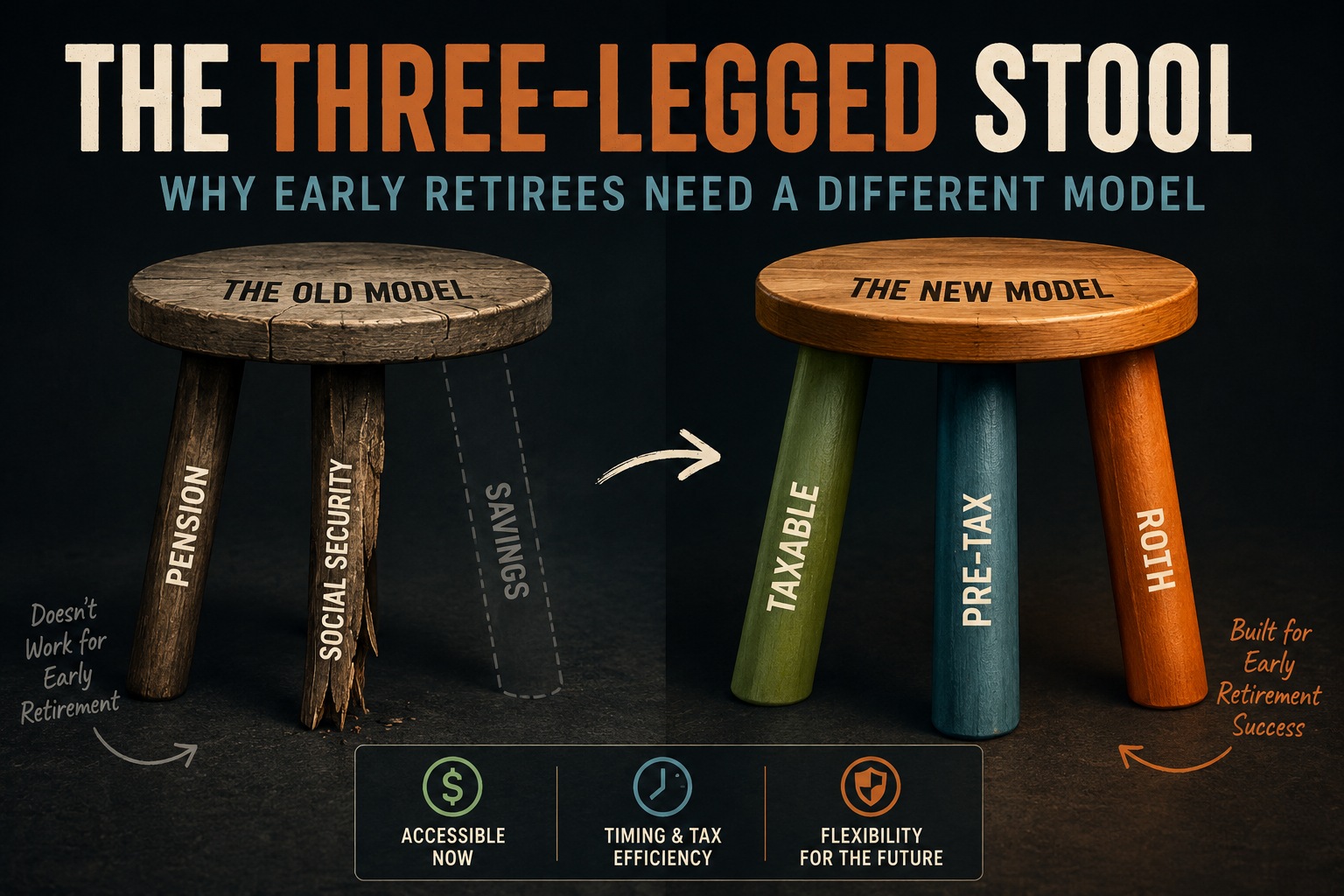

My dad used to describe retirement to my mother as a three-legged financial stool. The first leg was a pension, the second was Social Security, and the third was retirement savings.
That model made sense for how retirement used to work. You stayed at an employer long enough to earn a pension, Social Security showed up at a predictable age, and savings filled the gaps. It was mostly an income system, and a reasonably stable one.
Early retirement (well before 65) breaks the model. Most early retirees do not have a pension. Social Security is still in the picture, but will not show up for a long time, sometimes 20 years or more. During the years that matter most, two of the three legs are either missing or not yet available. What you are left with is savings, and maybe some passive income streams from investments or real estate. Structuring those savings correctly is more complicated than the original stool because the legs are different.
Different Questions and Different Answers
The traditional retirement model asks: what are my income sources?
For early retirement, the better question is: which accounts can I actually pull from, and what happens when I do?
That question matters because the three main account types, taxable, pre-tax, and Roth, do not behave the same way. Each one has different tax treatment and timing constraints. A balanced retirement plan includes a collection of different types of accounts. The order you draw from those accounts in a given year determines your tax bill, your Affordable Care Act (ACA) subsidy eligibility, and how much flexibility you have when something changes.
The stool still has three legs. They just work differently than my dad’s did.
Taxable Accounts: Most Accessible and Flexible
Your taxable accounts include brokerage accounts, cash, or any investments you can sell without penalties or age restrictions. This is the most accessible money in early retirement, and for most early retirees it is the primary funding source for the years between leaving work and reaching 59½, when you can tap retirement accounts without penalty.
Two things make taxable accounts especially valuable early on. First, long-term capital gains are taxed at 0% for married filers up to $98,900 in taxable income (2026). If you can manage your income to stay in that range, you can access investments tax-free. Second, you control the timing completely. You do not have required distributions, income floors, or IRS rules about when you have to take money out.
One other thing to note: you only pay taxes on gains from the accounts, and not return of capital. For example, if you bought $50,000 in investments and the account is now worth $100,000, when you sell, you only recognize $50,000 in taxable income because the rest is a return of your capital.
With taxable accounts, the biggest constraint is simple: they are finite. If this bucket runs dry before your pre-tax accounts unlock at 59½, you might find yourself in a difficult spot. How much you need here depends mostly on how early you retire and how long the bridge period runs.
Pre-Tax Accounts: The Biggest Bucket With Strings Attached
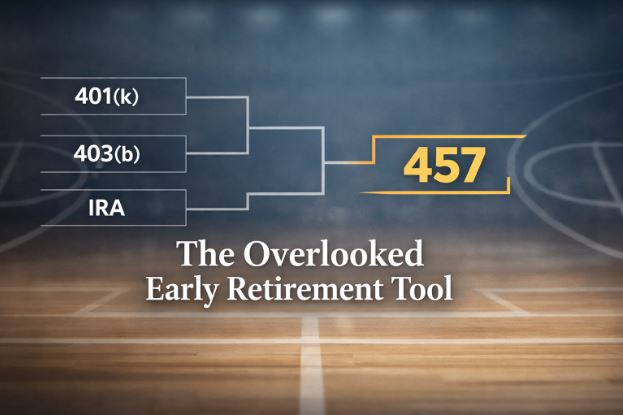
Your pre-tax accounts include the alphabet soup of the tax code: 401(k)s, traditional IRAs, 457s, 401(a)s, and 403(b)s. For most diligent savers, this is where the bulk of the money is because they have been saving through employer plans. It is also the least flexible leg of the stool.
Every dollar you pull from a pre-tax account is ordinary income, and it stacks on top of everything else: capital gains, dividends, Roth conversions, and Social Security when it starts. Pull $60,000 from your IRA in a given year and you have $60,000 in taxable income.
Then there are Required Minimum Distributions. For early retirees now, that means at age 75 the IRS requires you to take money out of pre-tax accounts whether you want to or not. Many years of aggressive 401(k) contributions can produce RMDs large enough to push you into a higher bracket and trigger IRMAA surcharges on Medicare premiums.
That is not to say pre-tax accounts should be avoided. In fact, contributing to pre-tax accounts in your highest earning years can allow you to capture an employer match, receive a valuable tax deduction, and enjoy portfolio growth without ongoing tax drag. You just have to understand that the funds will eventually come out as ordinary income and may require more advanced withdrawal strategies, such as a 72(t) or a Roth conversion ladder, to access funds before age 59½.
Roth Accounts
These include Roth IRAs and Roth 401(k)s, which offer tax-free qualified withdrawals and no required distributions. Roth IRA contributions (though not earnings) can come out at any time without penalty.
In early retirement, Roth accounts usually play a supporting role. They are most useful for filling income gaps in years where drawing from taxable or pre-tax accounts would push you over a threshold you are trying to stay under. They also let you add spending money without increasing taxable income. That is worth more than it sounds when you are trying to preserve ACA subsidies.
The Roth bucket matters for long-term estate and tax planning too, but that is a later problem. In the bridge years, its main job is to give you somewhere to go when the other two accounts create constraints.
Understanding the Basics: Account Types
| Account Type | Pros | Cons | Best Use Case |
|---|---|---|---|
| Pre-Tax / Tax-Deferred | Tax deduction now, employer match | Taxable on withdrawal, RMDs | High-income years |
| Roth | Tax-free withdrawals, no RMDs | No deduction today | Flexible early retirement withdrawals |
| Taxable | Flexible, can invest in anything | Tax on gains | Bridge gaps before 59½ |
So How Much Should Be in Each Bucket?
There are no universal rules about how much should be in each account type, but there are a few guideposts worth knowing.
Your taxable accounts need to be large enough to fund the years before age 59½ without fully depleting. Retiring at 50 means roughly a decade of living expenses to cover, offset by whatever you can access from Roth contributions and any 72(t) or conversion ladder strategy running against your pre-tax accounts. The most common imbalance for aspiring early retirees is being rich on paper but cash-poor before 59½. Tax deductions during peak earning years push people toward 401(k)s, but those dollars can become difficult to access when retirement starts early.
For people seriously considering FIRE, their pre-tax bucket is usually large enough on its own. The real work is managing distributions so the tax consequences do not crowd out everything else. That means starting Roth conversions before 59½ in years when income is low, running them through the top of your current bracket, and keeping an eye on where your pre-tax balance will be at 75 when RMDs begin.
The Roth bucket is the one most often neglected, especially by people who spent their peak earning years in high brackets where Roth contributions felt inefficient. If your Roth balance is small, the main tools for building it during retirement are conversions from pre-tax and, if you are still working, backdoor contributions.
Your goal should be to build enough flexibility to manage income deliberately across different years and different circumstances. A portfolio concentrated entirely in pre-tax accounts leaves less flexibility because your income will mostly be ordinary taxable income, and you might find yourself locked into a rigid 72(t)/SEPP. A taxable account can add tax diversification and allow you to draw income at lower, or even zero, capital gains rates.
On the other hand, if your savings are all in Roth accounts, you will pass up the chance to fill low-tax brackets with conversions that reduce future RMD exposure.
All three legs need to exist in meaningful form so that when something changes, a market drop, a health expense, unexpectedly high income, you have somewhere to go.
What Comes Next
Building the right structure is an accumulation-phase problem. Once you retire, you are working with whatever you have, which is why the planning work shifts from saving to sequencing.
How you draw down the three buckets, in what order, in which years, using which strategies, is where most of the real complexity in early retirement lives. Roth conversions, 72(t) plans, ACA income management, and withdrawal sequencing are each ways of working around whatever structure you started with, or extending the runway of the parts that work.
That is also what the Middle Class Trap series is about, if you want to see how the three buckets actually behave when someone tries to retire at 50 with $2.5 million and most of it locked up.
Early retirement is not just about having enough money. It is about having the right kinds of money in the right places, available at the right times.