
The 4% rule gets cited so often in FIRE circles that it has started to feel like settled law. Spend no more than 4% of your portfolio in year one, adjust for inflation each year after, and historically you have had a very high probability of not running out of money over a 30-year retirement.
That is a reasonable starting point, but you should understand that the 4% rule of thumb was not designed for early retirement.
The original research assumed a 30-year retirement. If you retire at 50, you might be planning for 40 years or more. In the early retirement community, the question of “how much do I need?” has been answered by so many people that writing about the topic risks revisiting math that has already been solved to death. Examples include the Trinity University study, Bill Bengen’s research, and Karsten Jeske aka “Big ERN” of earlyretirementnow.com who wrote a 63-post series (!) about safe withdrawal rates.
That said, figuring out how much you need to save to retire early is the fundamental question for most FIRE enthusiasts, so I do want to share some thoughts and advice.
Start With What You Actually Spend
Every retirement number starts with a spending number, and most people do not know theirs as well as they think they do.
The generic advice for retirees is to plan for 80% of your pre-retirement income, which is not a good fit for early retirees who are usually heavy savers. If you have been directing 25% or 40% of your income into investment accounts, plus relatively high payroll and income taxes, your actual lifestyle costs less than your gross income suggests. Running 80% of a $200,000 income through a retirement calculator produces a number that is almost certainly too high.
What you need is your real spending: actual dollars out the door in a normal year. You should track it carefully for at least two to three years before you retire. One year is not enough because spending is lumpy. Examples include roof replacements, a new car, a wedding, or an unexpected medical bill. Taking the average over a multi-year period gives you a more honest baseline than any single year.
Once you have that number, you should adjust it for your expected retirement lifestyle. Some costs will decrease: commuting, work clothes, or maybe a second car. Some will rise: travel, healthcare, the fact that you now have time to spend money. Be honest about which direction your spending is likely to move.
The Number: 25x to 30x Your Annual Spending
With a real spending number in hand, the math is straightforward.
A 4% withdrawal rate requires a portfolio of 25 times your annual spending. If you spend $80,000 a year, you need $2 million. If you spend $100,000, you need $2.5 million. These are the figures that have historically worked over a 30-year window.
For early retirement, 30x is more defensible. That is a 3.3% withdrawal rate, which buys a meaningful cushion against a longer time horizon and a bad sequence-of-returns in your early years. The difference between 25x and 30x on $80,000 in spending is $400,000. It reflects the reality that you are asking your portfolio to do more work for longer than the original research modeled.
A few factors that might push you toward the higher end of that range:
- Retiring before 50. A 40- or 45-year retirement is meaningfully different from a 30-year one. The Trinity study did not model it, and the safe withdrawal rate research that has is more conservative.
- Historically high equity valuations. Retiring in a peak market means you might be forced to sell shares at depressed prices during an early bear market; what people call sequence-of-returns-risks.
- No pension or Social Security for 15+ years. If your entire income for the first decade-plus of retirement comes from your portfolio, you are fully exposed to sequence-of-returns-risk during the period when it matters most.
- Healthcare costs before Medicare. This is the most underestimated line item in early retirement budgets. A couple in their early 50s buying their own coverage can easily spend $15,000 to $25,000 a year in premiums and out-of-pocket costs, depending on where they live and how they manage income for ACA subsidies. For a detailed look at what coverage actually costs at different ages and income levels, see How Much Will Health Insurance Cost in Early Retirement?
The Part Most FIRE Calculators Miss
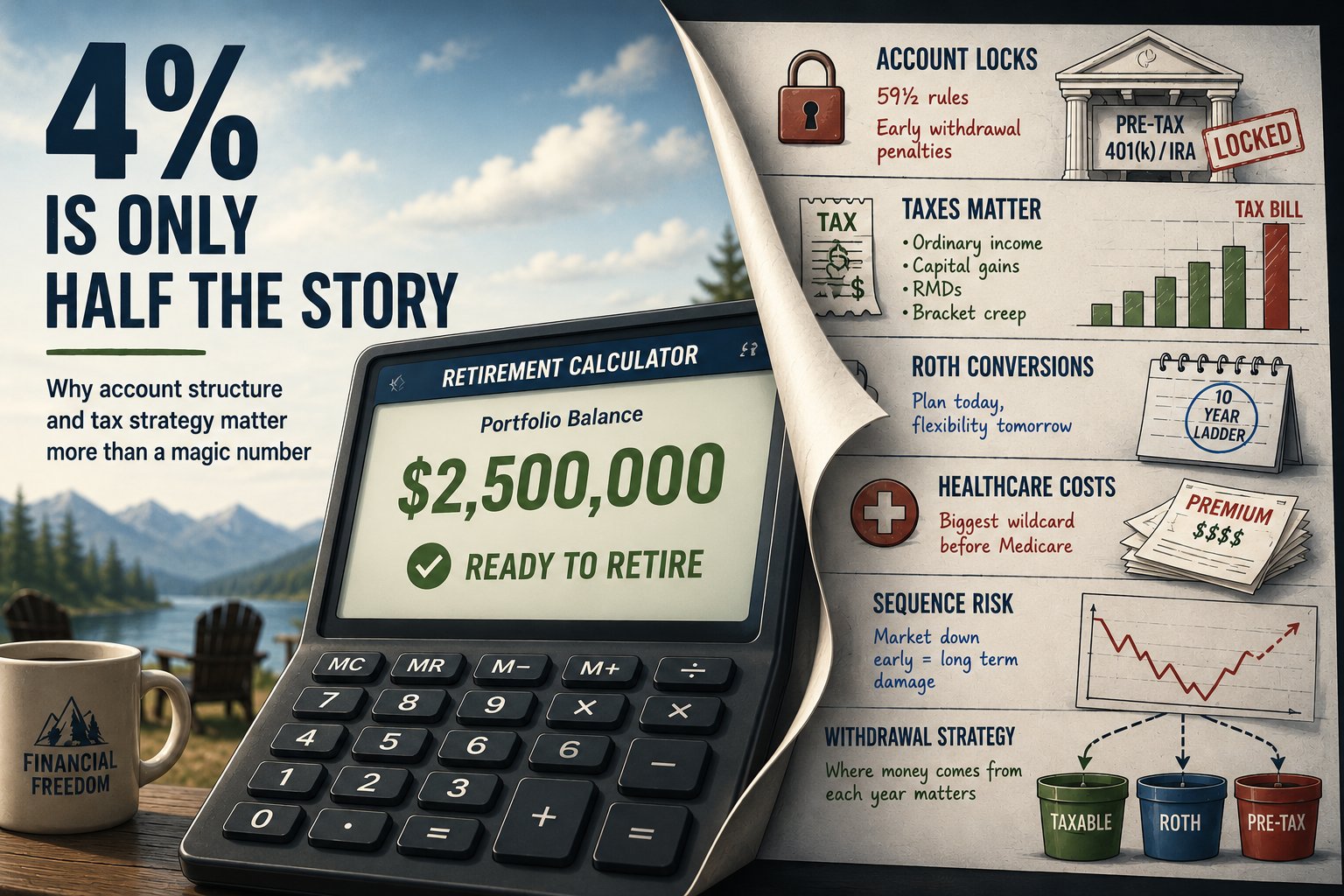
The standard 4% rule math assumes your money is immediately accessible. For early retirees, a significant portion usually is not, at least not without some planning.
If you have spent 20+ years maxing out a 401(k), you likely have a large pre-tax account. While you can access this money early penalty-free using strategies like a Roth conversion ladder or 72(t) distributions, those methods either require time to set up or create rigid withdrawal schedules. There are certainly ways to access your pre-tax funds before 59 ½, but you need a plan.
So your question is not just “do I have 25x?” but “do I have the right 25x?” Do you have enough accessible money in taxable and Roth accounts to bridge the gap and fund the early years?
This is where the three-account structure matters. Pre-tax, Roth, and taxable accounts each play a different role in an early retirement plan, and a portfolio that is heavily tilted toward one type creates real constraints regardless of its total size. A $2.5 million portfolio that is 90% pre-tax looks very different from one spread across all three account types, even if the headline number is identical. The three-legged stool post covers this in detail.
For the mechanics of accessing pre-tax money before 59½, including 72(t) SEPP distributions, Roth conversion ladders, and taxable account sequencing, see How to Access Retirement Accounts Before 59½.
Your Real Tax Rate in Retirement
Some people dramatically overestimate how much they will pay in taxes in early retirement, which inflates their target unnecessarily.
Before Social Security starts and before RMDs (Required Minimum Distributions) kick in, your income is largely what you choose it to be. A couple spending $80,000 a year from a mix of taxable account gains, Roth contributions, and modest Roth conversions can often manage to keep their federal tax bill very low. The 0% long-term capital gains bracket covers the first $98,900 in combined taxable income for married filers in 2026. Qualified dividends get the same treatment.
This matters for your target number in two ways. First, if you have been modeling a 24% or 27% effective tax rate in retirement, you have probably built too large a number. Second, managing income deliberately, keeping MAGI below the ACA subsidy cliff, filling the 0% capital gains bracket, and doing Roth conversions in lower-income years, can reduce the actual portfolio size you need to sustain a given lifestyle.
The caveat: this assumes you have enough in taxable and Roth accounts to have that flexibility. A retirement funded almost entirely from pre-tax distributions looks very different on a tax return.
What This Means in Practice
If you spend $80,000 a year, here is the honest range:
- Floor ($2M, 4% withdrawal): Defensible if you are retiring at 60 or later, have Social Security coming within a few years, and have a flexible spending floor.
- More Conservative ($2.4M, 3.3% withdrawal): Reasonable for early retirement at 50 to 55 with modest Social Security in the future.
None of these are guarantees. A Monte Carlo simulation with honest inputs, real spending, realistic healthcare costs, your and actual account mix, is more useful than any rule of thumb. Flexibility also matters a lot. If you can decrease your spending when markets are down, you have the ability to spend more when the markets are performing well.
Your plan, your flexibility, and your risk tolerance will tell you when you’ve actually arrived.
The Readiness Question Is Separate
How much you need is a strictly financial question. Whether you are actually ready to retire is a different beast entirely. True readiness includes your account structure, your healthcare plan, your withdrawal sequence, and whether you have stress-tested your plan against a down market in the first five years.
A large portfolio does not automatically mean you are ready. Conversely, a portfolio at the lower end of your target range, held in the right accounts and paired with a credible bridge plan, often is.
If you want to work through the structural side of your plan, ensuring your accounts are optimized, confirming you have enough accessible cash to fund the bridge years, and verifying your portfolio will hold up in a bad market, the Middle Class Trap series walks through these steps using a real-world example.