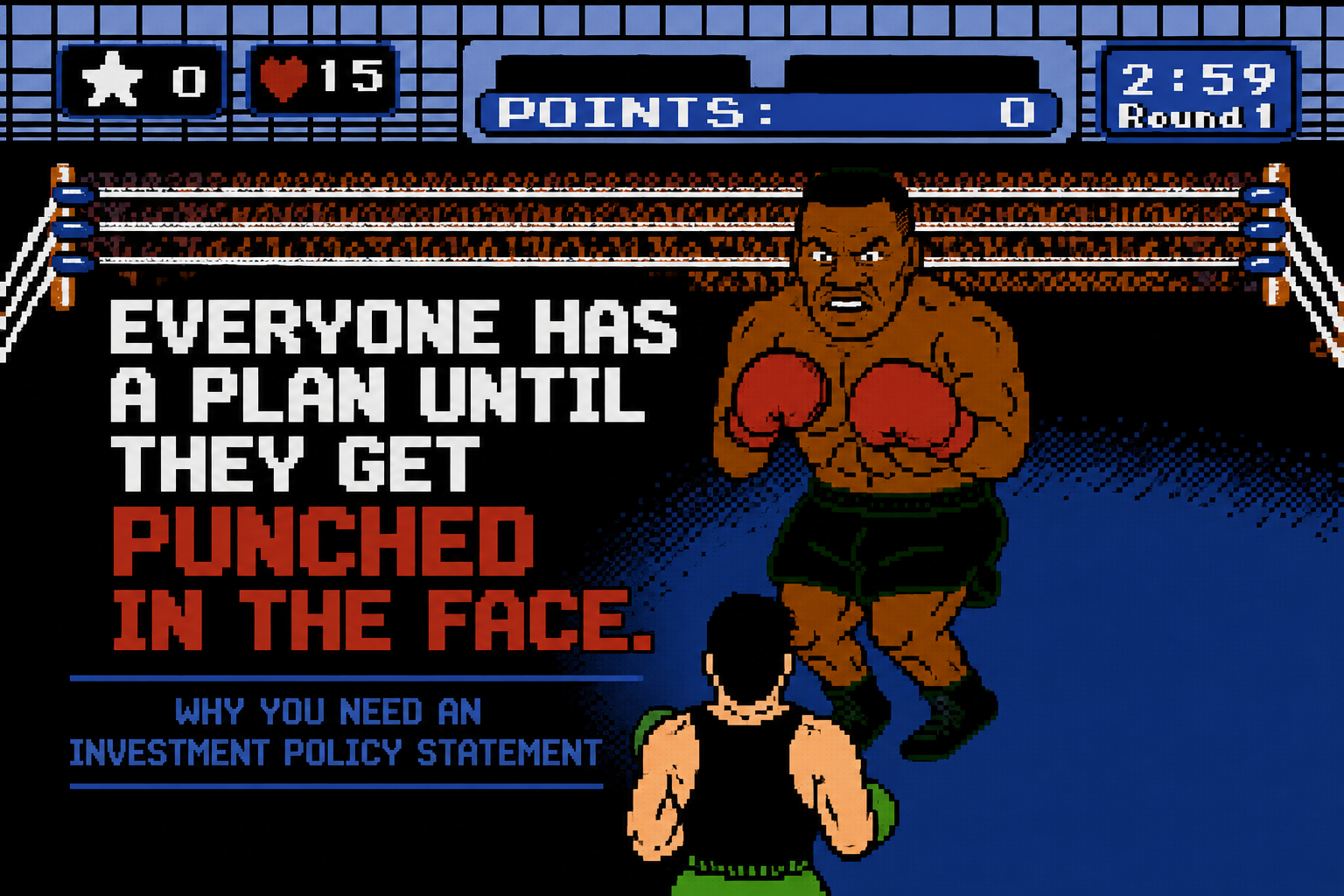

Boxer Mike Tyson famously said, “Everyone has a plan until they get punched in the face.” There may be no better description of retiring just before a major market downturn.
When you are still working and saving money, planning for retirement is a calm, math-based exercise. You look at long-term historical charts, run calculations, and assume you can handle normal market drops.
Then you actually retire. Your regular paycheck stops, the market drops 20%, and the punch lands. Watching hundreds of thousands of dollars of your life savings disappear in real time feels very different from looking at a hypothetical down year on a spreadsheet. It triggers a strong emotional response to do something—anything—to stop the loss. In a moment of panic, it is easy to abandon your strategy.
To survive a market drop without making catastrophic mistakes, you cannot rely on willpower, and you cannot invent a new plan on the fly. You need a written document that takes over the moment things go bad: an Investment Policy Statement (IPS).
What is an Investment Policy Statement?
An Investment Policy Statement (IPS) is a written framework that outlines exactly how you will manage your money in both good times and bad. You can think of it as an operating manual for your portfolio: a document that tells you what actions to take,and just as importantly, what actions not to take, when emotions are running high.
Key Sections
Your written plan does not need to be long or complicated, but it should be specific enough to eliminate guesswork when things get chaotic. A functional IPS should cover these core areas:
- Objectives: Your specific financial goals, including your target annual spending in real dollars, your expected retirement timeline, and any major objectives you have (ex. pay off your mortgage, meet charitable giving targets, or pay for children’s college).
- Asset Allocation Targets: The specific percentage mix of stocks, bonds, and cash you choose to hold. You should also define the allowed ranges for drift (for example, a target of 60% stocks with an allowed range of 50% to 70%). This tells you exactly when you need to rebalance and when you should leave things alone.
- Investment Selection Rules: This details your core investment philosophy. For example, a common approach is a strict commitment to simplicity, focusing on low-cost, diversified index funds while avoiding speculative moves or trying to time the market. If your philosophy is different, like it includes individual stocks, real estate, or alternative assets, you should note that in your plan.
- An Equity Glidepath (If Used): If your plan involves changing your asset mix over time, the rules must be written down. For instance, some early retirees use a rising equity glidepath, starting with a higher bond cushion and slowly increasing their stock exposure over the first 5 to 10 years of retirement. Your IPS should state your target schedule and specify how you will modify that strategy over time.
- A Clear Withdrawal Strategy: Your IPS should note the method you will use to calculate how much cash you can withdraw from your portfolio for the next year’s expenses. It should state clearly when and how you will calculate your withdrawals; often people will set a minimum and maximum withdrawal range.
- A Downmarket Protocol: The plan should address what you will do in down markets. Your IPS will dictate where you will draw your living expenses from first (ex. spending down your cash reserves and bonds first) and lists the spending cuts you will make if the market drops past specific milestones.
- Changes: How you want to make changes to your document. Many people will set a self-imposed waiting period (like 30 or 90 days) as a cooling off period before making any major changes to their portfolio allocation or other key strategies.
The IPS Should be a Joint Project
While it is common for one person in a household to handle investments and budgeting, an IPS should never be a solo project. When a market drop occurs, the lack of shared agreement can create anxiety and conflicting ideas.
A written IPS helps to ensure that both halves of a couple fully understand and agree to a strategy. When the market falls, having a pre-established plan removes the stress of debating what to do in the heat of the moment.
A Plan Only Works If You Use It
The most perfect plan is useless if it sits in a desk drawer or digital folder and is forgotten until a crisis hits. Your IPS must be a tool you actively use to run your household. To make it work, you should establish a schedule for checking your portfolio. For most early retirees, a quarterly review is best.
If quarterly reviews make sense for your situation, every three months you can log in, review your balances, and determine whether your allocation has drifted outside its allowed ranges. Outside of those specific quarterly dates, you do not need to compulsively check your account balances or make changes based on financial news or market commentary.
The Fight Is Won Before It Starts
An Investment Policy Statement is preparation. It is the work you do before the market falls, before the headlines become frightening, and before emotions start calling the shots.
If you do not have a written plan for your household, do not wait for a market downturn to expose the cracks in your strategy. Sit down, write down your operating rules, and print them out. When the next downturn comes, you will not need to guess what to do, because you’ll already know.
Because in investing, just like in boxing, the fight is often won before it starts.