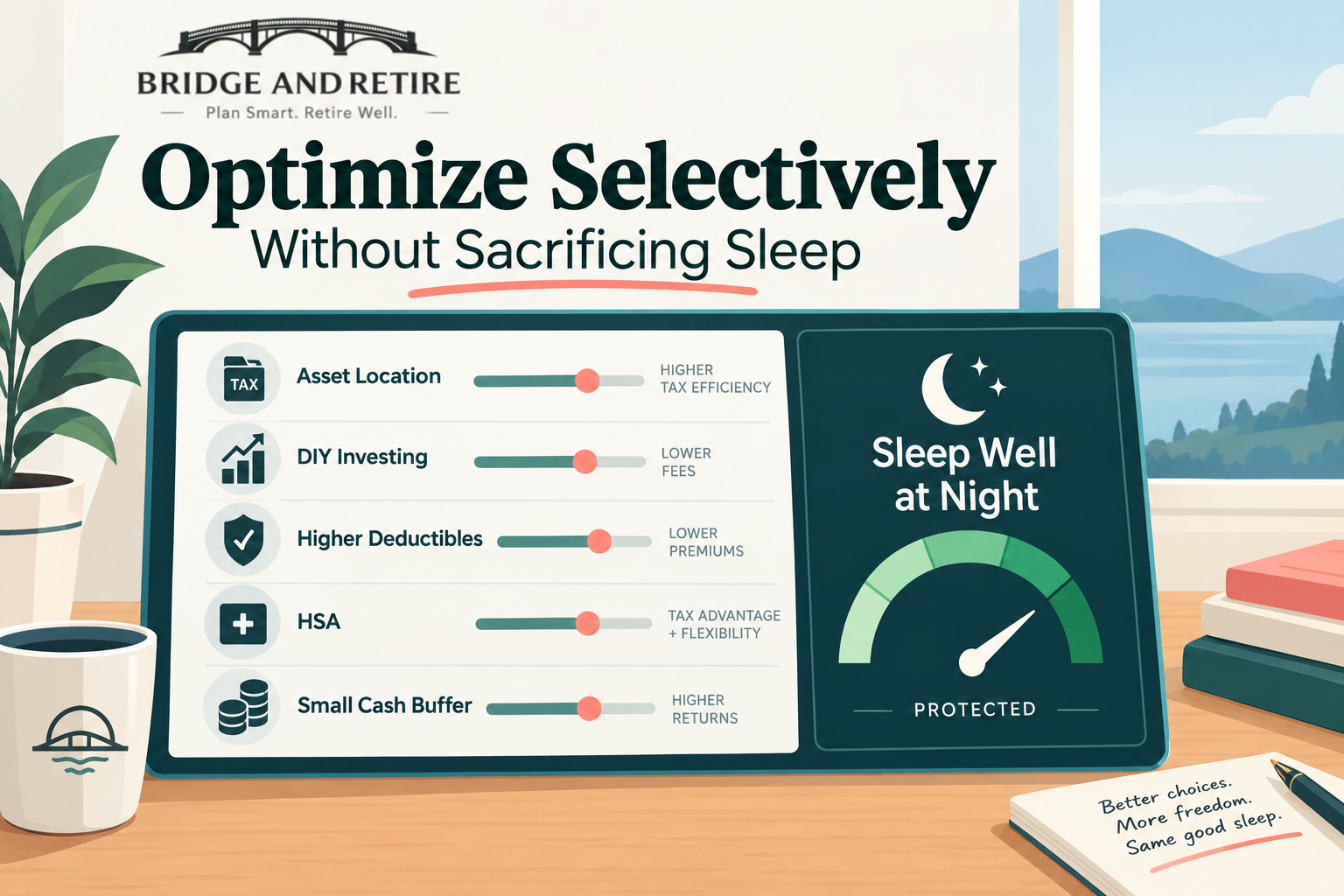

In a recent post, I listed five things I choose not to optimize in favor of sleeping well at night (SWAN). My list included chasing credit card points, archiving lifetime HSA receipts, and mortgage prepayment. I promised a follow-up on the opposite list, so here it is.
I should note that good general financial habits won’t appear below. Practices like automating contributions and taking an employer 401(k) match are great habits, but they don’t cost you any sleep, so they don’t really fit in this discussion. My list covers choices where an easier or simpler option was available and I took the higher-return path instead. Without further ado, here’s my list.
5. Tax-Efficient Asset Location
Tax-efficient asset location means matching your asset types (ex. stocks, bonds) to the best corresponding type of account (ex. Roth, pre-tax, post-tax). Typically that means holding bonds and other tax-inefficient investments like REITs in tax-deferred accounts, and holding stock index funds in a taxable brokerage or Roth accounts, where they generate few distributions and qualify for long-term capital gains rates. A simpler alternative is to hold the same mix in every account or even to use target retirement funds that give you a complete retirement portfolio in a single fund.
I’ve written previously about the benefits of tax-efficient location, and even tried to quantify how much it matters. For my portfolio, I estimate that tax-efficient asset location will save me 0.10-0.15% per year in annual tax drag.
The cost is complexity. The only way I can see my total asset allocation is by adding everything up in a spreadsheet, or using an account aggregator like Empower or Monarch Money. Because I’m keeping different types of investments in different accounts, rebalancing can take more thought (see my tools section for a spreadsheet rebalancer). Most of the work happens once, at setup, which is another reason that I take the time to do it.
4. Investment Costs and Doing It Myself
Some people sleep better knowing there is someone to call when the market drops significantly. That is a legitimate benefit, and for plenty of investors it is worth paying for. A common fee for full-service investment management is 1% of assets under management (AUM) per year. On a $2 million portfolio that is $20,000 a year, and over two decades, once you add the growth those dollars would have earned, the cost of the AUM fee compounds.
I use low-cost index funds, and for me the DIY approach is the SWAN choice as much as the optimized one. This is one item where my optimized choice and my sleep-friendly choice happen to coincide. I sleep better knowing I can make any change, any time I want, without asking anyone. If I imagine the alternative, I feel more stress: scheduling check-ins, explaining my decisions to someone else, and eventually having to “break up” with an advisor if the relationship stopped working. Some people would rather hand off that responsibility, and I get that. The same control that lets me act when I want to also means I can act against my own self-interest. If I panic in a crash and do something foolish, nobody else shares the blame.
I don’t think there is a right answer here. If you know you’d panic and make a rash decision, or if you would simply rather spend your time on something other than your portfolio, paying for help can be the rational choice, and a good advisor can earn their fee. The question I’d ask is which arrangement costs you less sleep. For me, that’s the one where I hold full control.
3. Higher Deductibles and Self-Insuring the Small Stuff
There is real comfort in knowing that if something goes wrong, you pay a small deductible and the insurance company takes care of the rest. That peace of mind has a price, though. Policies with low deductibles cost more in premiums, and those extra premiums go out the door every year whether or not you ever file a claim. Insurers price low-deductible policies to cover a steady stream of small claims, so over time you mostly pay the insurer back for the convenience.
I keep my deductibles higher on my home and auto policies, and I skip any extended warranties. What lets me sleep well is the other side of the policy: I carry large coverage maximums, because for me, insurance exists for rare but expensive events, like a house fire, a serious accident, or a liability claim that could threaten everything I’ve built. Those are the losses I can’t absorb from cash flow, so those are the ones I want covered generously.
The cost of this approach is that an occasional claim stings. When something breaks or a small accident happens, I foot the entire bill. I’m comfortable with that trade-off because I’ve already decided what I’m using the coverage for. If a deductible would strain your budget or keep you up at night, a lower one may be worth the higher premium. The point is to pick a deductible you can pay without worrying, and then put your effort into making sure the big-loss coverage is in place.
2. A High-Deductible Health Plan
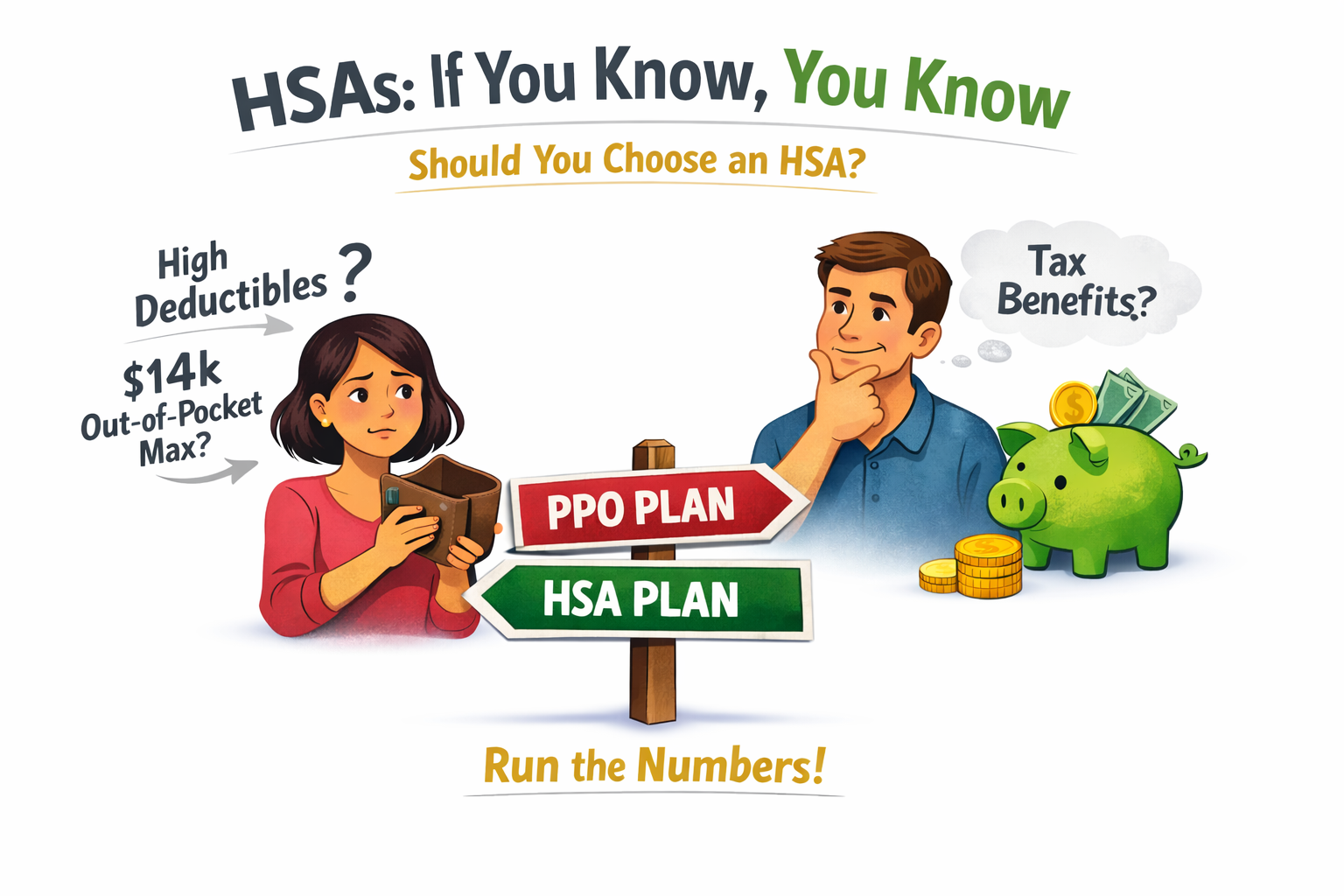
A traditional high-coverage PPO gives you predictable copays and few surprises. A high-deductible plan means I could owe the full out-of-pocket maximum ($8,500 for an individual or $17,000 for a family) in a bad year, in exchange for lower premiums and access to an HSA.
I choose the high-deductible plan and fund my HSA each year. I built a breakeven calculator and rerun it whenever my benefits change significantly. This choice also depends on having the cash to cover the worst case, which brings me to the last item. If you expect regular, predictable care, run your own numbers before assuming the high-deductible plan wins.
1. A Small Cash Buffer
For some people, a comfortable cash buffer is two to three years of expenses in cash, so a market crash never forces them to sell anything while their portfolio is down. I keep much less, typically only 3-4 months of expenses in a high-yield savings account, and I keep the rest invested.
My backstops are my brokerage account, my credit cards, and a line of credit. Each backstop has weak points. Selling stocks in a downturn can lock in losses, and credit lines can be frozen or reduced during the same downturn, so I treat credit as a bridge and never as the foundation. If I know a big expense is coming, I build up a larger cash balance ahead of time.
From my standpoint, a large cash reserve would cost me returns every single year, and I have a large enough brokerage buffer that I don’t lose any sleep. Your comfort level may differ.
Side by Side
| Decision | What I Chose | The Simpler Alternative |
|---|---|---|
| Asset location | Split assets by tax efficiency | One simple mix in every account |
| Investment costs | Low-cost funds, self-managed | Full-service advisor |
| Insurance | Higher deductibles, no warranties | Low deductibles, full coverage |
| Health plan | High-deductible plan plus HSA | Low-deductible PPO |
| Cash buffer | Small, backed by investments and credit | Two to three years in cash |
Closing Thoughts
Each of these took effort up front or a little attention on a schedule, and each one costs me some certainty. I still sleep well, because I know which risks I’m carrying and why I took them. If you’re curious about what I’m not optimizing, you can read my first post here.