

I can sense my teenage daughter cringing from the next room for using “IYKYK” (If You Know, You Know). But in this case, it fits.
In many financial independence circles, Health Savings Accounts (HSAs) are treated almost like a secret handshake. The people who understand them tend to understand them deeply. The people who don’t often skip them entirely.
This post isn’t about rehashing the well-known “triple tax advantage.” Instead, I want to explore something more practical:
Why do so many people skip HSAs — and how should you actually evaluate the decision?
Why People Avoid HSAs
In my experience, three forces drive hesitation:
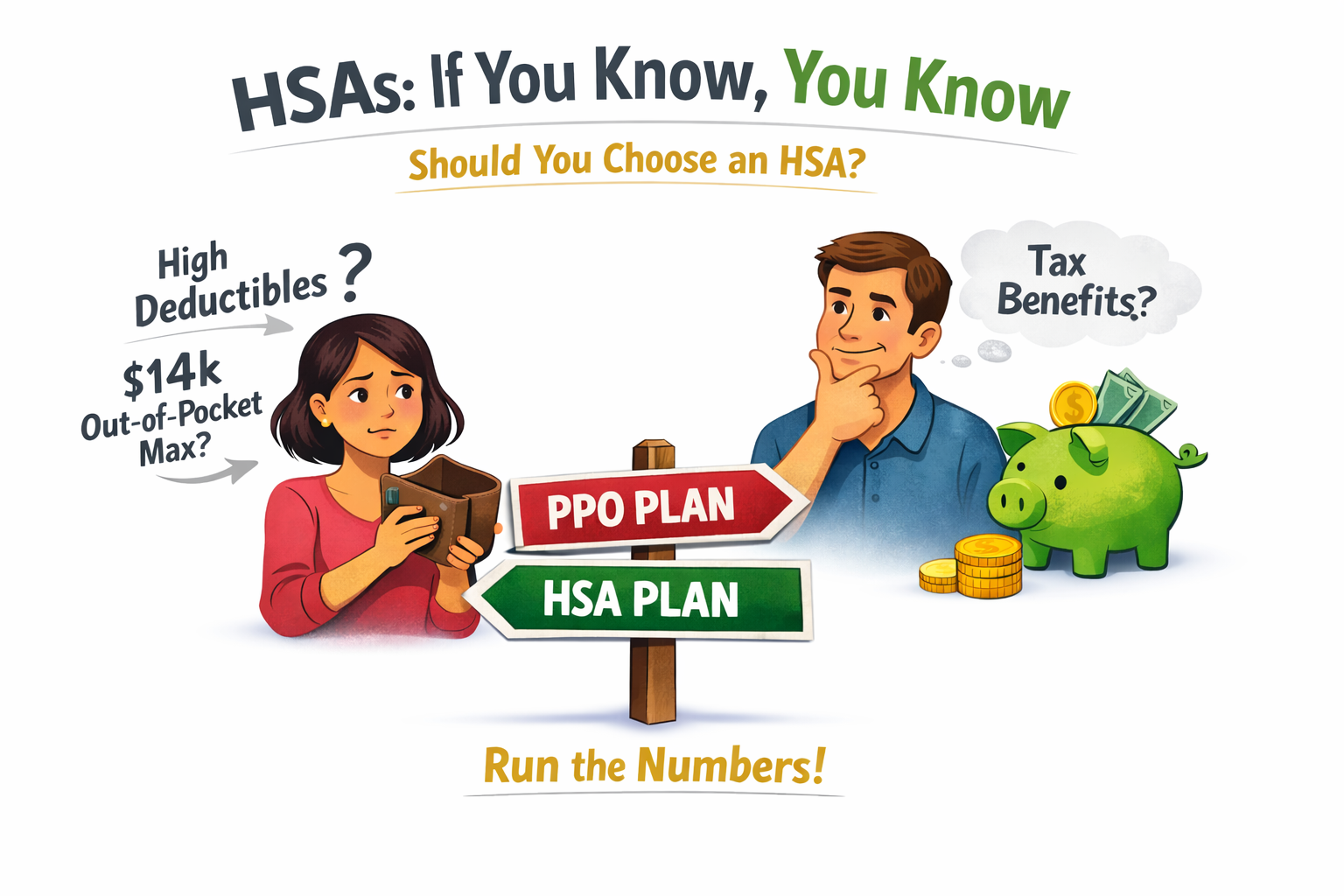
- High deductible plans feel risky. A $14,000 out-of-pocket maximum looks scary on paper.
- We are conditioned to shop based on visible prices (deductibles and copays) rather than expected annual cost.
- Inertia. If your current plan works or has the providers you like, switching feels unnecessary.
I fell into each of these traps myself.
The key is understanding how financial risk is actually shared between you and the insurer — and then running the math.
The Four Variables That Matter
At a high level, four variables determine how costs are split:
Deductible
The amount you pay out of pocket before insurance begins sharing costs (preventive care often excluded).
Monthly Premium
The fixed amount you pay to maintain coverage, whether you use it or not.
Coinsurance
The percentage of costs you pay after meeting the deductible.
Out-of-Pocket Maximum
The most you’ll pay for covered services in a year. After that, insurance pays 100%.
Choosing a plan is ultimately about how much predictable cost (premium) you’re willing to pay to reduce uncertain cost (deductible and coinsurance).
A Real-World Example
Using a real world employer family plan i was offered (numbers slightly simplified but directionally accurate):
| PPO Plan | HDHP / HSA Plan | |
| Monthly Premium | $200 | $0 |
| Annual Deductible | $1,000 | $3,500 |
| Coinsurance | 10% | 20% |
| Out-of-Pocket Max | $5,500 | $14,000 |
The employer also contributes $2,000 annually to the HSA.
For 2026, a family can contribute up to $8,750 total. I’m assuming:
- 24% marginal federal tax bracket
- Including FICA at 7.65% but no state income taxes
- Including the immediate tax deduction benefit
- Ignoring long-term tax-free growth for now
This is strictly a one-year breakeven analysis.
Low Spending Year: $500 in Expenses
If total healthcare spending is $500:
PPO
- $2,400 annual premium
- $500 expenses
= $2,900 net cost
HDHP
- $0 premium
- $500 expenses
- minus $2,000 employer HSA contribution
- minus $2,136 tax savings (31.65% × $6,750 total contribution)
Result: The HDHP is dramatically ahead–in fact your health plan left you with $3,636 net savings!
Not surprising. When spending is low, lower premiums plus tax benefits dominate.
High Spending Year: $20,000 in Expenses
Now assume a heavier year of healthcare expenses:
PPO
- $2,400 premium
- $1,000 deductible
- $1,900 coinsurance
= $5,300 net cost
HDHP
- $0 premium
- $3,500 deductible
- $3,300 coinsurance
– $2,000 employer contribution
– $2,136 tax benefit
= $2,664 net cost
Even with significant spending, the HDHP still wins.
Why?
Because many people focus on the deductible and out-of-pocket maximum but ignore three powerful offsets:
- Lower or zero premium
- Employer HSA contribution
- Immediate tax deduction
Those “hidden subsidies” materially reduce the effective risk.
Where Does the PPO Win?
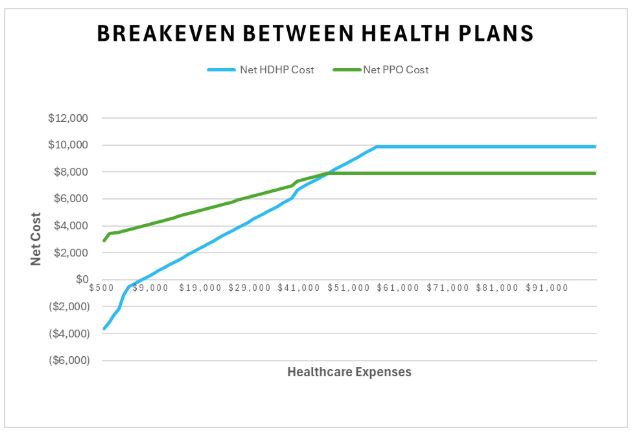
In my example, the breakeven point doesn’t occur until roughly $46,000 in annual healthcare spending — an unusually high level.
At that point, the PPO’s lower out-of-pocket maximum finally overtakes the premium and tax advantages of the HDHP.
Even then, the worst-case difference is roughly $2,000.
Under these assumptions, the HDHP is financially superior across almost all realistic spending levels.
The Real Insight
The mistake isn’t misunderstanding deductibles.
The mistake is evaluating plans based on visible risk instead of total economic cost.
High deductible plans feel riskier.But once you incorporate premium savings, employer contributions, and tax benefits, the picture changes.
That doesn’t mean every HDHP is superior.
It does mean the only rational way to decide is to run the numbers.
Coming in Part II
Check Out Part II here where I will:
- Run the same analysis using a different employer plan
- Share the spreadsheet framework so you can test your own assumptions
Because if you know, you know.
And if you don’t — a spreadsheet helps.
Pingback: HSAs: If You Know, You Know (Part I) - Bridge and Retire