
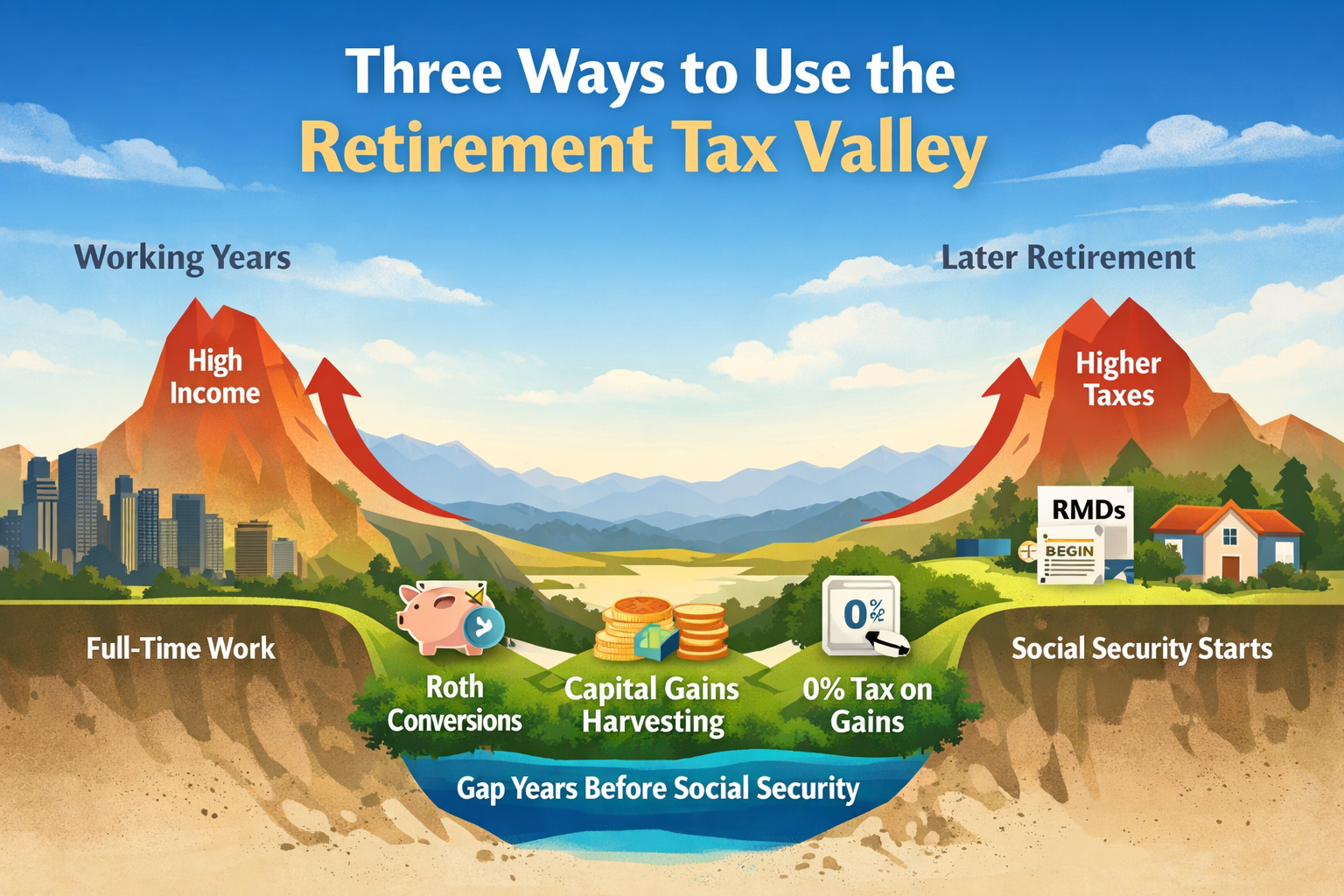
In a previous post (Tax Preparation Is No Longer the Hard Part – Tax planning is), I described what I call the retirement tax valley.
For many households, the years between stopping work and claiming Social Security create a temporary drop in taxable income. Your paycheck disappears, but other income sources—like Social Security and required withdrawals from retirement accounts—haven’t started yet.
For a period of time, your income may be lower than it has been in decades.
That valley creates planning opportunities.
Instead of letting those low-income years pass by, retirees can sometimes intentionally recognize income while their tax rate is relatively low.
Here are three ways people commonly use the retirement tax valley.
1. Convert Pre-Tax Retirement Money to Roth
One of the most common strategies during the tax valley is converting money from a traditional retirement account into a Roth account.
When you convert money from a traditional IRA or 401(k) to a Roth IRA, the converted amount is taxed as ordinary income in that year.
The trade-off is simple:
- You pay taxes now
- Future withdrawals from the Roth can be tax-free
Many retirees intentionally do these conversions during low-income years because their tax bracket may be lower than it was during their working career.
This can also reduce the size of future required withdrawals from tax-deferred accounts.
2. Harvest Long-Term Capital Gains
Another opportunity involves long-term capital gains.
If your taxable income is low enough, long-term capital gains may be taxed at 0% federally.
This creates an interesting opportunity.
A retiree might sell appreciated investments, realize the gain, and immediately buy the investment back. The portfolio remains invested, but the cost basis resets higher.
Over time, this can reduce future taxable gains.
Many investors are surprised that the tax code sometimes allows gains to be realized at a 0% rate during lower-income years.
3. Reduce Future Required Minimum Distributions
Tax-deferred retirement accounts eventually require withdrawals.
These are known as Required Minimum Distributions.
Once these withdrawals begin, retirees must take money out each year whether they need it or not. Those withdrawals are typically taxed as ordinary income.
For people with large retirement accounts, Required Minimum Distributions can push income and tax brackets higher later in retirement.
Using the tax valley to convert some traditional retirement savings to Roth can reduce those future required withdrawals and create more flexibility later in life.
How Much of the Tax Valley Should You Use?
How much income should you intentionally create during these years?
In practice, many retirees think about this in terms of filling up a tax bracket.
The idea is straightforward:
- Estimate your baseline retirement income
- Identify your current tax bracket
- Generate additional income until you approach the top of that bracket
That additional income might come from:
- Roth conversions
- Capital gains harvesting
- Portfolio rebalancing
- Withdrawals from retirement accounts
The goal isn’t maximizing income. The goal is recognizing income at relatively low tax rates before higher-income years arrive later in retirement.
What Does “Filling the 12% Bracket” Mean?
Many retirement planners talk about “filling the 12% bracket.”
These are the federal tax brackets set by the Internal Revenue Service. For this discussion we’re skipping the 0 and 10% tax brackets, assuming that most early retirees will have enough income to fill those brackets.
For the 2025 tax year, the 12% bracket applies roughly to the following taxable income ranges:
| Filing Status | 12% Bracket (Taxable Income) |
| Single | $11,925 – $48,475 |
| Married Filing Jointly | $23,850 – $96,950 |
A key detail: these numbers refer to taxable income, which means income after deductions.
Most households take the standard deduction, which can vary by age and other characteristics like disability status, but for most people’s 2025 taxes was:
- $15,750 for single filers
- $31,500 for married couples
That means a married couple could potentially generate roughly $128,000 of total income and still remain inside the 12% federal tax bracket.
This income might come from:
- Roth conversions
- Dividends and interest
- Withdrawals from retirement accounts
- Realized capital gains
An Example
Imagine a married couple who retires at age 62.
They decide to delay claiming Social Security until age 70 and have not yet reached the age when Required Minimum Distributions begin.
Their early-retirement income might look something like this:
| Source | Income |
| Dividends and interest | $10,000 |
| Taxable portion of withdrawals from savings and taxable investment accounts | $30,000 |
| Total income | $40,000 |
Because their income is relatively low, they may have substantial room inside lower tax brackets. Just as an aside, it is also worth noting that capital gains and qualified dividends are are taxed at 0% in this bracket. Interest income and some other investment income (like short-term capital gains) is taxed at 12%. One of the challenges about writing about taxes is there are so many exceptions!
Example: Filling the 12% Bracket
Total Income Capacity Inside 12% Bracket
(Married Filing Jointly Example)
$128k ─────────────────────────────
Top of 12% bracket (after standard deduction)
Available space for
Roth conversions or
capital gains harvesting
$40k ─────────────────────────────
Current retirement income
(dividends + withdrawals)
$0 ─────────────────────────────
In this simplified example, the couple might have roughly $88,000 of unused space inside the 12% tax bracket.
They could potentially convert part of a traditional IRA to Roth, or realize more capital gains, while still staying within that bracket.
Without planning, that space may disappear later in retirement once income increases from Social Security and Required Minimum Distributions.
Both of these can push taxable income higher later in retirement. Required Minimum Distributions, in particular, can force withdrawals from traditional retirement accounts whether you need the income or not.
That’s why many retirees look at the years between retirement and these later income sources as a temporary planning window.
A Temporary Window
The retirement tax valley doesn’t last forever.
For many households it exists roughly between:
- The year you stop working
- The year you begin collecting Social Security
- The year Required Minimum Distributions begin
During those years, income can be unusually low compared with both your working years and your later retirement years.
That creates a rare opportunity to intentionally recognize income at relatively low tax rates.
The Real Goal
The goal isn’t to minimize taxes in a single year.
The goal is to minimize taxes over the course of an entire retirement.
Sometimes that means paying a little tax earlier—through Roth conversions or realizing capital gains—in order to avoid paying more later.
The retirement tax valley is valuable because it creates a period when retirees often have unusual control over when income is recognized, something that is much harder to do during peak earning years.
Used thoughtfully, those years can permanently reduce the taxes paid on a lifetime of savings.
A Final Thought
Many retirement discussions focus on how much you save.
But for many households, the years between working and full retirement may be just as important for how those savings are taxed.
Understanding the retirement tax valley can make a meaningful difference in the long-term efficiency of your retirement plan.