

“Diversification is the only free lunch in investing.” This phrase is attributed to Nobel laureate economist Harry Markowitz, who developed modern portfolio theory.
It’s a simple idea, but a powerful one. By spreading your investments across different assets, you can reduce risk without sacrificing returns. There aren’t many opportunities in finance that work that cleanly.
Most people understand this when it comes to building a portfolio. They avoid concentrating everything in one place and instead spread their investments across different asset classes, accepting that the future is uncertain.
But that same instinct doesn’t always carry over to taxes.
What Is Tax Diversification?
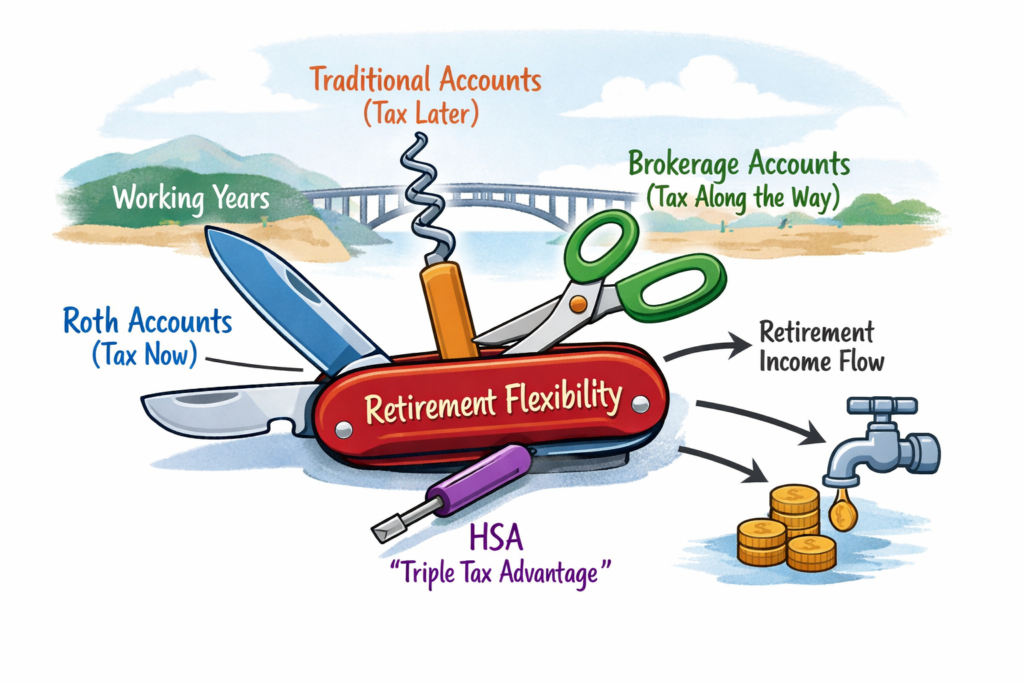
At its core, tax diversification is about not placing all of your savings into a single tax basket.
Some accounts give you a deduction today and tax you later. Others ask you to pay taxes now in exchange for tax-free withdrawals in the future. Still others sit somewhere in between, with taxes applied gradually over time.
Each approach has its advantages, and none is universally better than the others. What matters is the combination. A mix of account types creates flexibility. And over a long retirement, flexibility tends to matter more than precision.
How Concentration Happens
Most people don’t set out to concentrate their savings in one tax bucket. It happens gradually, almost by default.
You begin contributing to a workplace retirement plan, often a traditional 401(k), because it’s available and offers an immediate tax benefit. It’s a sensible decision, and for many people, it’s the right place to start. Then the pattern repeats.
Year after year, contributions go into the same type of account. Balances grow, habits solidify, and eventually a large portion of your savings sits behind a single set of tax rules.
Nothing about this feels like a mistake. In fact, it usually reflects consistency and discipline.
But over time, it can leave you with fewer options than you might expect.
Why This Matters More for Early Retirement
Tax diversification becomes even more important the earlier you plan to retire, in part because not all dollars are equally accessible.
Many of the accounts people rely on, like traditional 401(k)s and IRAs, come with age-based restrictions. Accessing those funds before age 59½ often requires advance planning or comes with penalties. While there are ways to navigate those rules, they tend to add complexity and reduce flexibility (see my post about accessing funds before 59 1/2).
If most of your savings are tied up in those accounts, early retirement can feel constrained in a way that isn’t obvious while you’re still working. The balance may be sufficient on paper, but turning it into usable income becomes less straightforward.
This is where tax diversification overlaps with something more practical: access.
Accounts that are taxed along the way, such as brokerage accounts, don’t carry the same restrictions. Roth contributions can often be accessed more flexibly as well. When you have a mix of account types, you’re not relying on a single pathway to fund your spending once earned income stops.
Some funds are available immediately. Others can be deferred. Still others can be used selectively, depending on the situation. Over a traditional retirement timeline, these differences may smooth out. Over an early retirement that could last decades, they tend to compound.
In that context, tax diversification isn’t just about reducing taxes. It’s about making sure your money is usable when you need it.
Control, Not Just Efficiency
It’s easy to think of tax diversification purely in terms of minimizing taxes, but that framing is incomplete.
The more meaningful benefit is control.
When all of your savings sit in one type of account, your withdrawals tend to follow a single pattern. Income shows up the same way each year, and there’s limited room to adjust.
With a mix of tax treatments, that changes. You gain the ability to decide where income comes from and when it’s recognized. That, in turn, affects how much shows up on your tax return and how it interacts with other parts of your financial life.
Over time, those decisions can shape not just how much you pay in taxes, but how easily you can adapt to changing circumstances.
Retirement becomes less of a fixed outcome and more of an ongoing process of adjustment.
A More Active View of Retirement Income
It’s common to think of retirement income as something passive. You stop working, and then you begin withdrawing.
In reality, it’s more dynamic than that.
Different sources of income are treated differently. Some withdrawals increase your taxable income immediately. Others may have little or no impact. Some income must be taken on a schedule, while other sources can be used more selectively.
The structure you build during your working years determines how much flexibility you have when making those decisions.
For early retirees in particular, this flexibility isn’t just helpful — it can be essential.
The Overlooked Free Lunch
The idea that diversification is a “free lunch” is usually applied to investments, but it fits just as well here.
You’re not trying to predict future tax rates or optimize every decision perfectly. You’re acknowledging that the future is uncertain and building a system that can adapt to it.
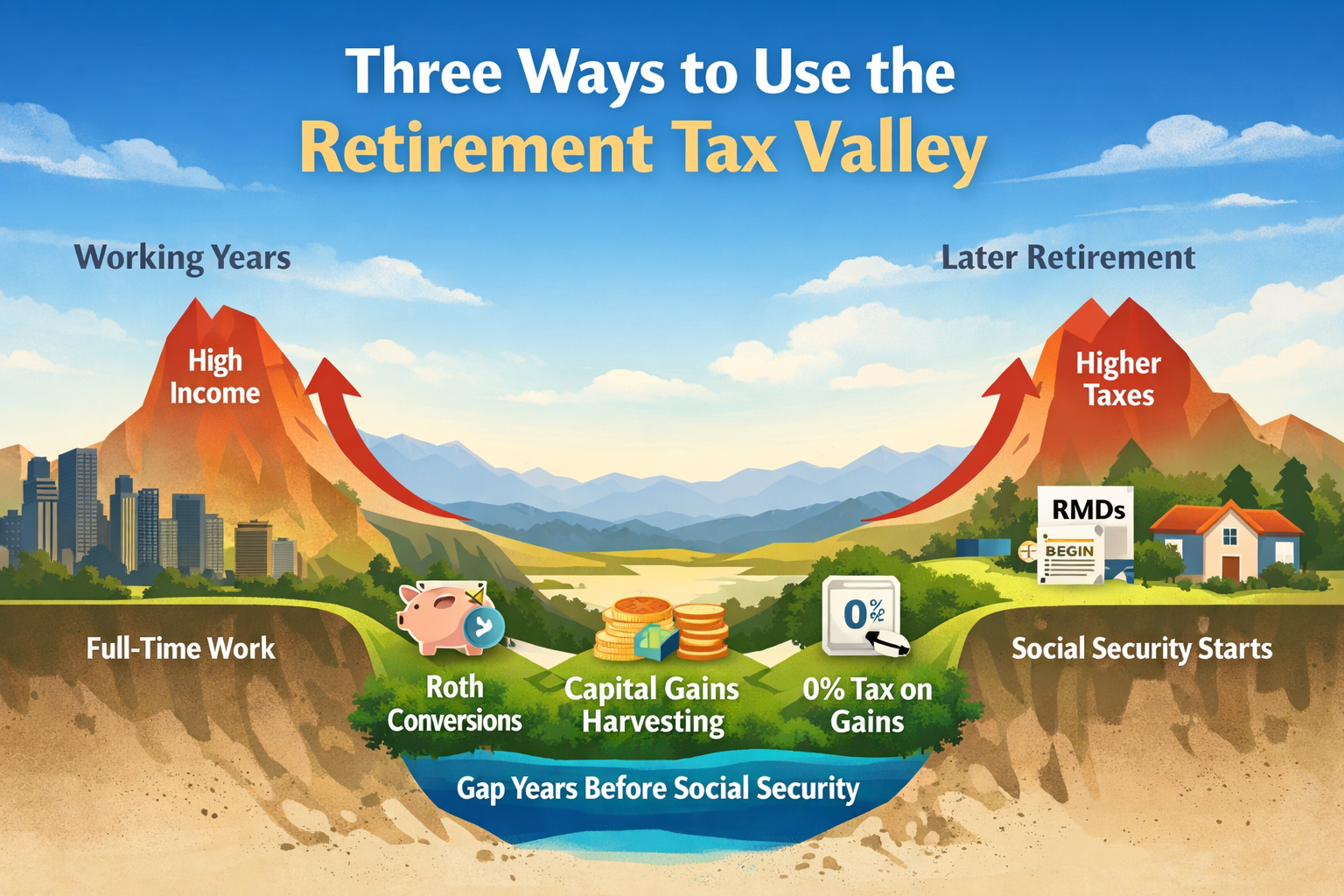
The best example of this might be the 0% tax rate for long term capital gains and qualified dividends. In 2025 a couple filing jointly could earn up to $96,700 completely tax free. That’s a free lunch and then some!
Planning ahead doesn’t guarantee a specific outcome, but it increases your ability to respond to whatever the future brings: changes in tax policy, shifts in spending needs, or simply the realities of a long retirement.
In the end, tax diversification isn’t about optimizing every dollar. It’s about building a bridge to a retirement where you’re not boxed into a single path; where you have the flexibility to adjust, adapt, and decide what makes sense as you go.
Some people Some people collect gadgets. You collect accounts. With the right mix, your Swiss Army knife of retirement is ready for anything life throws at you — taxes included.

Pingback: Should You Save Pre-Tax or Roth?A Tax Lifecycle Framework for Better Retirement Decisions -