

There’s a rule most people internalize pretty early on when they learn about early retirement: if you take money out of an IRA before age 59½, you pay a 10% penalty. But not everyone knows that there’s an exception available that has been in the tax code for decades.
When the exception is discussed, it’s often framed as something to avoid because it is too rigid, too easy to mess up, and not worth the risk. The official name is Substantially Equal Periodic Payments, which doesn’t do it any favors. Most references shorten it to Rule 72(t), which is at least easier to say, if not much clearer.
What makes it interesting isn’t the name so much as what it allows. There is a way to access IRA money early, avoid the penalty, and stay fully within the rules.
At the same time, the hesitation around it is real. This isn’t a flexible strategy. Once it starts, it has to keep going. And mistakes don’t just create small problems; they can come with substantial and retroactive penalties.
So 72(t) ends up in an odd place: widely dismissed, rarely used, but potentially very useful in the right circumstances.
What follows is a walkthrough of how 72(t) actually works, the three ways the payments are calculated, where things tend to go sideways, and what it looks like to set it up in a way that fits into a broader plan instead of driving one.
What Is a 72(t), Actually?
Rule 72(t) allows you to take penalty-free withdrawals from a traditional IRA (or SEP-IRA) before age 59½, as long as you agree to take a series of substantially equal periodic payments based on your life expectancy. The IRS is essentially saying: we will waive the 10% penalty, but you have to commit to a schedule. You cannot just take a withdrawal here and there whenever you feel like it.
A few things to understand up front:
The commitment period is long. You must continue payments for the longer of five years or until you reach age 59½, whichever comes later. If you start at age 50, you are locked in until 59½, which is 9.5 years. If you start at age 57, you are locked in until 62, which is five years. The five-year rule only helps you if you start late.
This only removes the penalty, not the tax. Every dollar you withdraw is still ordinary income and taxed accordingly. This is a common source of confusion.
The rules apply to IRAs, SEP-IRAs, and SIMPLE IRAs.
The Three Calculation Methods
The IRS gives you three approved methods for calculating your annual payment. You choose one when you start and generally stick with it.
| Method | Payment Level | Flexibility | How It Works |
| RMD Method | Lowest | Most flexible | Account balance divided by IRS life expectancy factor, recalculated each year |
| Fixed Amortization | Higher | Rigid | Fixed payment calculated once using life expectancy and an IRS interest rate |
| Fixed Annuitization | Similar to amortization | Rigid | Uses an annuity factor; slightly different math, rarely used in practice |
The RMD method recalculates your payment every year based on your current account balance. If the market drops, your required payment drops with it. This gives you some cushion, but it also means your income is unpredictable (and smaller).
Fixed amortization calculates a payment once at the start and holds it constant for the life of the schedule. It typically produces higher payments than the RMD method. Most people who use 72(t) use this one.
Fixed annuitization is mathematically similar to amortization but uses a different annuity factor table.
For most people, the decision is between the RMD method (lower, flexible) and fixed amortization (higher, locked in). Which is better depends on how much income you need and how much you value predictability.
The One Safety Hatch
Fixed amortization and annuitization lock you into a payment. But there is one escape valve worth knowing about.
The IRS allows a one-time, one-way switch from fixed amortization or annuitization down to the RMD method. You can use this to reduce your payments if your situation changes. Maybe you need less income than you expected, or the market dropped significantly and you want to preserve the account.
You can only do this once, and you cannot switch back. But it is a meaningful pressure release and one of the reasons most people prefer to start with fixed amortization rather than the other way around. You get the higher fixed payment while things are going well, with the option to dial back once if needed.
The Isolated IRA Strategy
One other key point: you do not have to run a 72(t) on your entire IRA.
Best practice is to transfer just the portion of your IRA that you need into a new, separate IRA account, and then start the 72(t) on that account only. Your remaining IRA balance stays untouched, flexible, and available for Roth conversions, lump-sum needs, or whatever else comes up.
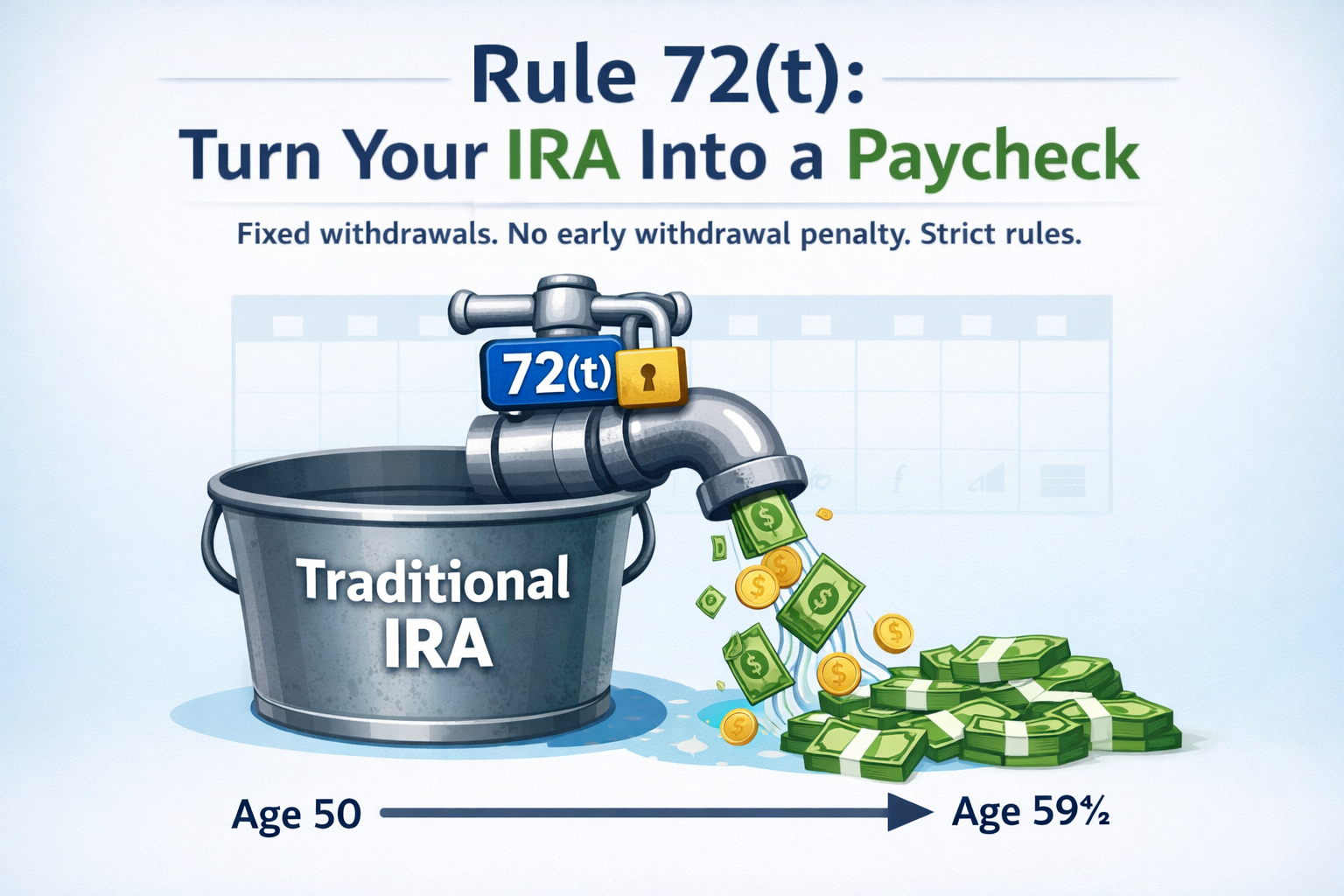
Think of each 72(t) as a faucet. You decide how big the faucet is before you open it. Once it is open, it runs until the commitment period ends. You cannot close it early (though you can turn it down once, as described above). But you can add a second faucet later by starting a new 72(t) on a different IRA if your income needs change.
The practical implication: figure out how much annual income you need from this strategy, work backwards to determine what account balance generates that amount, and transfer only that portion into the account you will use for the 72(t).
A Real Example With Numbers
Meet Alex. He is 50 years old, retired, and has $1.5 million in a traditional IRA. He has some taxable investments but not enough to carry him all the way to 59½ on his own. He wants to use a 72(t) to create a $40,000 annual spending floor from his pre-tax accounts.
Step 1: How much does he need in the 72(t) account?
Using the fixed amortization method, with an IRS maximum interest rate of 5% and a life expectancy of 36.2 years from the IRS Single Life Expectancy table, an account balance of $663,220 generates an annual payment of exactly $40,000.
That is the number Alex must take every year. Not approximately $40,000. Not $40,050 because it felt close enough. Exactly $40,000. The IRS expects you to document your calculation and take the precise amount it produces. Deviating from that figure, even slightly, can be treated as a modification of the schedule.
(Note: The IRS publishes a maximum allowable interest rate each month based on federal mid-term rates. Your actual calculation should use the rate in effect when you set up the schedule, and an online SEPP calculator will give you the exact payment amount to use. These numbers are illustrative.)
Step 2: Set up the account
Alex transfers $663,220 from his existing IRA into a new, separate IRA. He leaves $836,780 in his original account, untouched.
Step 3: Start the 72(t) on the new account
Alex begins taking $40,000 per year from the $663,220 account. He is committed to this schedule until age 59½, which is 9.5 years from now.
Step 4: What happens to the rest?
The remaining $836,780 in Alex’s original IRA stays flexible. He can use it for Roth conversions in low-income years, leave it to grow, or start a second 72(t) later if he needs more income.
What does Alex actually take home?
The $40,000 is ordinary income, taxed at his marginal rate. If his total income for the year is $40,000 plus some taxable investment income, he will likely be in the 12% federal bracket. His actual after-tax income from the 72(t) will depend on his full picture, including state income taxes.
The commitment in plain terms:
Alex must take exactly $40,000 from this account every year until he turns 59½. He cannot stop. He cannot round up or down. He cannot contribute to this account during the schedule. If he gets the math wrong or misses a payment, the IRS can retroactively apply the 10% penalty to every withdrawal he has ever taken from this account, plus interest.
Why Most Financial Advisors Approach This With Caution
This is not a strategy advisors warn people away from because it does not work. It works fine when used correctly. The caution comes from a few legitimate concerns.
The margin for error is real. A missed payment, an accidental contribution to the account, or a calculation error can trigger retroactive penalties on the entire withdrawal history. The IRS has specific rules about what counts as a modification, and not all of them are intuitive.
Life changes, but the schedule does not. A 72(t) schedule has no provision for “I changed my mind” or “I got a job offer.” Once you start, you are committed. If you need to stop for any reason other than reaching the end of the commitment period, you will likely owe back penalties.
It limits your tax planning flexibility. The account running the 72(t) is essentially frozen in terms of strategy. You cannot do Roth conversions from it, and you cannot adjust withdrawals based on your tax bracket in a given year. The payment is what it is.
There are usually better options if you planned ahead. Roth contributions, taxable brokerage accounts, and governmental 457(b) plans all provide penalty-free access with far more flexibility. If you have those options available, 72(t) probably should not be your first move. The catch, of course, is that your advisor suggesting you “just use your Roth contributions” can feel a little like someone telling you to bring an umbrella after you are already soaked. If you are reading this mid-career, that is your cue to go open a taxable brokerage account. Go ahead and read my earlier post about the importance of tax diversification.
The honest summary: this strategy rewards careful people who have saved a big pile in their pre-tax accounts, thought through their income needs in advance, and are confident they will not need to change course.
When a 72(t) Makes Sense
Your money is mostly pre-tax. If the majority of your retirement savings are in a traditional IRA or 401(k) and you have limited Roth or taxable assets, 72(t) may be one of the few ways to access those funds early without a penalty.
You are planning a long early retirement. The commitment period is most manageable when you have time to plan around it. Someone retiring at 48 or 50 has years to set up the strategy thoughtfully and build their income plan around it.
You want a defined spending floor. Using 72(t) to cover predictable fixed expenses like housing, food, and insurance lets you treat other accounts as flexible reserves. Knowing a certain amount of income is coming every year has real planning value.
You are confident you will not need to stop. The biggest risk is life changing in ways you did not anticipate. If you are reasonably certain you will not need to return to work or make major changes to your financial plan, the rigidity of 72(t) is less of a concern.
You are organized and detail-oriented. This is not the strategy for someone who occasionally forgets to pay a bill. It requires consistent execution for years and careful attention to the account rules. If that description fits you, great. If it does not, factor that in honestly.
When It Is Probably Not for You
You might go back to work. If there is a real chance your income situation changes, locking in a mandatory withdrawal schedule adds unnecessary complexity. A new salary could push you into a higher bracket and make those forced withdrawals more costly.
You might inherit an IRA. An inherited IRA changes your options significantly and could make a 72(t) unnecessary or redundant. If that is a real possibility in your near-term future, it is worth waiting to see how things shake out.
You have other options you have not fully used. If you have meaningful Roth contributions, a taxable brokerage account, or access to a governmental 457(b), start there. Those options give you the same penalty-free access without the rigidity.
Your balance is modest. The annual payments from a smaller account may not be large enough to justify the inflexibility. Run the numbers first and make sure the income generated is actually meaningful to your plan.
You are not great at tracking long-running financial obligations. Said without judgment, because it is a real consideration. A 72(t) requires consistent execution for up to a decade. If you know that is not your strong suit, this strategy has a higher risk of going sideways for reasons that have nothing to do with the market.
Closing Thoughts
Rule 72(t) is a legitimate tool with a specific use case. It is not a trap, and it is not a secret. It is a structured way to access pre-tax retirement savings early, with real tradeoffs attached.
The early retirees who use it well tend to share a few things in common: their assets are mostly pre-tax, they have thought carefully about how much income they need, they set up the account correctly from the start, and they treat it as one piece of a coordinated plan rather than a standalone solution.
If you are building an income bridge to traditional retirement age and want to understand the full picture of available strategies, my guide here covers how 72(t) fits alongside taxable accounts, Roth contributions, the Rule of 55, and governmental 457(b) plans in early retirement.
Frequently Asked Questions
What happens if I stop my 72(t) payments early?
If you modify or stop your payment schedule before the commitment period ends, the IRS will retroactively apply the 10% early withdrawal penalty to every payment you have already taken, plus interest. This is the main reason the strategy requires a firm commitment before you start.
Can I have more than one 72(t) at the same time?
Yes. You can run multiple 72(t) schedules simultaneously, as long as each one is set up on a separate IRA account. You cannot add a new schedule to an account that already has one running, but you can open a new IRA, transfer funds into it, and start a separate schedule. This is how you would increase your income if your needs change after you have already started.
Does a 72(t) work with a 401(k)?
The 72(t) rules technically apply to qualified plans like 401(k)s, but in practice most employer plans do not support SEPP schedules administratively. If your money is still in a 401(k), the more common approach is to roll it over to an IRA first and then set up the 72(t) from there.
Can I still do Roth conversions while running a 72(t)?
Not from the account running the 72(t). That account is locked into its payment schedule. However, you can do Roth conversions from a different IRA you own. This is one of the main reasons to isolate the 72(t) into its own account rather than running it on your entire IRA balance.
What if I miss a payment?
Missing a payment is treated as a modification of the schedule, which can trigger retroactive penalties. If you are using fixed amortization, taking the exact same amount each year on a consistent schedule is essential. Setting up automatic distributions is the simplest way to make sure this does not become a problem.
How do I know what interest rate to use for the fixed amortization calculation?
The IRS publishes a maximum allowable interest rate each month, based on the federal mid-term rate. You can use any rate at or below that cap. The rate you choose at the start is locked in for the life of the schedule if you use fixed amortization. A higher rate produces a higher annual payment, and vice versa. Your calculation should use the rate in effect during the month you establish the schedule.
What happens when the commitment period ends?
Once you have completed the required period (the longer of five years or until age 59½), you are free to take distributions in any amount, stop entirely, or continue the same schedule. The IRS no longer requires equal payments at that point. Most people simply shift to flexible withdrawals based on their actual income needs.
How do I report a 72(t) withdrawal on my taxes?
Your IRA custodian will send you a Form 1099-R at the end of each year showing the amount you withdrew. You also need to file Form 5329 with your federal tax return to claim the penalty exception. On Form 5329, you enter the distribution amount and use exception code 02, which tells the IRS the payments qualify as part of a SEPP plan. Without Form 5329, the IRS (or our tax preparation software) has no way of knowing your withdrawal is exempt from the 10% penalty and may assess it automatically. You will still owe ordinary income tax on the full amount regardless. Keep your SEPP calculation documentation on file in case the IRS ever has questions.


Pingback: Help! My Tax Software Says I Owe a 10% Penalty After a 72(t) - Bridge and Retire