
If you spend any time in FIRE circles, you’ve heard the warning about the middle-class trap. The cautionary tale goes something like this: you buy a house, save diligently in tax-advantaged accounts your whole career, retire early, and discover that your money is locked behind a door you can’t open until 59½, at least not without paying a 10% penalty.
It sounds like a cautionary tale for people who didn’t plan carefully enough, or who are too young to retire. We’re going to meet a couple that planned carefully, but seem to have this problem.
Spoiler alert: it is a solvable problem!
This is Part 1 of the Middle Class Trap series. A full series is coming soon.
Meet Ben and Leslie
Ben and Leslie are 50 years old and ready to retire. Ben wants to sleep in and perfect his waffle technique. Leslie has a list of 50 national parks she wants to visit. Our couple has done almost everything right. They have $2.5 million saved, a paid-off house, and a spending plan of $90,000 per year, which is a 3.6% withdrawal rate that’s considered reasonable by most FIRE standards.
Ben and Leslie are also smart enough to know about the so-called middle-class trap. For the past several years, they’ve been building up their taxable brokerage account specifically to bridge the gap to 59½. They’ve also made regular Roth contributions.
Here’s where they stand:
| Account | Balance | Cost Basis |
| Traditional 401(k) / IRA | $1,600,000 | — |
| Roth accounts | $300,000 | $100,000 |
| Taxable brokerage | $600,000 | $300,000 |
| Total | $2,500,000 | — |
Desired annual spend: $90,000
Ben and Leslie know they have to plan for a 9-year bridge before penalty-free traditional account access at 59½, and at least 12 years until they could claim Social Security. They also know that it is prudent to delay Social Security until full retirement age at 67, or 70 if they can manage it.
For anyone following along with a spreadsheet, here are the assumptions baked into the numbers I’m going to present:
- Dividend yield on taxable accounts: 1.5% (95% qualified)
- Annual portfolio growth: 6%
- Inflation: 2.5%
- Health insurance budget: An Affordable Care Act Plan at $10,000/year is included in Ben and Leslie’s $90,000 budget. They would like to keep their income below 400% of the federal poverty level (FPL) so they are eligible for some health insurance tax credits.
The Plan That Almost Works
The standard playbook for early retirement is straightforward: spend down your taxable brokerage first, leave the tax-advantaged accounts alone to grow, and start tapping traditional accounts once you hit 59½. Simple, logical, and for Ben and Leslie—almost right.
Here’s what that looks like in practice:
| Age | Brokerage Balance (EOY) | Dividends | Effective Spend | Brokerage Drawn | Federal Taxes | % FPL |
| 50 | $557,803 | $9,000 | $82,770 | $73,770 | $0 | 253.6% |
| 51 | $509,121 | $7,814 | $85,314 | $77,501 | $0 | 255.0% |
| 52 | $453,904 | $7,056 | $87,965 | $80,910 | $0 | 259.6% |
| 53 | $391,584 | $6,202 | $90,687 | $84,485 | $0 | 263.6% |
| 54 | $321,544 | $5,240 | $93,480 | $88,240 | $0 | 267.0% |
| 55 | $243,120 | $4,161 | $96,346 | $92,185 | $0 | 269.8% |
| 56 | $155,597 | $2,955 | $99,286 | $96,331 | $0 | 272.1% |
| 57 | $58,203 | $1,611 | $102,301 | $100,689 | $0 | 273.8% |
| 58 | $0 | $118 | $100,520 | $58,203 | $0 | 152.4% |
Seven years of smooth sailing. Federal taxes: zero. Then age 58 arrives, and the brokerage account can’t cover the full year’s expenses. The number turns red.
Ben and Leslie are 58 years old, 18 months from penalty-free access to their traditional accounts, and they’re out of runway.
The Trap
Here’s the cruel part. While they’ve been drawing down the brokerage account, the untouched traditional accounts have been compounding quietly. By age 58, their pre-tax accounts have grown to roughly $2.8 million. Their Roth is sitting at $506,000, but still only $100,000 in basis to withdraw. They have $3.2 million in total savings.
They’re surrounded by money. They just can’t easily get to it.
It’s the man dying of thirst on a beach surrounded by saltwater. The money exists. The rules make it complicated. This is the middle-class trap! Clearly not a failure of saving, but a failure of access.
One More Thing Worth Noting
Look again at the % FPL column. For all seven years, Ben and Leslie are sitting around 250%-275% of the federal poverty level, which is squarely in the range that qualifies for significant Affordable Care Act premium tax credits. I ran their numbers for a zip code in Muncie, Indiana, and the lowest-deductible HSA-eligible plan came in under $200 per month with subsidies, much less than the $10,000 they budgeted.
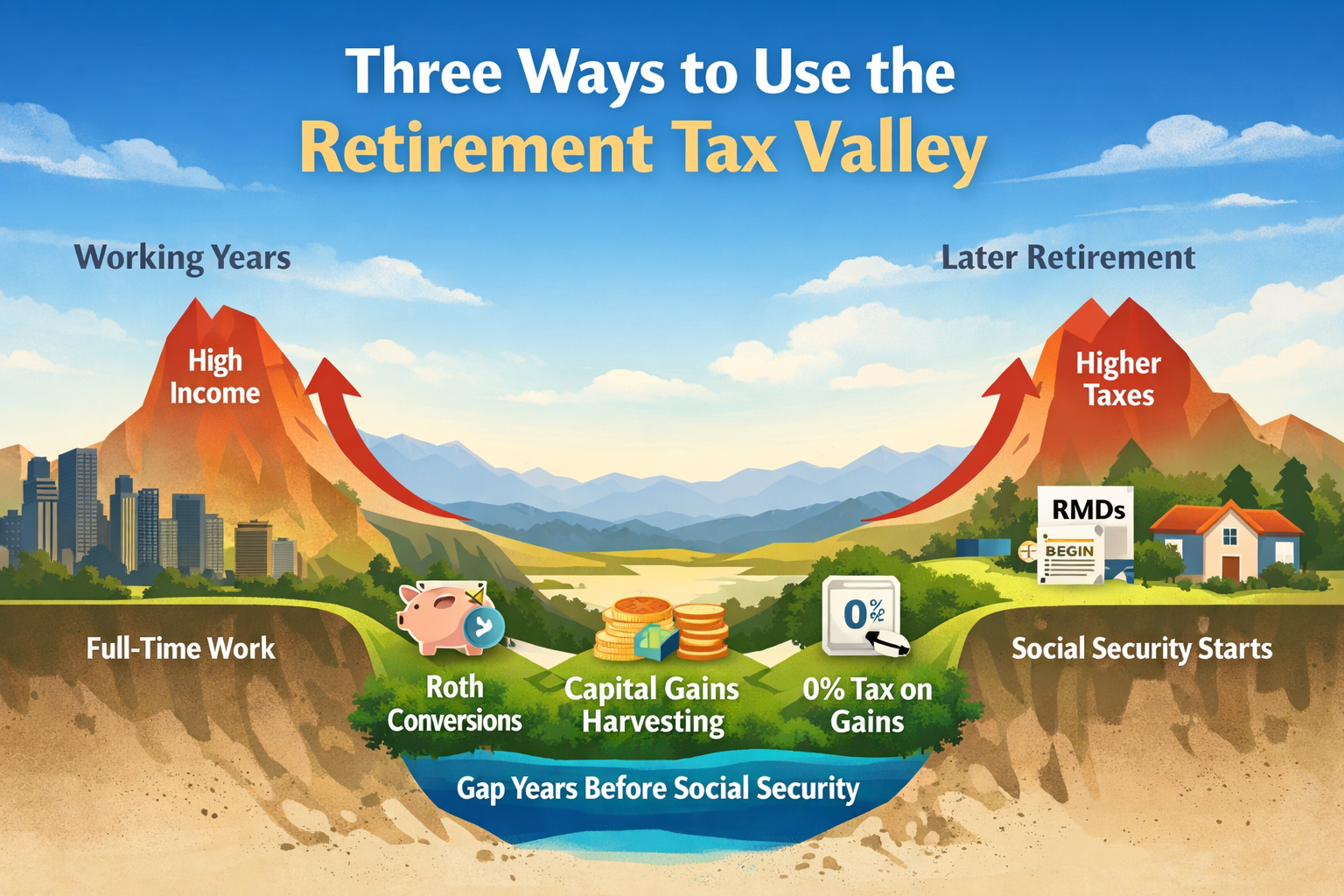
Also, because their income is almost entirely qualified dividends and capital gains, they’re paying zero federal income tax. But here’s the problem: paying zero taxes while sitting on $1.6 million (growing to $2.8 million) in pre-tax accounts isn’t actually a great long-term plan. They’re letting more than $30,000 of standard deduction go to waste every year. Those low-income years are an opportunity, and right now they’re not using them.
We’ll come back to that.
What Comes Next
Ben and Leslie are not trapped. Not really. The tax code includes several legitimate strategies for accessing retirement funds before 59½ without a penalty, and their situation, with substantial pre-tax savings, a taxable account that’s running low, and a clear timeline are exactly what those strategies were designed for.
They have three viable paths forward:
- Withdrawing Roth principal
- Rule 72(t) — Substantially Equal Periodic Payments
- A Roth conversion ladder
In Part 2, we’ll look at each option and start running the numbers.
Read Part 2 in the Series