
If you’re planning for early retirement, health insurance often feels like the biggest unknown.
Most people assume costs rise steadily with age:
Younger = cheap
Older = expensive
That seems logical. But under the affordable care act (ACA), that’s not always how it plays out. Sometimes, a 64‑year‑old can actually pay less than a 45‑year‑old for the exact same plan. Let’s meet two couples to see how it works.
Meet the Couples
The 45‑Year‑Olds: Sarah and Mike are both 45. They’re considering leaving their jobs early and want to understand what health insurance will cost.
The 64‑Year‑Olds: Linda and Tom are the same household setup but 64. They’re approaching retirement and have similar income considerations. They are eligible for Medicare next year and this will be the last year they have to find a private plan.
Both couples live in Seattle (King County, WA) and are looking at the same bronze HSA plan, with an $11,000 deductible. The only difference is their age. We’re going to make this a bit interesting by varying the couple’s incomes a bit to show how premium tax credits change at different income (more precisely, modified adjusted gross income aka MAGI) levels.
A Few Notes on the Insurance Plan
Before getting into the results, a little context on the plan I picked. This wasn’t the absolute cheapest plan on the exchange.There were cheaper options and there were more expensive ones. I picked the top rated bronze plan available on the exchange based on survey results and data provided by carriers.
So think of this as a reasonable baseline, not a best-case scenario. A couple other quirks: In this market, there were bronze and gold plans available—but no silver plans The ACA still uses a benchmark silver plan behind the scenes to calculate subsidies, so the math still works.
More importantly, this is a high-deductible plan: $11,000 family deductible and $15,000 out-of-pocket maximum. Preventative care is covered, but most other costs are out of pocket first.
If you’re coming from robust employer coverage, this will feel like a step down. This kind of plan is closer to catastrophic coverage. It protects you from really bad outcomes, but you’re taking on more of the routine risk. People with significant ongoing health needs might be better served by a Gold tier plan.
But for early retirees with savings (and maybe an HSA), that tradeoff can make sense. For others, it can be a tough adjustment. There’s more at the end of this piece about how to choose the right plan for you.
Age 45: In the Middle of the Curve
At first glance, Sarah and Mike’s premiums net of tax credits look reasonable:
- $50,000 income → $465/year
- $70,000 income → $3,467/year
- $80,000 income → $4,680/year
But then they hit a bump:
- $85,000 income → $12,648/year
That’s a nearly $8,000 increase from just a $5,000 rise in income — the subsidy cliff at work.
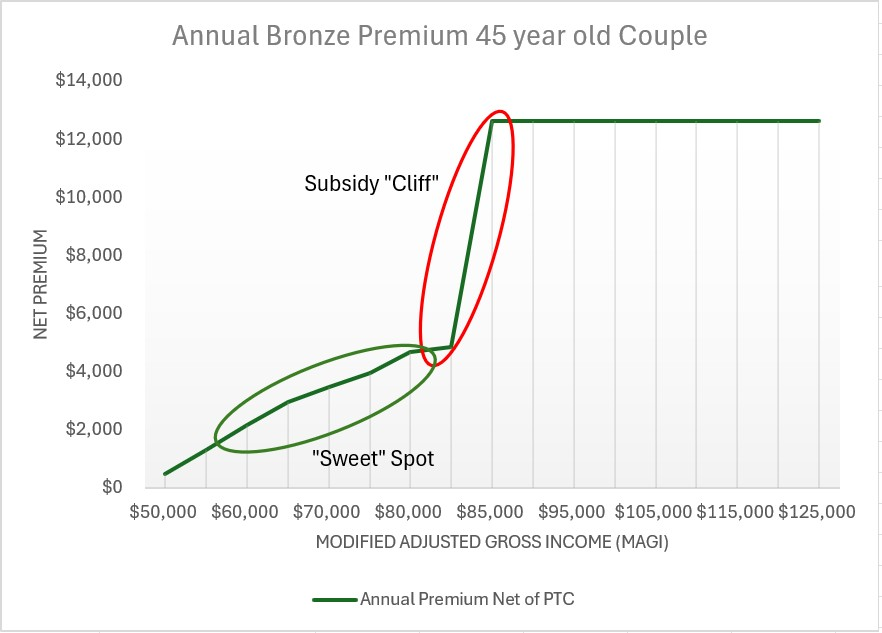
Here’s how the ACA subsidy works: instead of subsidizing the plan you pick directly, it calculates what you’re expected to pay based on your income, then looks at the cost of a benchmark silver plan. The difference becomes your subsidy, which you can apply to any plan. At age 45, benchmark plans are only moderately expensive, so the subsidy isn’t very large. Lose it, and your net cost jumps.
Age 64: Subsidies Working in Your Favor (…Until They Don’t)
Linda and Tom see a very different picture with the same plan:
- $50,000 income → $0/year
- $60,000 income → $0/year
- $70,000 income → $0/year
- $80,000 income → $685/year
What is going on here?
The full premium for this plan is $26,276/year, but subsidies wipe out almost all of it at $50,000 to $70,000 of income. At $80,000 of income the subsidy covers all but $685 in premium. Here, age actually helps, because the benchmark silver plan is much more expensive for older adults, which means the subsidy is much larger and can be applied to this bronze option.
But the cliff hits just as hard as for our younger couple:
- $84,000 income → $1,084/year
- $85,000 income → $26,276/year
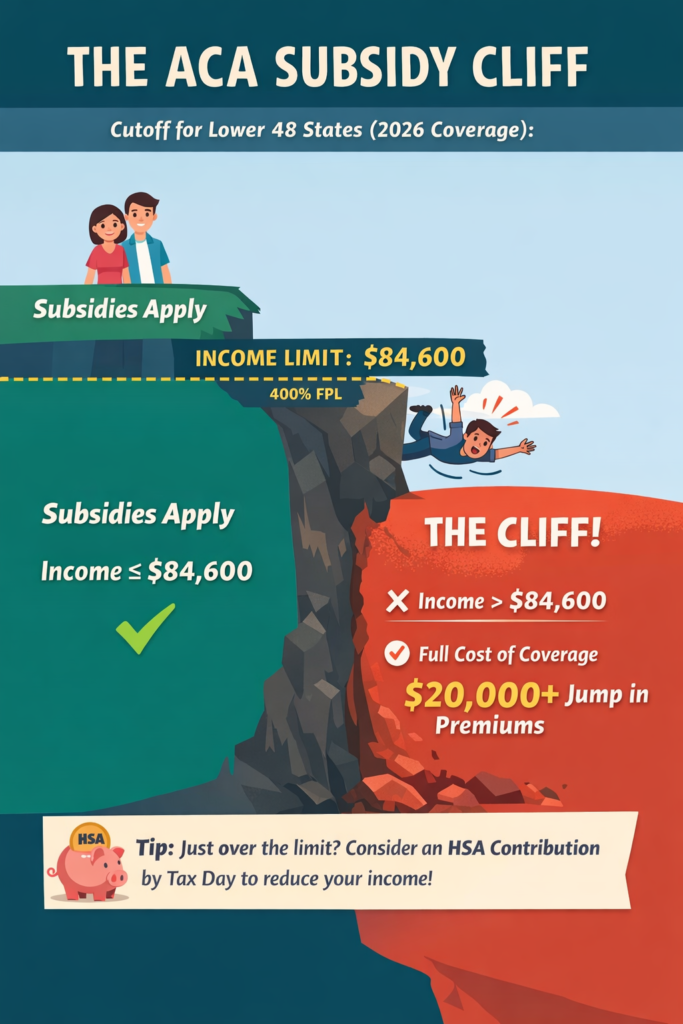
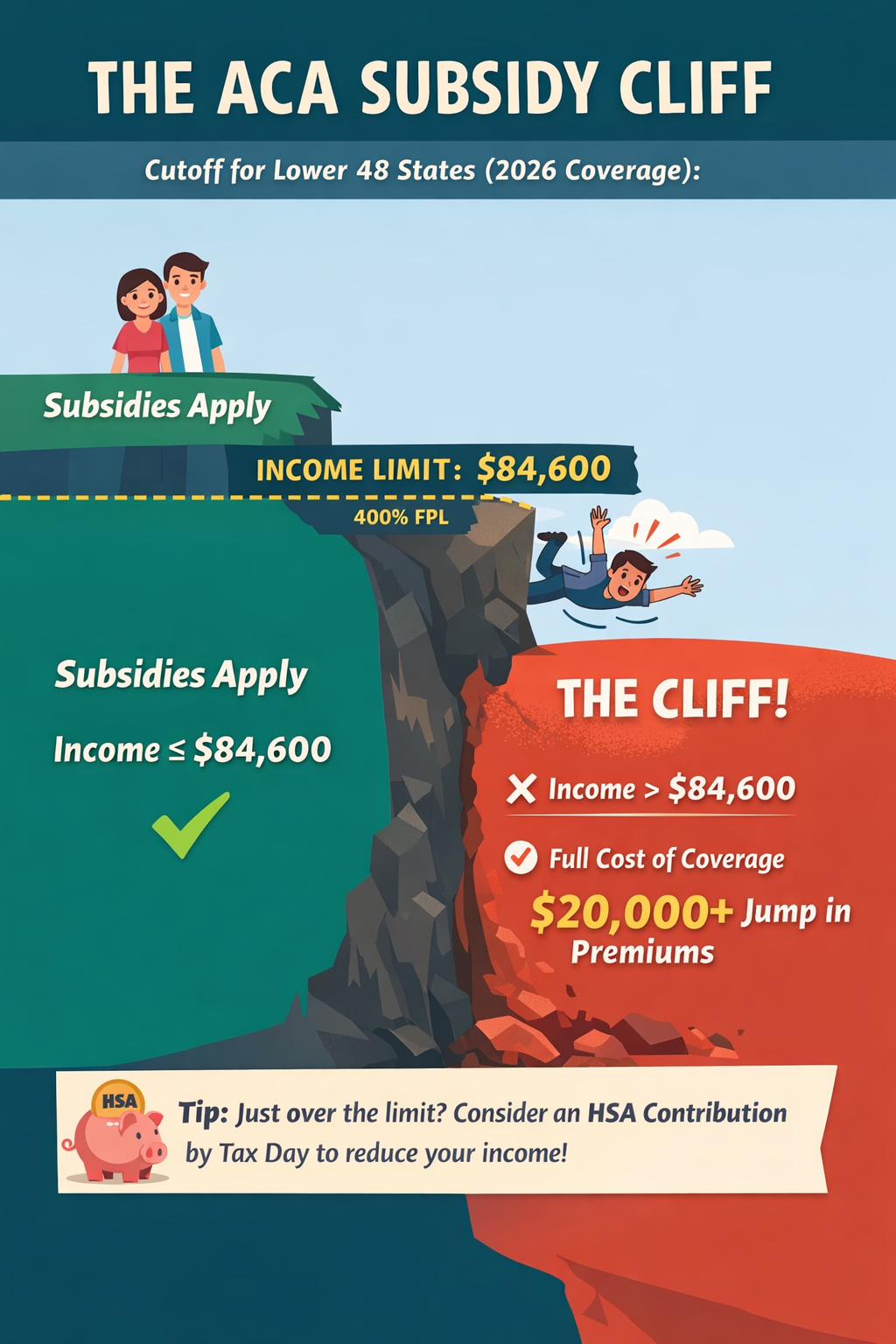
That’s more than $25,000 extra for just $1 over the limit. For a household size of 2 in the contiguous 48 states the 400 % Federal Poverty Level cutoff is $84,600 for 2026 coverage.
Remember the government shutdown at the end of 2025 and all of the discussion about the subsidy cliff returning? This is what those debates were about–rather than a gradual decrease in subsidy, there is a hard cliff when you go $1 over the limit.
There is a small safety valve: because this plan is HSA‑eligible, Sarah and Mike or Linda and Tom could make a pre‑tax HSA contribution up until they file taxes the following April 15. That would reduce their modified adjusted gross income (MAGI) and can help bring them back under the subsidy limit if they’re just over the threshold. It’s not a cure‑all, but it can soften the blow for folks near the cliff.
What This Means for Early Retirement
A few key takeaways:
- Your 40s can be tricky. Subsidies are smaller, so costs are more sensitive to income. Even modest income bumps can create large premium jumps.
- Your early 60s aren’t necessarily more expensive. Depending on the plan you choose, larger subsidies and lower net premiums can make coverage more affordable, until you hit the cliff.
- Managing income matters more than age. Roth conversions, capital gains, retirement withdrawals, and HSA contributions all play into what you end up paying.
Shopping for a Plan
Numbers help, but coverage is personal:
- Start with your providers. Make sure your primary care doctor, specialists, and hospital system are in‑network. That matters as much as the monthly premium.
- Understand your risk tolerance. High‑deductible plans work if you have savings and can handle out‑of‑pocket costs, but may be tougher for those expecting regular medical expenses.
- There isn’t a single “right” choice. You’re balancing monthly cost, out‑of‑pocket risk, and provider access.
Bottom Line
Most people expect health insurance costs to rise steadily with age.Under the ACA, that’s not necessarily true net of subsidies: costs can rise, flatten, or even decrease before spiking dramatically if you cross the subsidy cliff. For early retirees, even a small change in income can dramatically alter what you pay. Understanding how subsidies interact with age and income and planning around the cliff can make a huge difference.
Disclaimer: This analysis assumes current ACA subsidy rules remain as written. Future legislation or changes to subsidy policy could materially alter these outcomes.