

The Expense Everyone Worries About
When most people picture early retirement, they imagine freedom, travel, and finally escaping the 9-to-5. But for almost every retiree under 65, one concern looms largest: healthcare costs.
Healthcare often represents the biggest pre-Medicare expense, and navigating the options can feel overwhelming. Even retirees who have meticulously saved can feel paralyzed by the choices—and by the potential cost mistakes that could wipe out months of savings.
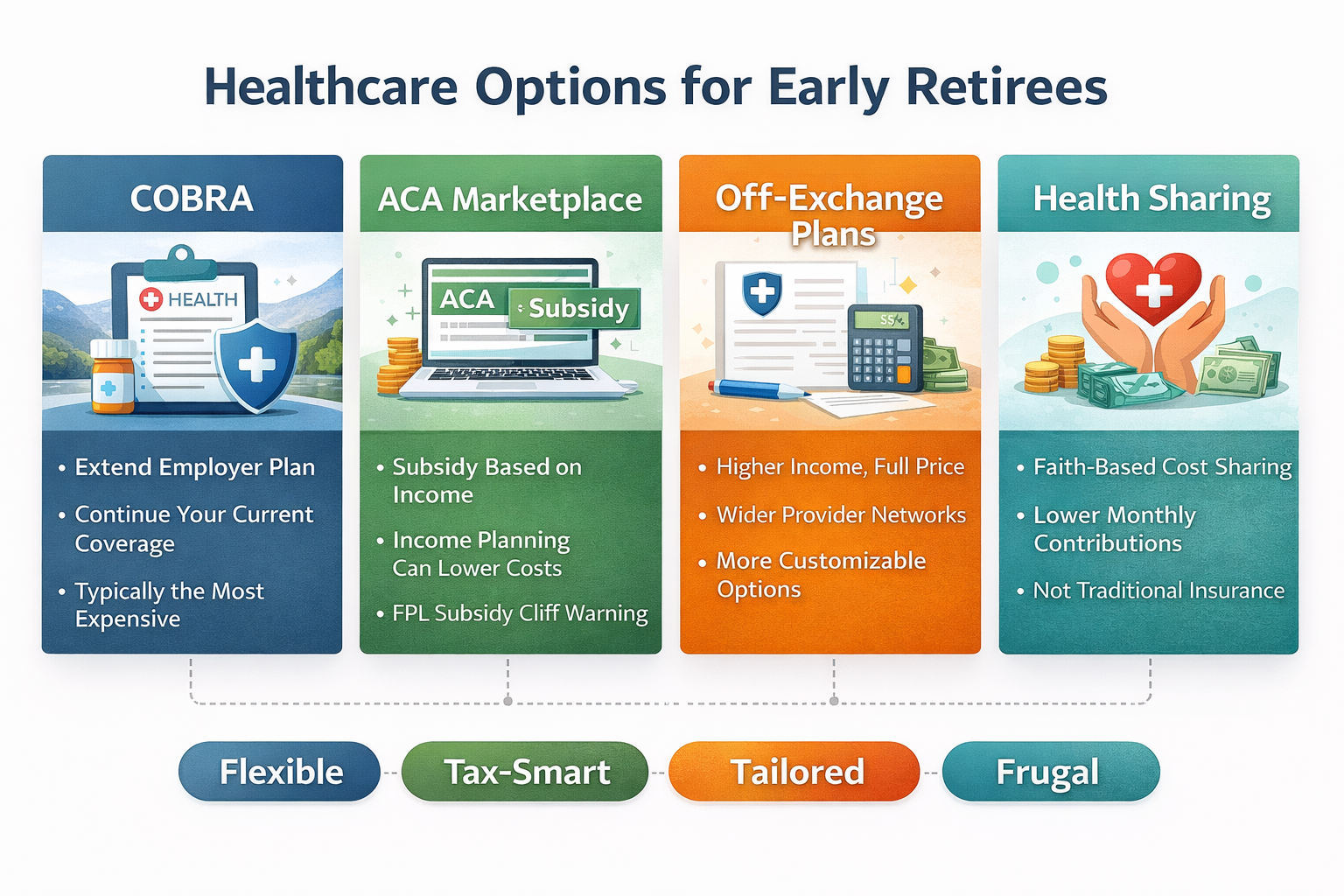
Before Medicare eligibility, retirees face several paths: COBRA continuation coverage, ACA Marketplace plans, off-exchange private plans, and health sharing programs. Each comes with trade-offs in cost, coverage, flexibility, and taxes. This post walks through your choices, shares real examples, and shows how strategic planning can make a huge difference.
Disclaimer: This content is for educational purposes only and reflects general planning concepts. I’m not a licensed health insurance broker, and this isn’t personalized advice.
Option 1: COBRA — The Easy (and Expensive) Button
COBRA often feels like the safe, obvious choice. It allows you to continue your employer’s health plan after leaving your job, usually for up to 18 months. For someone mid-treatment or who values continuity with their current doctors it can feel like a no-brainer.
The main drawback? You pay 100% of the premium plus a small administrative fee, which can be surprisingly expensive. COBRA also ends after a limited time, so it’s a temporary bridge—not a long-term solution.
Imagine retiring in January or February and realizing you’ve already met your annual deductible. COBRA lets you continue coverage seamlessly while you figure out your next move. You have 60 days to elect COBRA coverage after leaving a job or losing employer-sponsored coverage. But as reliable as it is, many retirees look for alternatives once the 18-month window closes.
It can also be the most expensive option. Many employees aren’t aware how much their employers actually contribute to healthcare costs. If you’re curious, check last year’s W-2 Box 12, code “DD” shows the total cost of your coverage. That’s roughly what COBRA will cost you annually, plus a small administrative fee.
Quick Note: Retiree Health Insurance
Some employers offer retiree health benefits, especially in government, education, or large corporations. These can include subsidized premiums, group pricing, and coverage until Medicare eligibility. If you qualify, this can be a major advantage—so don’t assume COBRA is your only option.
Option 2: ACA Marketplace Plans (The Strategic Play)
For many early retirees, Affordable Care Act (ACA) Marketplace plans are where strategy becomes most powerful. Subsidies are tied to your Modified Adjusted Gross Income (MAGI), which means you can influence your healthcare costs through thoughtful income planning.
The Marketplace offers a range of plan levels, from Bronze to Gold, and coverage can continue until Medicare eligibility. On the flip side, you need to plan carefully—networks vary, coverage rules can be complex, and how you generate income significantly affects subsidy eligibility.
Income Control = Lower Costs
This is where early retirement planning shines. Imagine two retirees with similar portfolios and lifestyles: one draws income from taxable account basis or Roth withdrawals, keeping MAGI low; the other takes larger traditional IRA withdrawals, pushing MAGI higher.
Even if they spend the same total amount, the first retiree might pay $3,500 annually for a Bronze plan, while the second could pay $12,000 or more.
Example: ACA Premiums in Seattle, WA
Picture a 45-year-old couple early retiring in Seattle choosing a Bronze HSA plan. The table below shows estimated costs based on exchange data (as of March 2026):
- $50,000 income → $465/year
- $60,000 income → $2,171/year
- $70,000 income → $3,467/year
- $80,000 income → $4,680/year
- $90,000 income → $12,648/year (full unsubsidized price)
Even a $25,000 difference in income can translate into a $10,000 swing in annual premiums—without changing lifestyle or plan.
The return of the 400% Federal Poverty Level (FPL) subsidy cliff is a quiet but meaningful shift. During the pandemic, enhanced subsidies eliminated the hard cutoff, ensuring no one paid more than a set percentage of income for coverage—even slightly above the threshold.
With those enhancements expired, households above 400% of FPL can once again lose eligibility for premium tax credits entirely, sometimes facing thousands in additional annual costs for earning just a little more. It’s a sharp reminder that small income changes can have outsized effects on net premiums.
Visual: Income vs. ACA Premium Chart
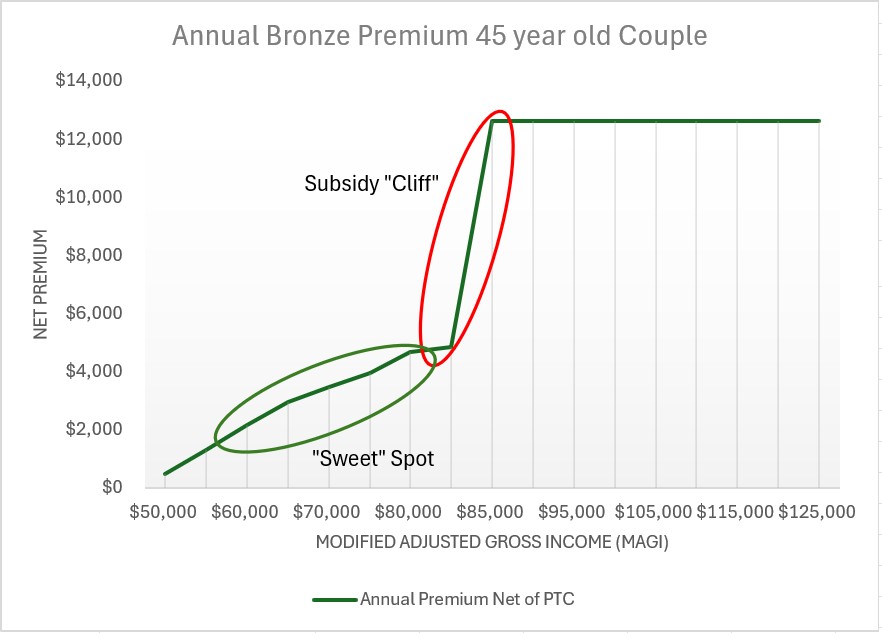
- Green: “Sweet spot” ($50k–$80k) where subsidies are strongest, balanced with some taxable income
- Red: Above ~$84k (household of 2), subsidies disappear
Thoughtful income planning isn’t just about taxes—it can be the difference between ~$200/month and $1,000+/month premiums for the same coverage.
Option 3: Off-Exchange Plans
Some retirees purchase insurance directly from insurers outside the ACA exchange. These plans are sometimes ACA-compliant but do not offer income-based subsidies.
They can appeal to higher-income retirees, those with specific provider needs, or those seeking more plan customization. The trade-off: you pay full price, which can be significantly higher than a well-planned ACA strategy.
Also, be careful—some off-exchange plans are not fully ACA-compliant and may underwrite based on health status, exclude pre-existing conditions, or have higher out-of-pocket exposure than ACA Marketplace plans.
Option 4: Health Sharing Programs
Health sharing ministries (such as Medi-Share or Samaritan Ministries) are not insurance, but some retirees use them to reduce monthly costs. Members share medical expenses within a community, often resulting in lower monthly payments.
However, these programs come with real risks: coverage isn’t guaranteed, pre-existing conditions may be excluded, and reimbursement limits can apply. For some, it’s a cost-saving tool—but only if you’re comfortable with the trade-offs.
The Tax Layer / Planning Notes
Healthcare costs are deeply tied to your income strategy. MAGI determines ACA subsidy eligibility and can include:
- Traditional IRA/401(k) withdrawals
- Roth conversions
- Capital gains
- Interest and dividends
Your MAGI typically excludes taxable account basis and Roth withdrawals.
Strategic account management can help you maximize subsidies, minimize premiums, and smooth taxes over time—potentially turning a $12,000 problem into a $3,500 one.
For retirees focused on the 4% rule, this matters. Higher healthcare costs can push a comfortable 4% withdrawal rate into something closer to 4.5%. And because premiums rise with age, the pressure often increases in your late 50s and early 60s.
Common Mistakes to Avoid
Even well-prepared retirees make missteps. Watch out for:
- Automatically choosing COBRA without comparing alternatives
- Ignoring MAGI sensitivity for ACA subsidies
- Over-converting to Roth and unintentionally losing subsidies
- Treating health sharing like traditional insurance
- Failing to plan for the transition year with irregular income
How to Choose the Right Option
- Short-term continuity or ongoing treatment → COBRA
- Long-term early retirement → ACA Marketplace
- High income or specific coverage needs → Off-exchange plans (typically using a broker)
- Cost-conscious and risk-tolerant → Health sharing
Your best choice is the one that aligns with your income strategy—not just the plan details.

Pingback: How Much Will Health Insurance Cost in Early Retirement? -