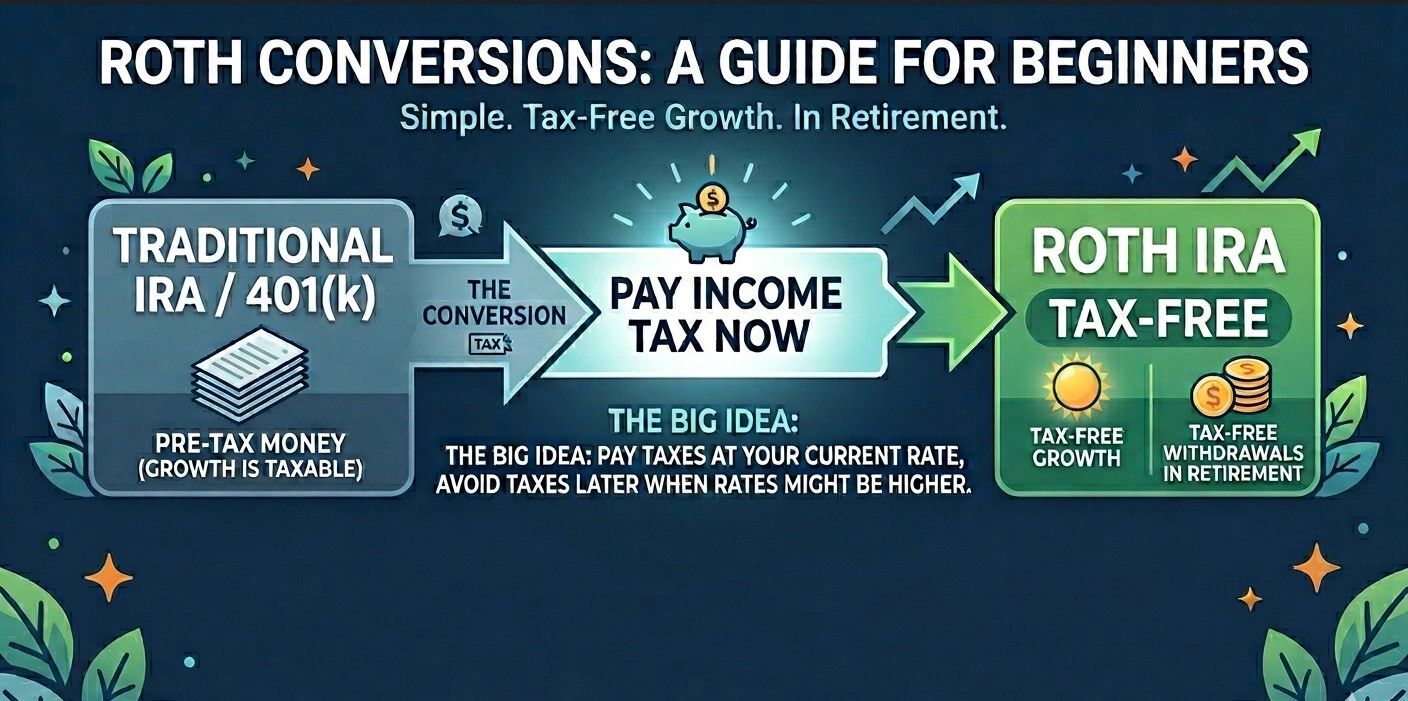

A Roth conversion is straightforward. You take money from a traditional, pre-tax retirement account, an IRA or 401(k), and move it into a Roth IRA. You pay income tax on it now. After that, it grows tax-free and comes out tax-free in retirement, as long as you follow the rules.
That’s really it. The complexity is in the details and the timing, not the concept.
What you’re really doing is changing when you pay taxes. You pay now instead of later, which is a good trade if future rates end up higher than your current rate, or if you just want more flexibility in retirement. Having a pool of tax-free money sitting alongside your taxable and tax-deferred accounts gives you options. That matters more than most people realize once withdrawals start.
Why Bother?
A few reasons, depending on your situation:
Tax diversification. Money spread across taxable, tax-deferred, and tax-free accounts gives you more levers to pull in retirement. You can manage your income, your tax bracket, your ACA subsidies, and your Medicare premiums with more precision. More on that below.
Potentially lower lifetime taxes. Convert during a low-income year, say, early retirement before Social Security and RMDs kick in, and you might pay a lower rate now than you’d face later when those income sources stack up.
Avoiding RMDs. Roth IRAs don’t have required minimum distributions. If your traditional IRA is large, RMDs can force taxable income on you whether you need the money or not. Converting reduces that future problem.
Estate planning. Roth money passes to heirs without income tax. Not the most exciting reason, but worth knowing.
No income limits. Anyone can do a Roth conversion. There’s no phase-out, no eligibility test. The IRS rarely hands out free passes, so this one is worth noting.
Rules Worth Knowing
The mechanics matter here, so let’s go through them.
You pay income tax in the year you convert. The amount you convert is added to your taxable income. If you convert $30,000, that $30,000 gets taxed at your marginal rate. Plan for it! This is not a surprise you want to discover in April.
Almost all conversions are fully taxable. The only exception: if you made after-tax contributions to a traditional IRA, those dollars don’t get taxed again when converted. The earnings on them do. Most people haven’t done this, but it’s worth knowing. That’s what people sometimes call a “backdoor Roth.”
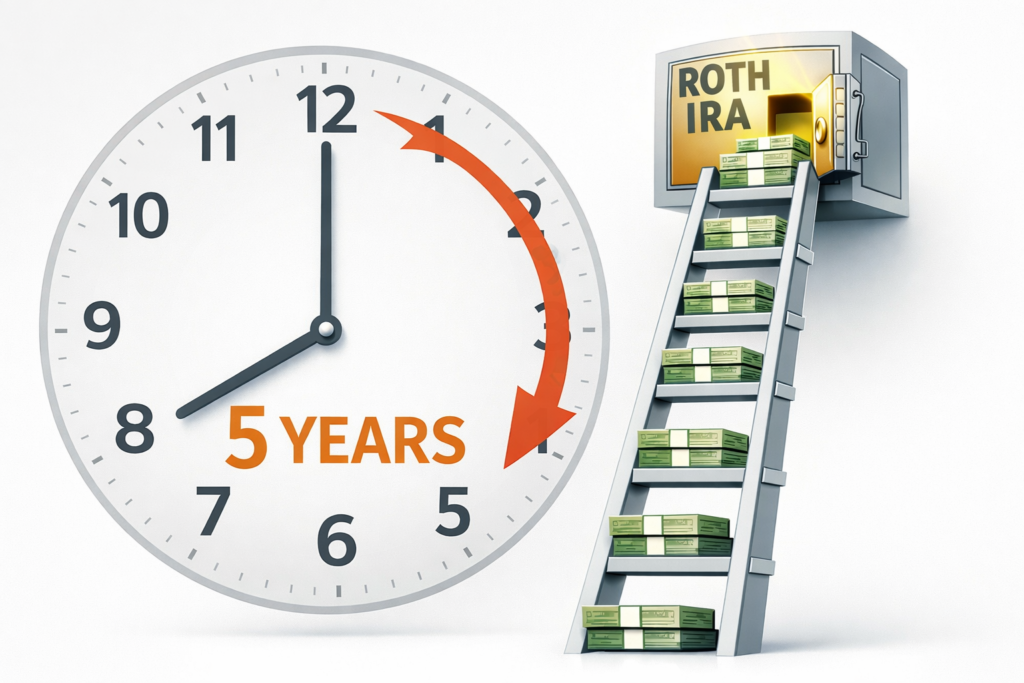
Each conversion has its own five-year clock. The IRS tracks when each conversion happened. Earnings on a conversion need five years before they can come out tax-free. If you’re under 59½, withdrawing converted principal before five years can trigger a 10% penalty.
Age 59½ changes things. Once you hit 59½, you can withdraw converted principal without penalty even if the five-year window isn’t up. Earnings still need the five years.
Here’s a quick summary:
| Situation | Converted Principal | Earnings |
| Under 59½ | Penalty if withdrawn before 5 years | Same |
| Over 59½ | No penalty; withdraw whenever | Need 5 years to be tax-free |
You don’t have to convert everything at once. Most people don’t. Spreading conversions across multiple years is a common strategy to manage the tax hit and to avoid accidentally blowing up your ACA subsidies or crossing into a higher bracket.
The Roth Ladder
If you’re planning for early retirement, the Roth ladder is worth understanding. It’s a way to create a predictable stream of tax-free income before you turn 59½.
The basic setup:
- Cover early expenses from taxable accounts. Most early retirees start here, brokerage accounts, savings, whatever doesn’t carry a penalty.
- Convert a portion of your traditional IRA each year. Each chunk starts its own five-year clock. Size the conversion to stay within a sensible tax bracket.
- Wait five years. After that, the converted principal can come out tax-free and penalty-free (earlier if you’re older than 59.5).
- Start withdrawing. Each year, another converted chunk becomes accessible. Over time, these form a continuous ladder of Roth money you can draw from steadily.
Done right, this strategy smooths your tax exposure and gives you reliable, tax-free income well before Social Security or traditional retirement accounts enter the picture.
When Does a Conversion Make Sense?
Conversions aren’t always the right move. They tend to make the most sense when:
- You’re in a low-income year. Early retirement is the classic window, after you’ve stopped working but before Social Security and required minimum distributions (RMDs) start piling on income.
- You expect taxes to be higher later, either because your income will rise or because the tax code changes.
- You have a large traditional IRA and want to reduce future RMDs before they become a problem.
When converting you’re often making a bet that paying taxes today is cheaper than paying them later. That bet depends on your current rate, your expected future rate, and how long the money has to grow. It’s not guaranteed to pay off, but for a lot of early retirees, the math favors conversion.
A Few Things That Can Go Wrong
Roth conversions are useful but not magic. A few things to watch:
ACA subsidies. Converted amounts count as income. A conversion that looks good on paper can wipe out premium tax credits and cost you more than you saved. If you’re counting on health insurance tax credits, make sure you do the math before you convert.
Tax bracket creep. Aggressive conversions can push you into a higher bracket, which can reduce the payoff. The math degrades quickly as you move up brackets.
Timing. Multi-year strategies tend to work better than doing everything at once. Patience is usually the right approach.
Bottom Line
A Roth conversion turns taxable dollars into future tax-free flexibility. It doesn’t automatically save you money. It depends on the timing, the rates, and your specific situation. But it’s one of the better tools available for managing taxes in early retirement, especially when you have a gap between leaving work and when the larger income sources start.
From here, the natural next step is figuring out how much to convert and when. In the next few posts about Roth conversions, we’ll run some numbers to show you how the tradeoffs play out. For those of you that are spreadsheet averse, it may not be the most exciting homework. But neither is a surprise tax bill at 75!