
How to choose accounts and grow wealth with minimal taxes
If you’re planning early retirement, every dollar counts. Not just how much you save, but where you save it. The wrong account choice can cost you tens or even hundreds of thousands over a few decades. Think of it like building a bridge—you want a strong, tax-efficient foundation that will carry you safely across to retirement, not one with gaps that make you stumble along the way.
This post breaks down the main types of accounts, some advanced strategies, and tips to structure your savings so your bridge is solid, flexible, and, yes, tax-savvy.
Why Retirement Accounts Matter
Before getting into strategies, it’s worth stepping back and remembering why retirement accounts exist in the first place. Governments actively encourage people to save for retirement. To do that, they offer significant tax advantages through accounts like 401(k)s, IRAs, and Health Savings Accounts. Those advantages can dramatically increase how much money you end up with over time.
There are three major tax benefits that retirement accounts can provide:
1. Tax Deduction Today (Pre-Tax Accounts)
Traditional 401(k) and IRA contributions reduce your taxable income in the year you contribute. This means you may pay less tax now while allowing your investments to grow for decades before being taxed in retirement.
2. Tax-Free Growth (Roth Accounts)
Roth accounts flip the timing of the tax benefit. You pay taxes on the money today, but future growth and withdrawals in retirement are completely tax-free. Over long time horizons, avoiding taxes on decades of compounding can be extremely powerful.
3. Tax-Sheltered Compounding
Even when withdrawals are eventually taxed, retirement accounts allow investments to grow without annual taxes on dividends, interest, or capital gains. In a regular brokerage account, those taxes create drag that slows compounding over time.
Because of these advantages, retirement accounts are often the most efficient place to build long-term wealth. Choosing the right mix of accounts allows you to reduce taxes both while working and during retirement.
For early retirees, this becomes even more valuable. Having money spread across different tax buckets—pre-tax, Roth, and taxable—creates flexibility to control income, manage tax brackets, and bridge the years before traditional retirement age.
Understanding the Basics: Account Types
| Account Type | Pros | Cons | Best Use Case |
| Pre-Tax / Tax-Deferred | Tax deduction now, employer match | Taxable on withdrawal, RMDs | High-income years |
| Roth | Tax-free withdrawals, no RMDs | No deduction today | Flexible early retirement withdrawals |
| Taxable | Flexible, can invest in anything | Tax on gains | Bridge gaps before 59 1/2 |
Pre-tax accounts are great for deductions today, Roth is great for tax-free withdrawals later, and taxable accounts give ultimate flexibility.
Special Accounts & Advanced Strategies
- Health Savings Accounts (HSAs)
Triple tax advantage: contributions reduce taxable income, growth is tax-free, and withdrawals for qualified medical expenses are tax-free. If you can, max out an HSA each year. - Backdoor Roth IRA
For high earners above Roth limits. Contribute to a traditional IRA, then convert to Roth. Taxes are minimal if your traditional IRA has little or no pre-tax balance. - Mega Backdoor Roth (401(k) Strategy)
Some 401(k)s allow after-tax contributions beyond standard limits and then convert to Roth. Can add tens of thousands per year in tax-free growth so they are perfect for early retirees looking to load up Roth accounts. - 529 College Savings Accounts
Contributions are after-tax, but growth and qualified withdrawals are federal tax-free. Reduces future family expenses, freeing more money for your retirement bridge. Some states offer tax deductions for 529 contributions.
Tax-Efficient Account Mix
Choosing the right accounts is only part of the strategy. How you distribute your investments across those accounts, which is often called asset location, can make a meaningful difference in long-term after-tax returns. Early retirees benefit from holding assets across multiple account types because it allows them to manage income and taxes during the years before Social Security and Medicare begin.
Different investments generate different types of taxable income. Interest from bonds is typically taxed as ordinary income, while stock returns often come from long-term capital gains and qualified dividends, which receive more favorable tax treatment.
A common rule of thumb is to place tax-inefficient assets in tax-advantaged accounts and tax-efficient assets in taxable accounts.
For example:
| Asset Type | Ideal Location | Why |
| Bonds | Pre-tax accounts (401k, IRA) | Interest income is taxed as ordinary income |
| REITs (publicly traded real estate investment trusts) | Pre-tax or Roth | Distributions are usually taxed at higher rates. |
| Broad stock index funds | Taxable brokerage or Roth Accounts | Tax-efficient, mostly long-term capital gains |
| High-growth stocks | Roth accounts | Future gains can be withdrawn tax-free |
This strategy helps minimize the taxes you pay each year while allowing your most tax-efficient investments to grow with fewer drag effects.
It’s important to remember that asset allocation still matters more than asset location; you shouldn’t dramatically change your investment strategy just to optimize taxes. But once you’ve chosen your investment mix, placing those assets in the most tax-efficient accounts can improve long-term outcomes.
For early retirees, this becomes even more valuable because a diversified account structure creates flexibility when it’s time to withdraw funds. Having money in taxable, Roth, and pre-tax accounts allows you to control your taxable income year-to-year and avoid unnecessary tax spikes.
Tip: Your ideal mix depends on income, tax bracket, and how much flexibility you want before age 59½.
Savings Order of Operations: Building Your Bridge
There’s a ton of great guidance out there on the order of operations for building your savings, from early retirement enthusiasts to personal finance blogs. If you want a detailed, systematic breakdown, Google “FIRE order of operations.” I’ll simply highlight some core steps that I think form a strong, tax-efficient bridge to early retirement.
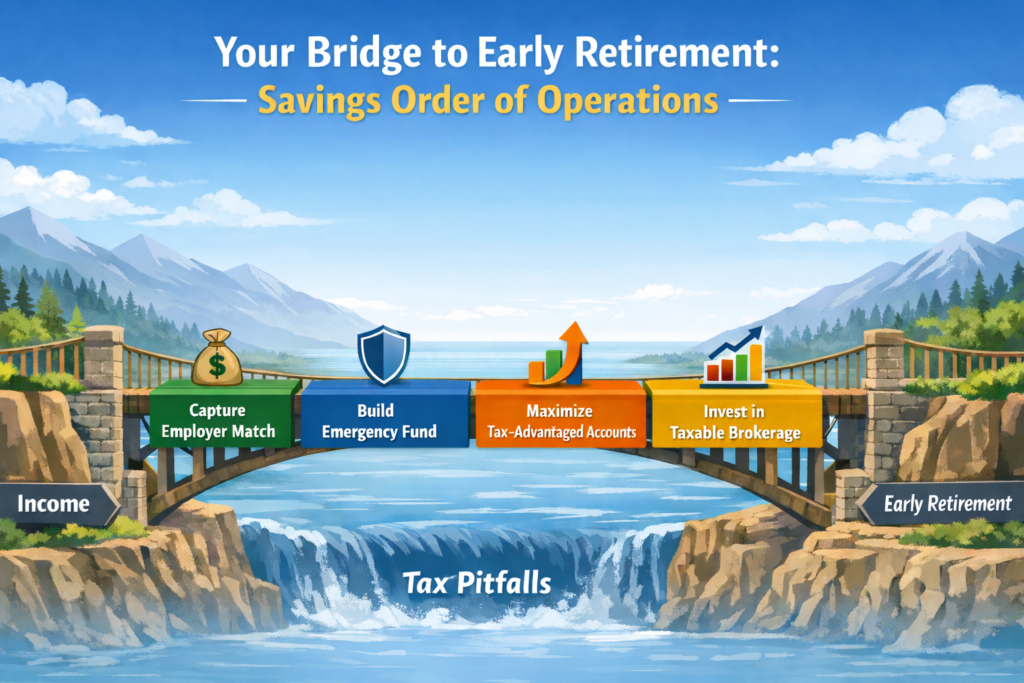
Flow Steps:
- Capture Employer Match (Foundation Plank)
- Contribute enough to your 401(k) or 403(b) to get the full employer match.
- Tax focus: Pre-tax or Roth contributions depending on current tax rate. If you are in a relatively high tax rate now, pre-tax savings will be more attractive.
- Why: You can’t beat free money when building your foundation.
- Build Emergency Fund (Safety Plank)
- Pay down any high-interest debt and build 3–6 months of essential expenses in a high-yield savings account.
- Tax focus: Taxable account; liquidity is priority, not growth.
- Why: Protects your bridge from unexpected shocks like job loss, market dips, or early retirement expenses.
- Maximize Tax-Advantaged Accounts (Growth Plank)
- Roth IRA / Traditional IRA (Backdoor Roth if income limits exceed)
- Mega Backdoor Roth if available in your 401(k)
- HSA contributions
- 529 accounts if education is a goal
- Why: These accounts maximize after-tax growth, shortening your bridge to a tax-free retirement.
- Fill Gaps with Taxable Brokerage Accounts (Flex Plank)
- Invest remaining savings in a taxable brokerage account.
- Tax focus: Long-term capital gains, dividends, and tax-efficient ETFs.
- Why: Provides ultimate flexibility for early withdrawals before age 59 1/2 and supports Roth conversion ladders.
Early Retirement Considerations
I wrote a post about how to access funds before age 59 ½: How Do I Withdraw Before 59 1/2? Guide. My key takeaway from that post is that most people have more options than they realize.
Quickly summarized here:
- Pre-59 1/2: Taxable + Roth conversion ladder + 72(t) distributions
- 59 1/2–65: Full access to Roth + remaining taxable accounts
- 65+: Social Security + Medicare + pre-tax withdrawals
Bridge Tip: The sequence of withdrawals determines how smoothly you cross your bridge.
Key Takeaways
- Start early—tax-efficient growth compounds over decades.
- Don’t just focus on contributions—think about taxes on withdrawals.
- Use HSAs, Backdoor Roths, Mega Backdoor Roths, and 529s to maximize tax-free growth.
- Keep your plan flexible; review annually.
Early retirement isn’t just about saving dollars; it’s about building a financial bridge strong enough to carry you across decades of life, market swings, and tax surprises. By structuring your savings thoughtfully across different account types, you create a flexible and tax-efficient pathway that gives you options, security, and peace of mind.