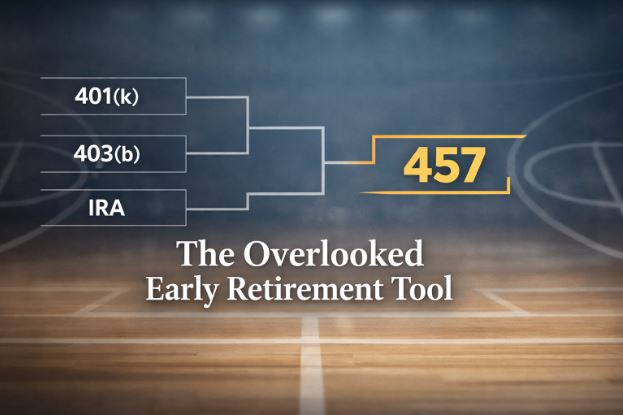

Every March we debate which teams are overrated and which are poised for a Cinderella run.
In the retirement account world, the 457 is the quiet mid-major that deserves a #1 seed.
If you work for a public employer and are even considering early retirement, a 457 plan may be one of the most flexible tools available — yet many employees either ignore it or don’t realize how powerful it can be.
Let’s walk through why.
Why 457 Plans Matter for Early Retirement
1. Penalty-Free Access After Separation
This is the headline feature.
With a governmental 457(b) plan, once you separate from your employer, you can withdraw funds without the 10% early withdrawal penalty — regardless of age.
That’s very different from:
- 401(k)s
- 403(b)s
- Traditional IRAs
Those accounts generally impose a 10% penalty before age 59½ (unless you use structured strategies like 72(t) distributions, which can be rigid and unforgiving).
For someone retiring at 55 — or earlier — this flexibility is enormous. A 457 can function as a built-in early-retirement bridge account.
2. A Separate Contribution Limit
If your employer offers both a 403(b) (or 401(k)) and a 457 plan, the contribution limits are separate. For 2026, that means you could potentially contribute:
- $24,500 to a 403(b) AND
$24,500 to a 457
For a total of $49,000 in tax-deferred savings — before catch-up contributions. For high-saving public employees, this “super-stacking” ability dramatically expands tax-advantaged savings capacity. Many employees don’t realize the limits are separate — and miss the opportunity.
3. Pre-Tax Arbitrage (and Roth Options)
For many public employees, peak earnings occur during their final working years.
A traditional (pre-tax) 457 contribution allows you to deduct contributions at today’s marginal rate, potentially deferring taxation into lower-income early retirement years.
Many plans now offer Roth 457 options as well, providing additional flexibility (Roth 457 funds generally still follow age 59½ distribution rules unless rolled into a Roth IRA after separation.).
The key point: the 457 expands your tax planning toolkit.
Important Caveats: Not All 457 Plans Are the Same
Precision matters here. There are two types of 457(b) plans:
Governmental 457(b) Plans
These are offered by:
- State governments
- Counties
- Cities
- School districts
- Public utilities
- Fire districts
- Ports
- Public hospitals
In these plans:
- Assets are held in trust for employees
- Funds are generally protected from employer creditors
- You can roll the account into an IRA, 401(k), 403(b), or another governmental 457
- Withdrawals after separation are penalty-free
This is the version that makes 457 plans especially attractive for early retirement planning.
Non-Governmental 457(b) Plans
These are typically offered by certain nonprofit organizations (including large hospital systems) and they operate differently.
In many cases:
- Assets are not held in trust
- Funds remain subject to the employer’s creditors
- Distribution schedules may be fixed in advance
- Funds generally cannot be rolled into an IRA (only into another non-governmental 457)
These plans can still be useful, but they carry additional risk and less flexibility.
If you have access to a 457, confirm which type it is.
Other Considerations
Investment Options and Fees
Like any employer-sponsored plan, quality varies.Some 457 plans offer low-cost index funds. Others have higher fees or limited investment menus. In certain public systems, multiple providers are available, making fee comparison especially important.
Forced Distributions
Some non-governmental 457 plans require you to select a distribution schedule at the time of contribution, which can reduce future tax-planning flexibility.
Again, know your plan.
Who Should Pay Attention?
A 457 plan is especially powerful for:
- Public employees considering retirement before 59½
- High savers already maxing a 403(b) or 401(k)
- Workers looking to build a flexible early-retirement bridge
Even if you have a pension, a 457 can complement it by adding liquidity and tax flexibility.
The Takeaway
If you work for a public employer, log into your benefits portal and confirm whether a 457 plan is available. Many employees are surprised to discover they have access to one, and even more surprised to learn how different it is from a 401(k).
For early retirement planning, a governmental 457(b) is one of the most flexible tax-advantaged tools available.
It may not get much attention.
But like a disciplined mid-major in March, the 457 doesn’t need hype to be a #1 seed.
It just needs the right matchup — and an investor who understands how to use it.