

Some people spend a lot of time looking for “secret” ways to reduce their taxes. Many of these strategies are overly aggressive and can get you in trouble with the IRS. The good news is that there are plenty of completely legal, well-understood ways to keep more of your money in retirement. These aren’t hidden loopholes; they are part of the tax code, designed to encourage saving, investing, and smart planning.
Some of these strategies feel almost like a free lunch for early retirees. You can get money or growth without paying taxes at all. Others are not completely free but still offer very good deals if you plan carefully. Understanding the difference can save thousands of dollars over a lifetime and help you build wealth more efficiently.
No Free Lunch… Literally
The phrase comes from 19th-century saloons that offered “free” meals, paid for by higher drink prices. Later, it was used in 1940s politics, popularized by sci-fi author Robert Heinlein (TANSTAAFL), and made famous by economist Milton Friedman to illustrate that nothing comes without a cost.
Tax Free Lunches
Filling the Standard Deduction with Ordinary Income
For 2026, the standard deduction will be $16,100 for single filers or $32,200 for married couples filing jointly. Income up to these amounts is completely tax-free. If you earn a modest salary, work part-time, or take withdrawals from retirement accounts in early retirement, you may not owe any federal income tax on your “ordinary” income. It’s literally free money you earned and is one of the simplest ways to reduce your tax bill.
0% Long-Term Capital Gains and Qualified Dividends
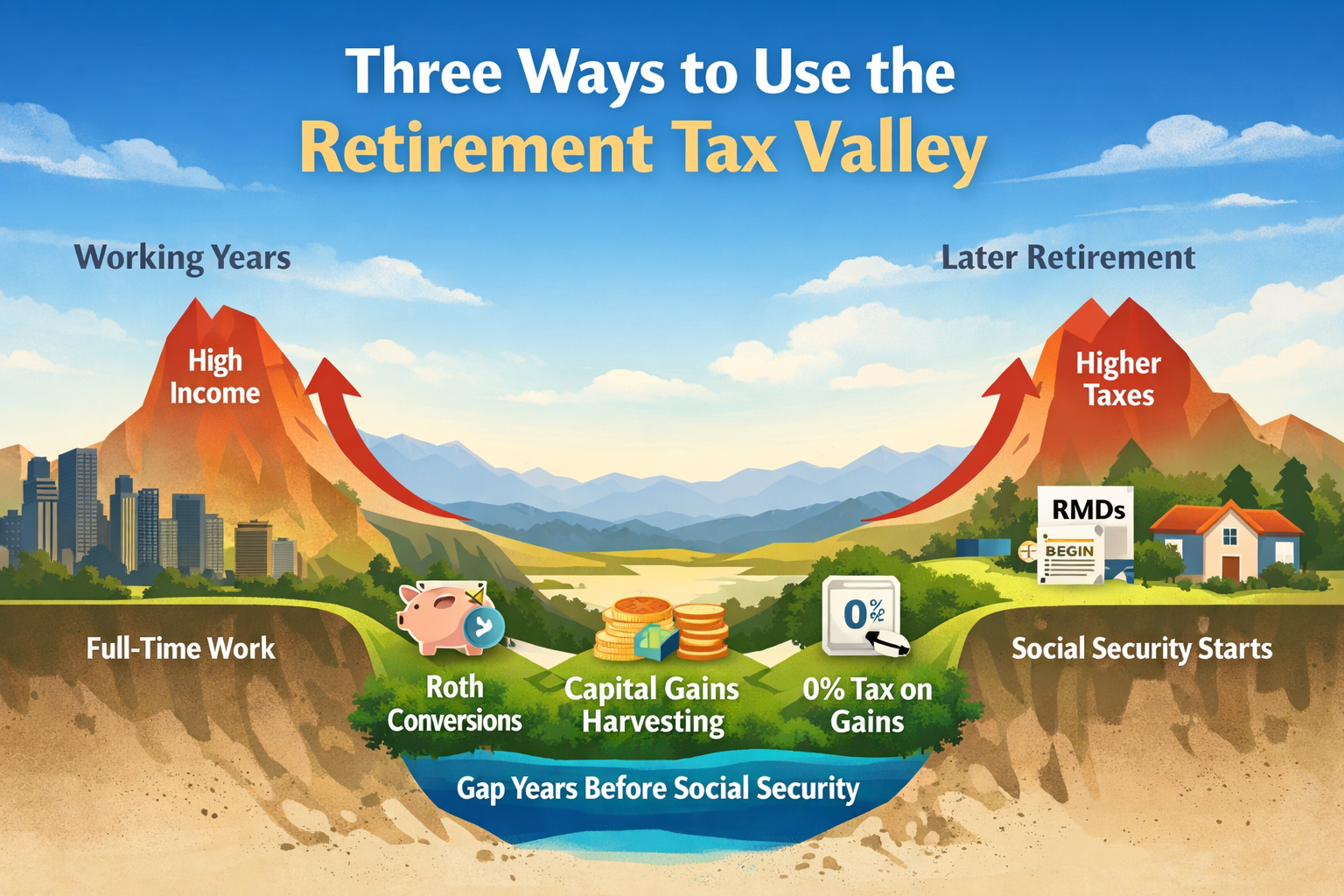
Long-term capital gains and qualified dividends are taxed differently than ordinary income. If your taxable income is below the 0% threshold: $44,625 for single filers or $98,900 for married couples filing jointly in 2026, you can realize long-term gains or receive dividends without paying federal taxes. Taxes only apply to the gains on your sales (not recovery of basis) and you have to have held the security for at least a year.
By combining this with the standard deduction, you can withdraw gains or sell appreciated assets entirely tax-free.
Health Savings Accounts (HSAs)
HSAs are often called triple tax-advantaged accounts. That’s because contributions are pre-tax or deductible, the account grows tax-free, and withdrawals for qualified medical expenses are also tax-free. Employer contributions are even more value added without touching your income. An HSA gives both immediate tax savings and long-term tax-free growth, making it one of the most powerful tools for retirement and healthcare planning.
Flexible Spending Accounts (FSAs)
FSAs allow you to set aside pre-tax money for medical or dependent care expenses. Contributions lower your taxable income and save federal and sometimes state taxes. For predictable annual expenses like a a child’s day care, FSAs can provide meaningful tax savings. Some employers allow funds to carry over or offer a grace period, making it easier to use effectively. But unlike HSAs, you do have to be careful to use the funds in the prescribed time periods.
Roth IRA Contributions at Low-Incomes
Roth IRA contributions are made with after-tax dollars, but all earnings grow tax-free and withdrawals in retirement are also tax-free. If you contribute when your income is low (ex. below the standard deduction), you maximize the benefit. This allows you to set aside money today that grows completely tax-free for decades. Probably the best opportunity for a tax free lunch with IRA contributions is making contributions when a person is in college and working part-time.
Very Good Deals (Not Quite Free)
These strategies reduce your taxes significantly but require timing, planning, or eligibility rules.
Employer Retirement Plan Matching
Employer contributions to retirement accounts like 401(k)s or 403(b)s are essentially free money. Even though withdrawals are taxed later, the combination of immediate contributions and compounding growth makes this one of the most effective ways to grow retirement savings. It will almost always make sense to contribute enough to get the full employer match. The only reason employer matching doesn’t quite meet the free lunch criteria is that you have to contribute some of your own savings to capture it.
Saver’s Credit
You can almost think of the Saver’s credit as the equivalent of a government match for low-to moderate-income taxpayers who contribute to retirement accounts, and taxpayers can qualify for a credit up to 50% of contributions (up to $1k for single and $2k for joint filers). This credit reduces taxes owed directly, not just taxable income, making it a valuable incentive to save for retirement.
Roth Conversions in Low-Income Years
If you have a year with unusually low income, converting traditional IRA or 401(k) funds to a Roth can minimize taxes owed on the conversion. You pay taxes now at a lower rate in exchange for future tax-free withdrawals, which can significantly reduce lifetime taxes.
Backdoor Roth IRAs
For high earners who exceed Roth IRA income limits, a backdoor Roth allows you to contribute to a non-deductible traditional account and then immediately convert it to a Roth. This provides access to tax-free growth and withdrawals legally, making it a powerful strategy to maximize retirement savings. There are some very specific rules to watch out for, which I’ll write about in a future blog post.
Harvesting Capital Losses
Selling investments at a loss can offset gains from other investments or up to $3,000 of ordinary income each year (the remainder can carry forward to future years). This strategy reduces your tax bill and can improve investment efficiency, especially when combined with low-income strategies for realizing gains tax-free.
Special Section: Last Lunch
Here’s one tax strategy that’s technically free, but there’s a BIG catch: you have to die to get it. While that might not sound cheerful, it is incredibly important for estate and investment planning.
When your heirs inherit your assets, their cost basis steps up to the market value at the time of your death. This means heirs can sell stocks or other appreciated assets without paying capital gains taxes on growth that happened during your lifetime. Decades of investment growth can transfer tax-free.
This is very different from traditional IRAs or 401(k)s, which pass to heirs as ordinary income and are fully taxable when withdrawn. It also highlights why asset allocation and account location matter. Holding growth stocks in taxable accounts rather than tax-deferred retirement accounts can be more efficient for passing wealth on because your heirs benefit from the stepped-up basis.
Think of it as the ultimate free lunch—or the “Last Lunch.” You don’t pay taxes on decades of growth, your heirs get the full benefit, and all you have to do is live your life (and die).
Bottom Line
Some tax strategies feel like a true free lunch, including the standard deduction, 0% long-term gains, HSAs, and Roth contributions at low-incomes. Others, such as employer matching, the Saver’s credit, FSAs, Roth conversions, backdoor Roths, and harvesting capital losses, are not technically free but are exceptionally good deals worth planning around. The stepped-up basis aka our Last Lunch is a special, once-in-a-lifetime opportunity to pass on wealth in a tax efficient way.
Understanding these differences can help you make smarter financial decisions, reduce taxes over a lifetime, and maximize your wealth-building potential.