
They say death and taxes are the only certainties in life. Taxes, it turns out, are lying.
The tax code changes constantly, and for early retirees who have built careful plans around today’s rules, that’s worth paying attention to. I recently finished Tax Planning To and Through Early Retirement by Cody Garrett, CFP and Sean Mullaney, CPA. It’s excellent. The authors make a compelling case that the tax code generally treats retirement income favorably, and that lawmakers will be reluctant to hurt retirees given their numbers and voting habits. (Retirees vote. A lot. Politicians know this.)
I found their arguments persuasive. but I also think we shouldn’t assume the rules stay frozen forever. Given large national deficits and historically low tax rates, it’s worth looking at what’s changed recently and what might change next.
This is not a partisan piece about tax policy. If you want my unvarnished opinion on that, send me an email. I’ll tell you exactly what I think.
Looking Back: The Rules That Made Early Retirement Possible
Many of the strategies early retirees rely on today didn’t exist a generation ago. Here’s a quick rundown of the greatest hits:
Roth IRAs (1997): Tax-free growth and withdrawals. High earners were initially phased out, which later opened the door to backdoor Roths. I like to brag that I was an OG Roth contributor, making my first $2,000 contribution in 1998 with internship earnings. The account has grown considerably since then. The brag has not.
Health Savings Accounts (2003): Triple tax-advantaged savings for healthcare expenses, bankable across years.
Low long-term capital gains and dividend rates (2003 and later): Established favorable rates on investment income, including 0% for lower brackets.
Backdoor Roth IRAs (2010): Allowed high earners to contribute to a nondeductible Traditional IRA and convert it to a Roth. Tax-free growth, made widely accessible.
Delayed RMDs (SECURE and SECURE 2.0 Acts, 2019 and beyond): More flexibility in withdrawals and tax planning across retirement.
Permanent Lower Tax Rates (TCJA, 2025 OBBBA): Low income tax brackets, larger standard deductions, and favorable treatment of pass-through income.
ACA premium tax credits (2014): Subsidized health coverage before Medicare eligibility, which for early retirees can be worth thousands per year.
Together, these rules make early retirement far more feasible than it was for previous generations. Roth conversions, tax-efficient investing, and affordable pre-Medicare coverage are all features of the current landscape, not accidents.
A Few Wrinkles Worth Knowing
Not every rule favors early retirees, and some benefits are temporary or not indexed for inflation:
SALT deduction: Temporarily higher through 2029, then reverting to $10,000 in 2030. If you live in a high-tax state, mark your calendar.
Net Investment Income Tax (3.8%) and Additional Medicare Tax (0.9%): The thresholds for these are not inflation-adjusted. Portfolio growth alone could push you into them over time, even if your lifestyle hasn’t changed.
New Senior Deduction: Temporary through 2028.
These aren’t reasons to panic. They’re reasons to know your plan.
What Could Change and Why It Matters
This is where I’m speculating, and I’ll own that. But a few areas deserve attention because early retirees tend to rely on them heavily.
ACA Premium Tax Credits: Probably the biggest one. Subsidies can reduce healthcare costs by thousands or even tens of thousands per year before Medicare kicks in. Many early retirement plans are built around managing income to maximize these credits. Any significant changes here would ripple through a lot of carefully built plans.
0% Long-Term Capital Gains: Plenty of strategies depend on staying in this bracket. If that rate changes or the income threshold tightens, it’s disruptive in a very concrete way.
HSA Receipt Banking: The ability to reimburse yourself years after an expense is an underappreciated superpower. There have been proposals to limit that window to one or two years. Worth watching.
Social Security Taxation: Right now, up to 85% of benefits are taxable. It’s not hard to imagine that percentage increasing for higher earners over time, which would effectively be a tax increase on retirees who planned carefully.
Estate Tax Exemption: The current federal exemption is very high, around $15 million per person. This was made permanent, but “permanent” in tax law just means it’s not currently set to expire. That’s a lower bar than it sounds.
Takeaways for Early Retirees
Core advantages remain strong. Roth IRAs, backdoor Roths, favorable capital gains rates, delayed RMDs, and current tax brackets still make early retirement very achievable. Nothing here is meant to scare you out of the plan.
Use temporary opportunities while they last. Higher SALT caps and the new senior deduction are worth taking advantage of now rather than assuming they’ll stick around.
Scenario planning beats prediction. You don’t need to guess the future. Run a few stress tests. What does your plan look like if your effective tax rate is 15 to 20 percent higher? If it still works, you’re in good shape.
Capture what’s real today. Near-term credits and planning opportunities are concrete. Future risks are uncertain. Act on what’s in front of you.
A Practical Way to Think About It
Many people already discount their Social Security estimates by 20 to 30 percent just to be conservative. A similar instinct makes sense to me for taxes. Assuming today’s rates last forever is an optimistic bet, not a plan.
I also lean toward capturing opportunities that exist now rather than overthinking what might happen in 30 years. If a tax credit or planning strategy is available today, take it.
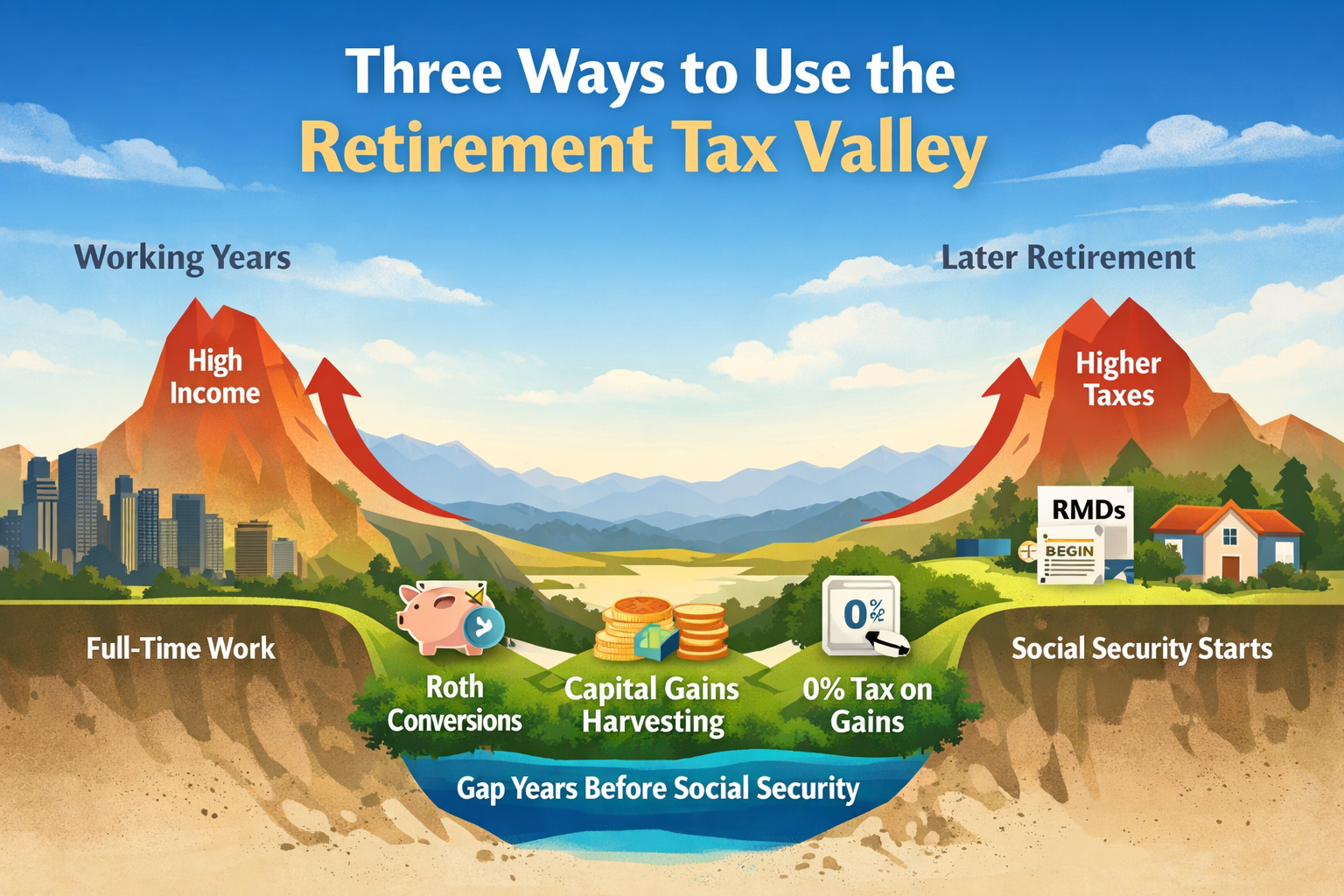
Here’s a real example of the tension: an early retiree at 45 might be deciding whether to take a premium tax credit today or forgo it to do Roth conversions to reduce RMDs at 75. The right answer depends on the specifics, but unless your pre-tax balances are exceptionally large, the credit today usually wins. RMDs mainly become a problem when accounts are very large, which is a sign that things have gone pretty well.
But please don’t get paralyzed by what the tax code might look like decades from now. Stay aware, keep up with changes, and adjust when it makes sense. The uncertainty is real, but it’s manageable. Understanding the rules and acting on today’s opportunities turns uncertainty into an advantage.
Bottom Line
The tax environment for early retirees is genuinely good right now. That’s not an accident, and it’s not guaranteed to last forever. The smart move is to use what’s available, stay flexible, and not build a plan so rigid that a single rule change breaks it.
Death is certain. Taxes are certain. The exact shape of those taxes 20 years from now is less clear. Plan accordingly.