
Part 1 Breaking down Tax Drag in a Portfolio
Every “three-fund portfolio” investor has heard the standard advice: put your bonds in pre-tax, stocks in Roth, and hold whatever is left in your taxable brokerage account. It is good tax planning advice, and I’ve seen some general research (ex. Vanguard Article) justifying tax-aware asset location strategies.
However I haven’t seen anyone try to quantify the benefit using a model portfolio where they showed their work, so I thought I would put the general advice to the test.
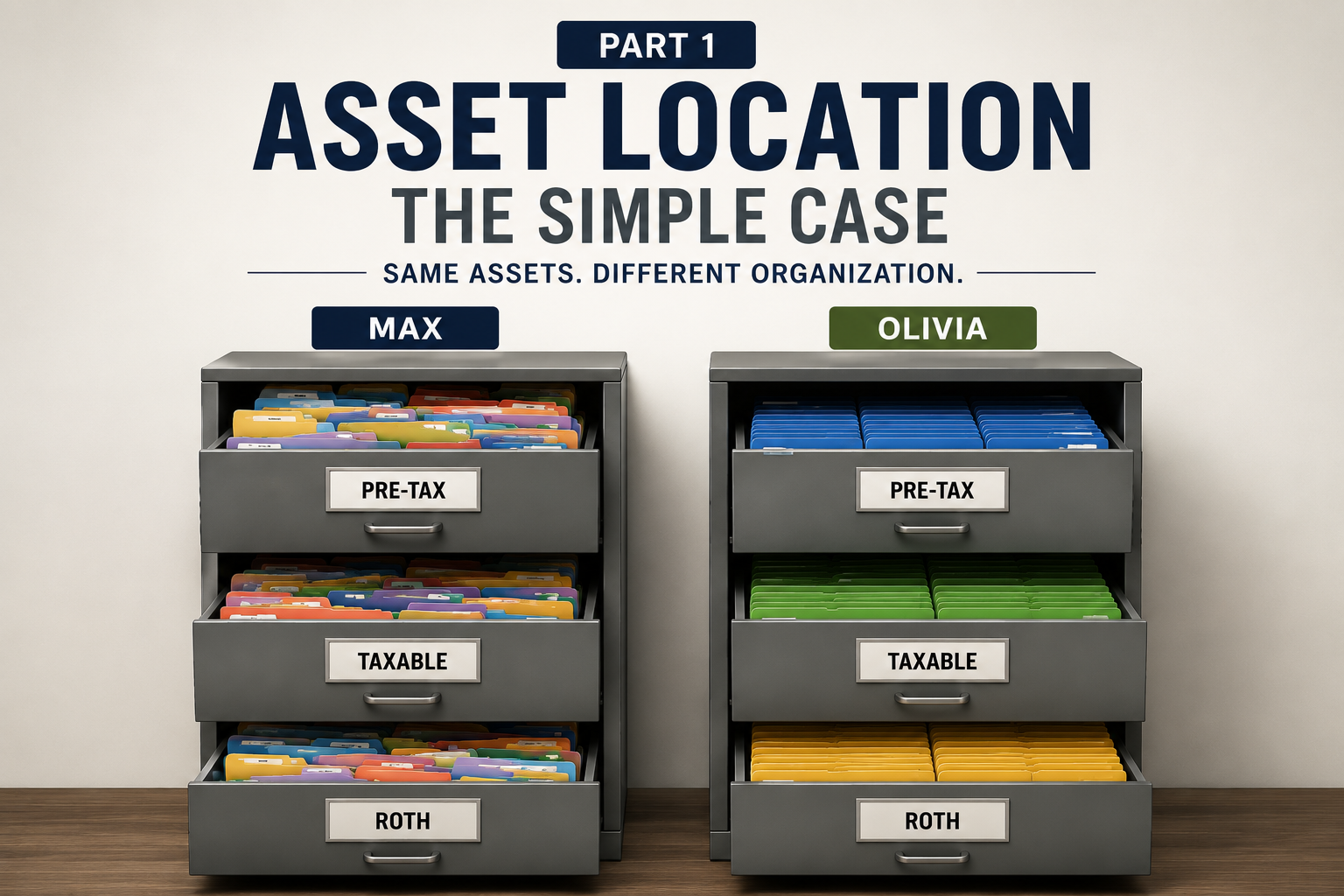
Two Investors, One Key Difference
To see the math in action, let’s look at two investors: Max and Olivia.
They are the same age, share the same $500,000 portfolio, target the same 70/30 asset allocation in stocks/bonds, and sit in the same 24% federal tax bracket. Even their money is split identically across the exact same account types: $350,000 in pre-tax (401k/IRA), $100,000 in a taxable brokerage account, and $50,000 in a Roth IRA.
Their portfolios look identical on paper, but they manage them with completely different philosophies.
Max is a mirror investor. He keeps a 70% stock and 30% bond split inside every single account. Stocks and bonds are everywhere. This is the default setup for anyone who mirrors their target allocation across accounts, or simply buys a Target Date Fund in their taxable brokerage.
Olivia is an optimizer. She looks at her wealth as one unified portfolio. She places her entire $150,000 bond allocation inside her pre-tax account, leaving her taxable and Roth accounts to hold nothing but equities.
This distinction is crucial: both portfolios hold the exact same dollar amounts of stocks ($350,000) and bonds ($150,000). To isolate the pure impact of asset organization, let’s look at a simple 20-year model with zero new contributions.
The Annual Tax Drag
In Max’s taxable account, two things trigger an annual tax bill. First, stock dividends are hit with a 15% long-term capital gains tax. Olivia suffers from this dividend drag, too.
Second, and more importantly, bond interest is taxed as ordinary income. In the 24% tax bracket, Max’s $30,000 taxable bond allocation paying 4.5% costs $324 in taxes in the first year. That is money leaving the portfolio forever, never to compound. Olivia avoids this bond interest bill entirely.
| Year | Max’s Tax Drag | Olivia’s Tax Drag | Annual Savings |
| 1 | $482 | $225 | $257 |
| 5 | $569 | $266 | $303 |
| 10 | $684 | $320 | $364 |
| 15 | $822 | $384 | $438 |
| 20 | $987 | $461 | $526 |
Year one savings amount to $257 on a $500,000 portfolio. At just 0.05%, it’s roughly the difference between a 0.04% and a 0.09% expense ratio between two mutual funds. It’s real, but hardly alarming. Over 20 years, however, those cumulative savings add up to $5,720.
The Portfolio Gap at Year 20
When we look at the raw balances after two decades, you do notice some other differences.
| Account | Max | Olivia | Difference |
| Pre-tax | $1,510,234 | $1,449,876 | ($60,358) |
| Taxable | $383,412 | $416,244 | +$32,832 |
| Roth | $209,886 | $251,516 | +$41,630 |
| Total Gross | $2,103,532 | $2,117,636 | +$14,104 |
Max’s pre-tax account is larger because it held more stocks, and stocks outgrow bonds. Conversely, Olivia’s taxable and Roth accounts are larger because bonds were kept out of them. Olivia’s gross gap of $14,104 is higher than the $5,720 in raw tax savings because those early savings compounded over time.
But gross numbers don’t tell the whole story. To find out what this is worth in the real world, we can hypothesize drawing from both portfolios at realistic retirement tax rates: 22% on pre-tax withdrawals, 15% on taxable gains, and 0% on Roth. Because Olivia’s taxable account grew larger, it triggers a bigger capital gains bill at withdrawal, but those will be drawn at favorable capital gains rates. More importantly, her post-tax Roth is larger also. Here is a look at the true, after-tax reality:
| Account (After Tax) | Max | Olivia | Difference |
| Pre-tax (After 22%) | $1,178,000 | $1,130,900 | ($47,100) |
| Taxable (After 15% LTCG) | $345,400 | $372,100 | +$26,700 |
| Roth (Tax-free) | $209,886 | $251,516 | +$41,630 |
| Total After-Tax | $1,733,286 | $1,754,516 | +$21,230 |
Max and Olivia had the save asset allocation and the same risk, but Olivia retires with $21,230 more to spend. The only difference was account organization.
Is This a Big Deal?
In the grand scheme of personal finance? Not compared to the heavy hitters!
- Switching from a 0.50% expense ratio fund to a 0.04% fund on this same portfolio saves $2,300 per year—nearly three times the annual benefit of optimized asset location.
- Saving just $5,000 more per year compounds to roughly $340,000 over 20 years.
Asset location sits firmly below all of those levers. But here is the catch: it doesn’t cost anything to set up, and the benefits scale. If you increase your savings rate, you increase the benefit from tax-efficient savings.
Looking Ahead: In Part 2, we model 25 years of continuous annual contributions across all three account types. In that scenario, the after-tax gap is significantly larger.
For early retirees, the account mix question goes deeper than just tax drag. Check out The Three-Legged Stool to see how pre-tax, Roth, and taxable accounts behave once the paychecks stop.