
Congratulations! You hit your FIRE accumulation goal. Whether that’s $1 million, $2.5 million, or $5 million, that is a big accomplishment, and one to be celebrated. But now what? How do you actually access this money, and in what order?
That’s what this post is all about.
The standard advice for drawing down a retirement portfolio is relatively straightforward. Most planners recommend spending your taxable brokerage accounts first, then your traditional pre-tax accounts, and touching your Roth accounts last. For a traditional retirement starting in your mid-sixties, this is usually a solid plan. It keeps your tax-advantaged money compounding and pushes required minimum distributions down the road.
However, if you are retiring early, this sequence is rarely sufficient on its own.
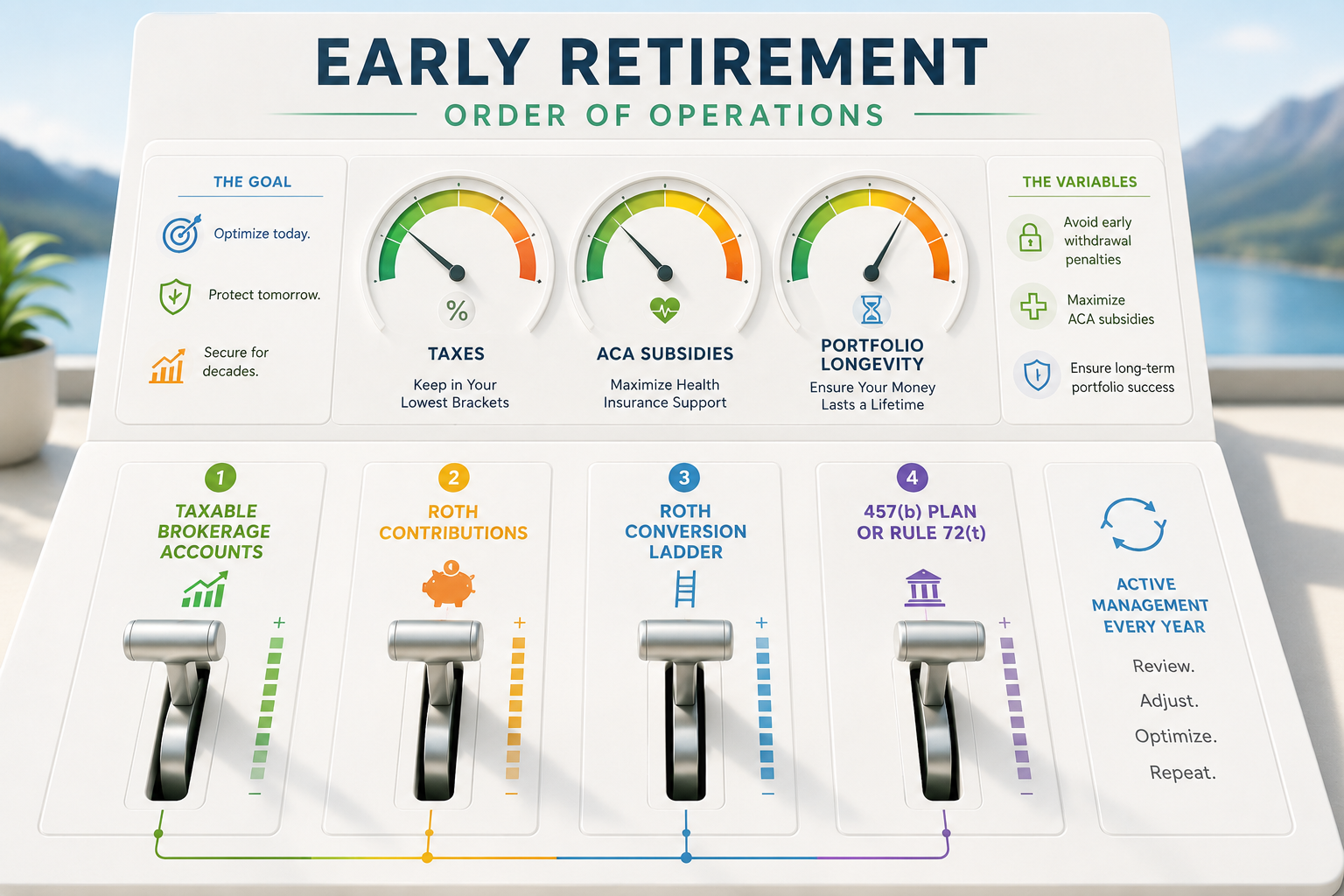
Early retirement requires navigating challenges that traditional retirees do not face. When you stop working in your 40’s or early 50’s, your drawdown strategy has to solve for three distinct variables simultaneously:
- Managing (ideally avoiding) early withdrawal penalties;
- Optimizing income for Affordable Care Act (ACA) health insurance subsidies; and
- Ensuring your portfolio can sustain a retirement that could last four decades.
To address all three variables, you need a withdrawal sequence designed specifically for the bridge years before age 59 1/2.
The Variables: Access and Managing MAGI
In a traditional retirement, withdrawals are mostly about cash flow and direct tax efficiency. In an early retirement, withdrawals are more complex, because where and how you access funds dictates your Modified Adjusted Gross Income (MAGI). In the bridge years before Medicare eligibility, your MAGI determines your eligibility for premium tax credits that can dramatically lower your healthcare costs. If you have children heading to college, that same income level impacts financial aid formulas.
If you follow the standard advice and drain your taxable brokerage account to zero while leaving your pre-tax accounts alone, you are missing out on filling your lower tax brackets with ordinary income and, worse, you might leave yourself without the liquidity needed to fund long-term tax-shifting strategies like Roth conversion ladders.
Your withdrawal plan needs to balance these competing priorities.
1.Taxable Brokerage Accounts
Your taxable brokerage account serves as the foundational source of cash flow in the initial years of early retirement. Because there are no age restrictions or early withdrawal penalties, these funds are immediately accessible.
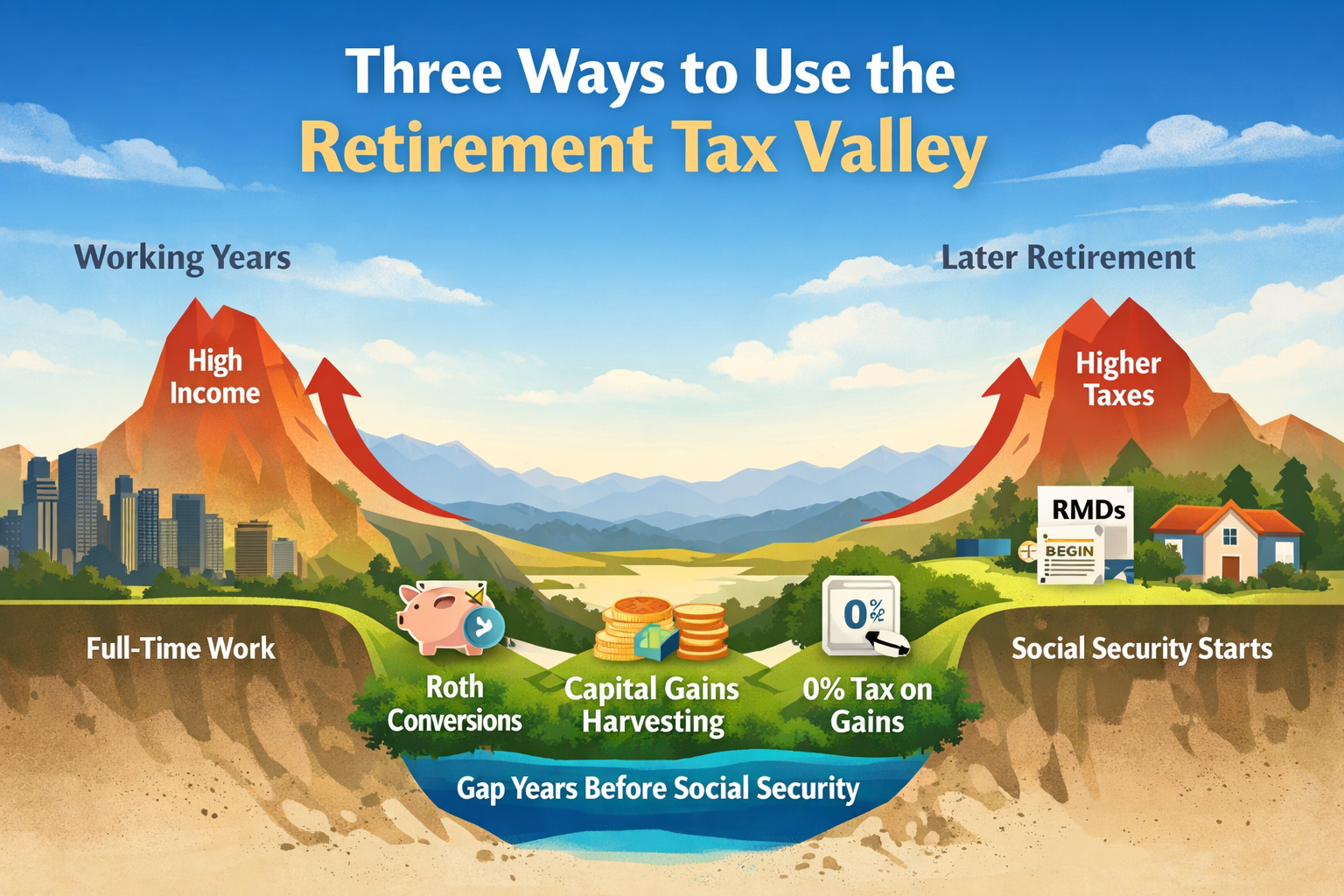
The primary benefit here is how the income is structured. When you sell an investment in a brokerage account, you are only taxed on the capital gains, not the principal you originally invested. Furthermore, if you manage your total income effectively, long-term capital gains can fall into the 0% federal tax bracket.
This account allows you to generate baseline spending money with minimal impact on your taxable income, though it should not be used entirely in isolation.
2. Roth IRA Contributions
Your original Roth IRA contributions can be withdrawn at any time, for any reason, completely free of taxes and penalties. It is important to distinguish between contributions and earnings. The growth in the account must stay locked away until 59 1/2 to avoid penalties, but the principal you contributed over the years is accessible immediately.
Accumulated Roth contributions represent a highly flexible pool of money. Because these withdrawals do not add to your MAGI, you can use them alongside your brokerage account distributions to fine-tune your precise taxable income for the year.
3. The Roth Conversion Ladder
A Roth conversion ladder allows you to move money from a traditional IRA or 401k into a Roth IRA, making it accessible penalty-free five years after the conversion. Because of that five-year waiting period, early retirees often need to start building the ladder in the first years of retirement.
Every year, you convert a calculated slice of your pre-tax money into a Roth IRA. You pay ordinary income taxes on the amount you convert today, and five years later, that specific amount becomes accessible principal. The goal is to size this conversion so that it fills your lowest tax brackets while keeping your total income below the threshold where you lose valuable health insurance subsidies.
4. Specialized Tools: 457(b) Plans and Rule 72(t)
If your portfolio does not have enough weight in standard brokerage accounts or Roth contributions to fund the five-year waiting period for a Roth ladder, you have to look at specialized exceptions to the early withdrawal rules.
If you worked in public service or for a non-profit and have a governmental 457(b) plan, this account is uniquely useful. Unlike a 401k, a governmental 457(b) allows for penalty-free withdrawals the moment you separate from your employer, regardless of your age.
Alternatively, you can consider Substantially Equal Periodic Payments under Rule 72(t). This rule allows you to take penalty-free distributions from a traditional IRA at any age, provided you commit to a strictly calculated distribution schedule for five years or until you turn fifty-nine and a half, whichever is longer.
Active Drawdown: A Yearly Exercise
The most fundamental shift between the accumulation phase and early retirement is that you can no longer simply “set-and-forget” your strategy. During your working years, automation is an advantage. In retirement, withdrawal becomes an active, annual customization exercise. That doesn’t mean it needs to be a burdensome or stressful process, but it does take some ongoing planning and maintenance.
Because you are pulling from a mix of taxable, tax-deferred, and tax-free buckets, every dollar you choose to move changes your financial architecture that year. You might pull fifty thousand dollars from your brokerage account to cover your living expenses, but only a portion of that amount consists of taxable capital gains. To maximize your 0% capital gains bracket or to hit a specific target for ACA credits, you can then intentionally convert thirty thousand dollars from your traditional IRA to a Roth IRA.
Through this coordination, you meet your spending needs, utilize your lowest tax brackets, and fund the next rung of your Roth ladder without exposing yourself to a massive tax hit. Early retirement planning is ultimately about maintaining this year-by-year flexibility and making intentional adjustments before the calendar year locks. For a deeper look at how to run these numbers and track your targets before December 31, see my guide on Annual Retirement Tax Planning.
Summary
Reaching the starting line of early retirement is a huge milestone, but switching from an accumulation mindset to one focused on distribution requires a new set of skills. By using a flexible order of operations, balancing your taxable brokerage, leveraging accessible Roth principal, and methodically funding a conversion ladder, you transform your portfolio from a collection of separate accounts into a single, coordinated income stream.
The path out of the workforce isn’t about finding a single formula to run on autopilot, but about giving yourself the tools and the options to control your financial timeline year-by-year.