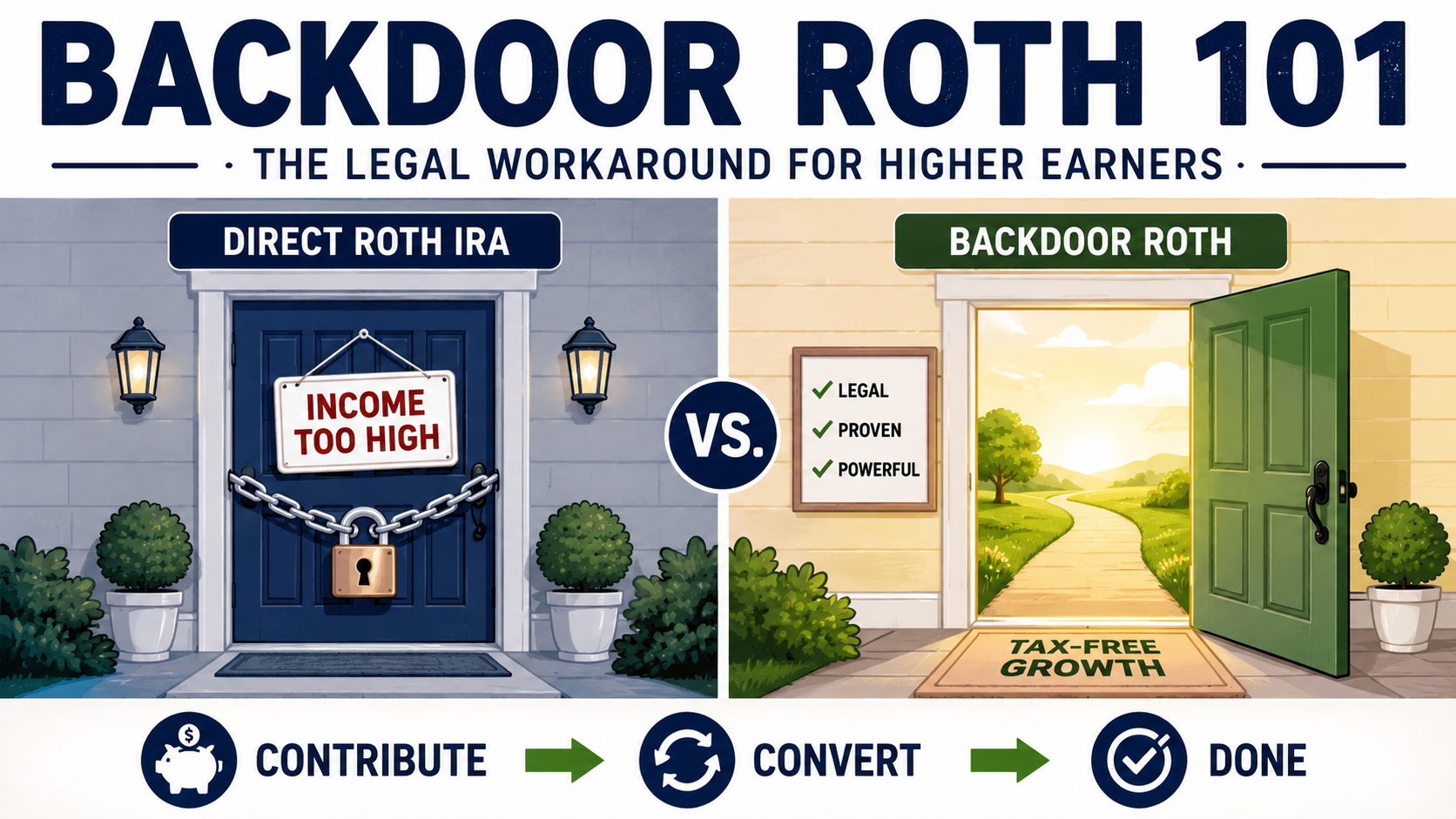

You may have noticed you make too much money to contribute to a deductible traditional IRA or a Roth IRA. Those are the two traditional front doors into individual tax-advantaged retirement accounts, and the IRS locks both of them once your income crosses a certain line.
Here’s what the income limits are for 2026:
| Account | Filing Status | Full Contribution Below | Phased Out Between | No Contribution Above |
| Roth IRA | Single / HOH | $153,000 | $153,000–$168,000 | $168,000 |
| Roth IRA | Married Filing Jointly | $242,000 | $242,000–$252,000 | $252,000 |
| Traditional IRA (deduction), covered by a workplace plan | Single / HOH | $81,000 | $81,000–$91,000 | $91,000 |
| Traditional IRA (deduction), covered by a workplace plan | Married Filing Jointly | $129,000 | $129,000–$149,000 | $149,000 |
| Traditional IRA (deduction), spouse covered but you’re not | Married Filing Jointly | $242,000 | $242,000–$252,000 | $252,000 |
If you cross above these income limits you’re locked out of a direct Roth contribution and locked out of deducting a traditional IRA contribution.
However, there’s a workaround that’s been available since 2010. You are still able to contribute to a traditional IRA without taking the deduction, since a nondeductible contribution has no income limit. You then immediately convert that traditional nondeductible IRA to a Roth. Because you never deducted the contribution, there’s no tax due on the conversion. The only exception is if the money earned something between the contribution and the conversion, in which case you owe ordinary income tax on that growth and nothing else.
That’s the backdoor Roth. It’s two moves that can be stitched together to get you somewhere the direct route won’t.
This Is Different From a Roth Conversion Ladder
If you’ve read my guide to Roth conversion ladders, you already know the mechanics of converting a traditional account to Roth. The difference here is what’s inside the account before you convert it.
A conversion ladder moves money that was deducted going in, pre-tax dollars sitting in a 401(k) or traditional IRA. Every dollar you convert is taxable income in the year you convert it, because you got a deduction on the way in and now the IRS wants its cut on the way out.
A backdoor Roth contribution starts with money that was never deducted. You already paid tax on it before it went into the traditional nondeductible IRA. Converting it doesn’t create a second tax bill, because there’s no deduction to claw back. The only thing that gets taxed is whatever the account earned while it briefly sat there.
One catch: if you already have pre-tax money sitting in other IRAs, the IRS doesn’t let you cherry-pick which dollars you’re converting. More on that later. It’s called the pro-rata rule and it’s the whole reason this post has a “where it breaks” section.
Wait, Is This Actually Legal?
Fair question! If Congress capped who can contribute to a Roth based on income, why is a two-step version of the exact same outcome okay?
Here’s the history: a 2005 law called the Tax Increase Prevention and Reconciliation Act (TIPRA) repealed the income limit on Roth conversions, effective 2010. Congress didn’t necessarily want to hand high earners a contribution loophole. They did it because removing the conversion limit meant a wave of high earners would convert existing pre-tax balances and pay tax on all of it right away, which looked great on the federal budget ten-year revenue score. The backdoor contribution strategy is a side effect of that change; once conversions had no income limit and nondeductible contributions never had one, the two-step move became available.
Since then the IRS has clarified that no waiting period is required between the contribution and the conversion. There has been proposed legislation to close the backdoor loophole as recently as 2021 but it has never passed. So as sketchy as the backdoor process might feel, it isn’t a gray area you’re gambling on.
Where It Breaks: The Pro-Rata Rule
Here’s the catch I flagged earlier, and it’s the single most common way people blow up an otherwise clean backdoor Roth.
If you have any pre-tax money sitting in a traditional IRA, SEP IRA, or SIMPLE IRA at year-end, the IRS doesn’t let you convert only the after-tax dollars you just contributed. Instead, it treats every conversion as a proportional blend of pre-tax and after-tax money across all your IRAs combined, not just the account you funded this year.
Let’s say you had previously rolled over $50,000 from an old 401(k) into a traditional IRA, all of it pre-tax. Then you contribute $7,500 to a non-deductible IRA and try to convert just that $7,500 to Roth, expecting a tax-free move. The IRS looks at your total IRA balance, $57,500, and sees that only 13% of it is after-tax basis. Convert $7,500 and roughly $6,525 of it counts as taxable pre-tax money, even though you meant to convert only the new after-tax contribution. You end up paying tax on most of a conversion you thought would cost you nothing.
The fix, if you have access to it, is to roll that pre-tax IRA balance into a current employer’s 401(k) before doing the backdoor move, assuming the plan accepts incoming rollovers. That zeroes out your pre-tax IRA balance the pro-rata rule looks at, which clears the way for a clean backdoor contribution going forward.
One more catch: don’t forget to file IRS Form 8606 (Nondeductible IRAs) with your taxes the year you make the contribution! The number one mistake for people doing a backdoor roth is they forget this step or inadvertently make a deductible IRA traditional contribution. Doing this incorrectly can be a real pain to unwind, so if you are having someone else preparing your taxes, look for that Form 8606 when you sign your return, and if you’re doing your taxes yourself, make sure you note that you made a nondeductible IRA contribution.
Enter the Mega Backdoor
Once you’ve got the backdoor Roth mechanics down, the mega backdoor is the same move with more money at stake. Instead of working with the $7,500 IRA contribution limit, you’re working with the gap between what you can defer into a 401(k) and what the plan can legally hold in total.
For 2026, the employee deferral limit into a 401(k) is $24,500. The total combined limit, employee deferrals plus employer contributions plus after-tax contributions, caps at $72,000 under IRC Section 415(c) (more if you are over 50). That space between $24,500 and $72,000 is the room the mega backdoor uses.
The mechanics are similar to the IRA version. You contribute after-tax dollars into your 401(k), on top of your regular deferral, up to that combined ceiling. Then you convert those specific dollars to Roth, either through an in-plan conversion or by rolling them out to a Roth IRA. No deduction was taken on the way in, so no tax is due on the way out, aside from any growth before the conversion happens.
The catch is that not all plans offer this. You need two specific features:
- After-tax contributions allowed above the standard employee deferral limit; and
- In-service withdrawals or in-plan Roth conversions, so you can actually move that after-tax money to Roth instead of it sitting there as after-tax basis forever.
If you’re interested in a mega backdoor you should check your retirement plan’s Summary Plan Description or just ask HR directly whether both of these are available. If either one is missing, the mega backdoor isn’t an option.
Should You Actually Do This?
If you make too much money for a direct Roth contribution and you’re clear of the pro-rata rule, there’s no reason not to do a backdoor Roth. Put more plainly: you should do a backdoor Roth. Your contributions come back out tax-free and penalty-free whenever you want them, the growth compounds tax-free, and qualified withdrawals in retirement owe nothing.
The mega backdoor has a bigger impact for a smaller audience of mostly very high earners whose plans support it. But if your plan has the features and the extra contribution fits your budget, it’s one of the most efficient ways available to supercharge your Roth balance. The mega backdoor can hand you tens of thousands more into a tax-free bucket, for the cost of a form and a phone call to your plan administrator.