
When you are deep in the accumulation phase, building an early retirement plan feels like an optimization math puzzle. You look for the perfect answer to every variable: the highest possible risk-adjusted return, the optimal tax-saving strategy, and the minimum amount of cash sitting idle dragging down your returns.
But once you actually step away from your paycheck, it might feel like the game changes. You quickly realize that spreadsheets do not account for human emotion.
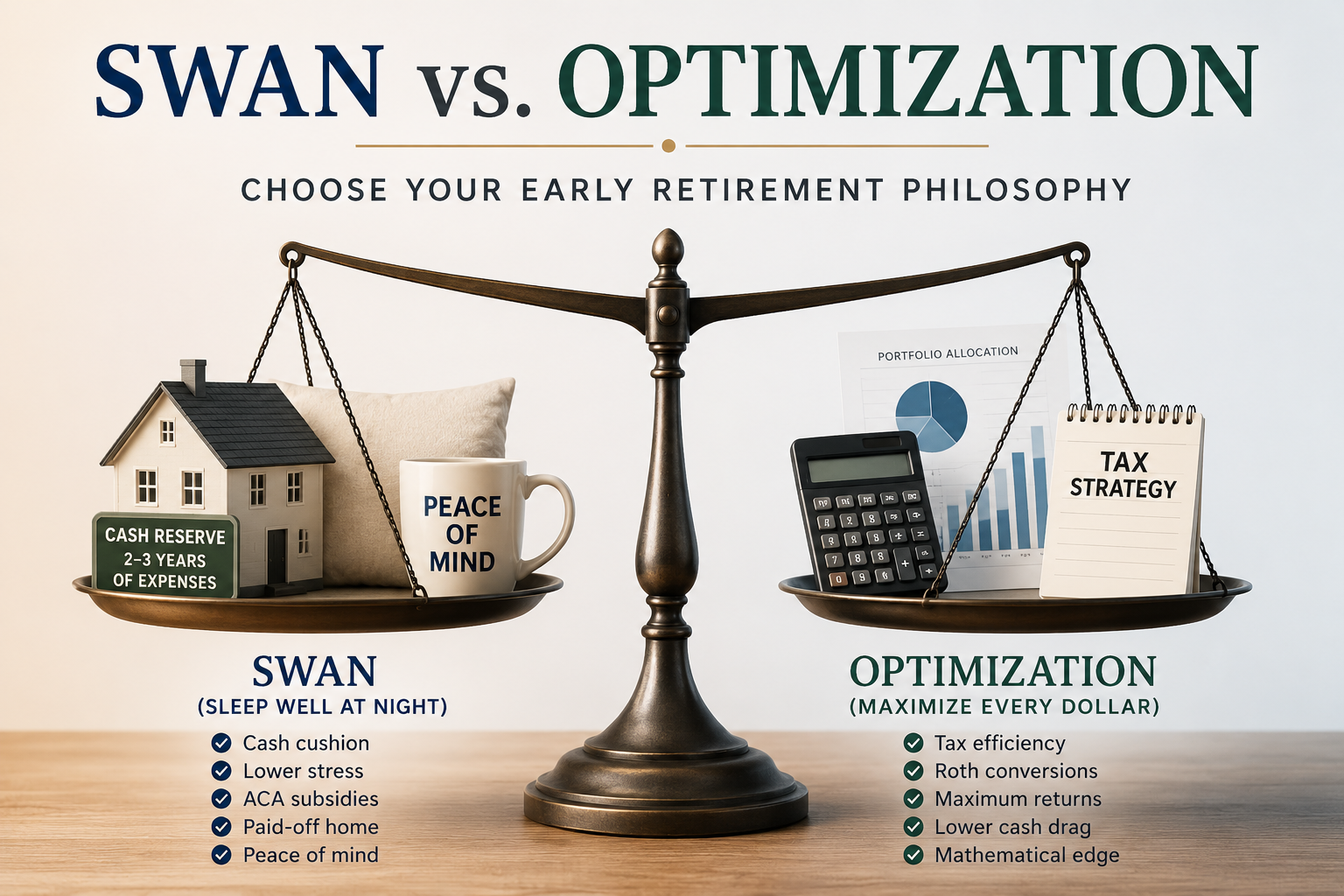
In early retirement, you will constantly face a choice between two competing financial philosophies: Optimization (maximizing every single dollar based based on mathematical analysis) and SWAN (Sleep Well At Night), which means prioritizing psychological comfort and peace of mind.
Neither approach is wrong, but trying to live in the middle of them can cause some friction. To build a sustainable drawdown strategy, you need to consciously choose which philosophy rules your decisions. Here are some examples of how these two mindsets clash across four common retirement crossroads.
1. Cash Reserves: Drag vs. Ballast
- The Optimization View: Holding large amounts of cash or short-term bills is a drag on your long-term compounding. Math dictates that you should keep your cash cushion as small as possible, perhaps just a few months of expenses, and leave the rest of your wealth fully invested in stocks, bonds, and other investments.
- The SWAN View: You maintain a large cash buffer, perhaps two to three years of living expenses, sitting safely in a high-yield savings account or money market fund. Even though inflation eats away at this money over time, knowing you can survive a multi-year market crash without touching a single share of stock eliminates daily anxiety.
2. Tax Planning: Maxing Roth Conversions vs. Guarding Subsidies
- The Optimization View: You aggressively execute traditional-to-Roth IRA conversions during your early retirement window. You intentionally fill up the 12% or 22% ordinary income brackets, even if it means voluntarily driving up your MAGI, blowing past the ACA subsidy cliff, and paying full price for health insurance today so that you can save taxes on large future Required Minimum Distributions (RMDs) down the road.
- The SWAN View: You intentionally hold off on heavy Roth conversions. Your primary goal is to keep your reportable income low to secure maximum ACA healthcare subsidies and keep your Safe Withdrawal Rate (SWR) low today. You prefer the immediate certainty of a lower monthly household budget over a theoretical tax savings decades into the future.
3. College Funding: The 529 Account Target
- The Optimization View: You fund a 529 college savings account to the exact dollar estimated by a Net Price Calculator. If your child qualifies for financial aid, you optimize the asset location so it doesn’t penalize your Student Aid Index (SAI). You avoid overfunding the account because you don’t want to risk trapped capital or penalty taxes on non-qualified withdrawals.
- The SWAN View: You deliberately save extra in the 529 accounts. You want to know with absolute certainty that the cost of tuition, housing, and books is covered regardless of what happens to the stock market or financial aid policy. If you end up with leftover money, you are entirely comfortable letting it compound, utilizing a Roth IRA rollover later, or saving for a different qualifying family member.
See: Saving for College When You’re Planning Early Retirement for more information
4. Housing: The Paid-Off Mortgage
- The Optimization View: If you have a legacy mortgage with a historically low interest rate (like 3%), keeping that debt alive can be a smart arbitrage play. Rather than paying it off early, you keep the cash invested in broad market index funds or even safe Treasury bills yielding 4% or 5%, pocketing the spread.
- The SWAN View: You pay the mortgage off entirely before you retire. Eliminating a large fixed-cost line item drastically drops your baseline monthly spending needs. From a pure math perspective, it might be sub-optimal, but emotionally, entering retirement with a 100% debt-free shelter provides psychological security.
Which Philosophy Is Yours?
| Decision | The Optimization Choice | The SWAN Choice |
| Cash Cushion | Minimal; maximum funds invested | 2 to 3 years of spending liquid |
| Tax vs. ACA | Maximize Roth conversions now | Maximize ACA subsidies today |
| College Savings | Targeted precisely to avoid overfunding | Risk oversaving to guarantee costs are covered |
| The Mortgage | Hold low-interest debt; invest the cash | Pay it off early for $0 balance |
There is an invisible tax to pay on both sides of the coin. Optimization can work for some people who love the details and the “correct” answer. SWAN-focused thinkers might value simplicity and a bit more certainly. You should also be open to the idea that your mindset will likely change over time.
The key to a successful retirement is knowing yourself well enough to pick the approach that works for you and that you are able to maintain for the long-term.