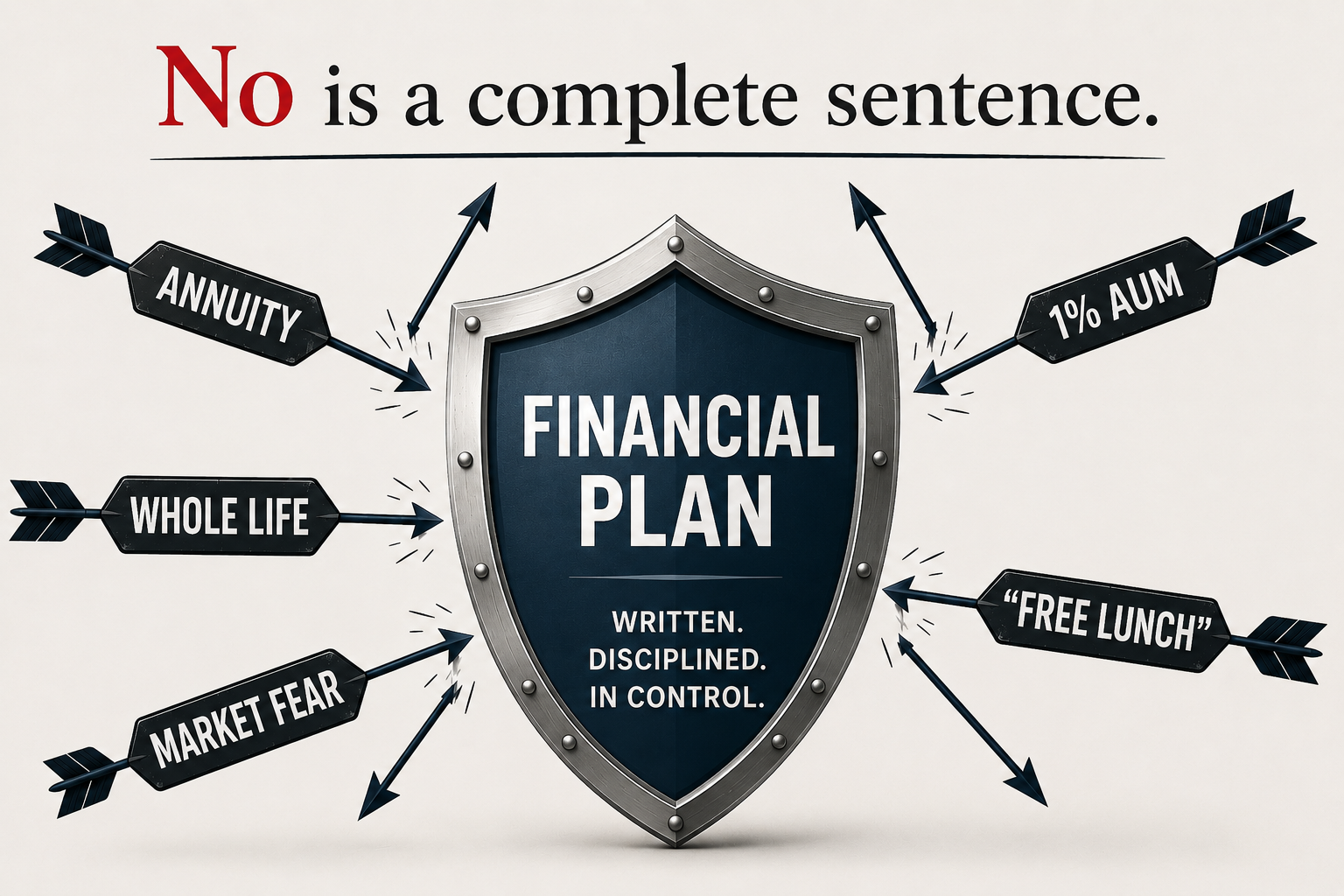

When people talk about financial literacy, they often immediately get into the mechanics and math of saving and investing. We learn how to compound interest, how to open an IRA, and how to track a budget. But there is a huge hole in standard financial education: nobody teaches you how to play defense.
No one sits you down in a classroom, roleplays a high-pressure pitch from a wealth manager, and teaches you how to look them in the eye and say, “No.”
When you are building wealth you often find yourself managing relationships with financial professionals whose business models rely on extracting small slices of your wealth. To survive with your savings intact, you have to realize that “No” is a complete sentence.
The Most Consequential 1% of Your Life
When you walk onto a car lot, your guard is up. You expect the hustle, so you’re on the lookout for upsells and high fee add-ons like extended warranties. But when you walk into a plush office, greeted by a charming financial advisor, your guard drops. They aren’t selling a rusty sedan; they are offering “peace of mind.”
Because the industry wraps itself in the language of caretaking, we gloss over the structural friction. We hear “1% fee” and think it sounds small, reasonable, and harmless.But let’s look at the actual math of a 1% Assets Under Management (AUM) fee.
Imagine you’ve built a $2.5 million nest egg and plan to retire using a standard 4% Safe Withdrawal Rate. That gives you an annual retirement budget of $100,000.
If you hand that portfolio over to a 1% AUM advisor, their fee isn’t a minor line item. It is $25,000 every single year.
That means the advisor is capturing one-quarter (25%) of your annual retirement spend. You are taking 100% of the market risk, while they take a guaranteed $25,000 cut of your lifestyle. The same extraction math applies to the complexity of whole life insurance policies or variable annuities; they are high-fee products that can siphon away your annual cash flow.
To defend yourself, you can start by asking one foundational question: “How is this person paid?”
The Reality of a 1% AUM Fee
- Your Portolio: $2,500,000
- Annual Living Budget (4% SWR): $100,000
- The Advisor’s 1% Annual Fee: $25,000
The Bottom Line: You take 100% of the market risk, but a 1% fee hands 25% of your annual retirement paycheck to an advisor every single year.
How You’ll Be Pitched: The Scripts to Watch For
Financial professionals rarely pitch you by asking for a $25,000 cut of your retirement check. Instead, they rely on sophisticated psychological hooks. This isn’t a secret; there are literally training seminars that financial professionals attend to learn these scripts. If you hear these lines, your defensive shield should immediately go up:
- The Complexity Hook: “Your situation is getting unique. With your asset level, you really need to look at specialized strategies like variable annuities or whole life insurance to protect against taxes.”
- The Reality: They are selling complexity because complexity hides fees. The perverse truth is that these products often produce less tax-efficient outcomes. By wrapping your investments in these vehicles, you frequently strip away highly favorable long-term capital gains tax rates and convert your future withdrawals into ordinary income tax rates. You pay higher fees for what can be a worse tax bill.
- The Fear Pitch (The “Don’t Do This Alone” Angle): “The markets are entering an unprecedented period of volatility. What’s your plan when the next crash hits? We act as your emotional circuit breaker.”
- The Reality: They are manufacturing a dependency. You don’t need to hand over a quarter of your annual retirement spend for an “emotional circuit breaker.” What you actually need is an Investment Policy Statement (IPS). A written IPS is your personal constitution, written when your head is clear, that dictates exactly how your money is allocated and how you will react during a downturn. When you have a written plan, you don’t need to buy discipline from a salesperson. (If you haven’t built yours yet, check out our guide on how to draft an IPS.
- The Relationship Obligation:“Let’s grab lunch and look over your old 401(k). I can easily transfer that over to our platform and manage it seamlessly for you.”
- The Reality: They want to trigger the law of reciprocity. By doing you a “favor” or buying you a meal, they make it incredibly awkward for you to say no to the stack of transfer paperwork later.
Out of Sight, Out of Mind: The Opaque Fee Illusion
One of the reasons people tolerate these fees is that they can be opaque.
If your advisor sent you an invoice every January for $25,000, and you had to log into your bank account, pull money from your checking account, and physically write a check for twenty-five grand, you would feel sick. You would immediately question the value you were getting for that money.
The industry knows this. That’s why the system is designed to keep fees out-of-sight:
- The Frictionless Deduction: AUM fees are quietly and automatically deducted from your investment accounts in quarterly or monthly increments. Because you never see the cash leave your hands, it just feels like a minor fluctuation on a balance sheet you rarely look at.
- Embedded Commissions: With products like annuities or whole life insurance, you don’t “pay” a fee at all. Instead, commissions are baked directly into the internal mechanics of the product, dragging down your underlying returns from day one.
Because you never have to actively pay the bill, it doesn’t feel real. But your portfolio feels it.
Don’t Let Stubbornness Cost You Good Advice
Playing defense doesn’t mean building a wall of pure, unyielding stubbornness. There is a big difference between being defensive and being uncoachable.
Good financial advice is incredibly valuable. Navigating complex tax optimization, structuring a Roth conversion ladder, or planning a multi-decade withdrawal strategy can save you six figures. You shouldn’t let a fear of bad actors stop you from getting expert help when your situation genuinely requires it.
The key is knowing the difference between a financial salesperson and someone selling advice.
When you need advice, seek out professionals who don’t have a structural incentive to target your assets. Look for flat-fee, hourly, or advice-only planners. You pay them for their time and their blueprints, just like an accountant or an attorney, and your portfolio stays entirely under your control.
Practicing the Financial “No”
Just like the car-buying experience, playing financial defense requires practice. You don’t owe anyone an elaborate justification. You don’t need to explain your modern portfolio theory strategy or defend your preference for low-cost index funds.
When a pro pitches a complex annuity, an aggressive life policy, or an ongoing AUM relationship, you only need one tool in your kit. Practice it now: clear, direct, and without apology:
“Thank you for the information, but no.”
It’s your money, your timeline, and your retirement. Don’t let polite compliance fund someone else’s bridge to financial freedom.