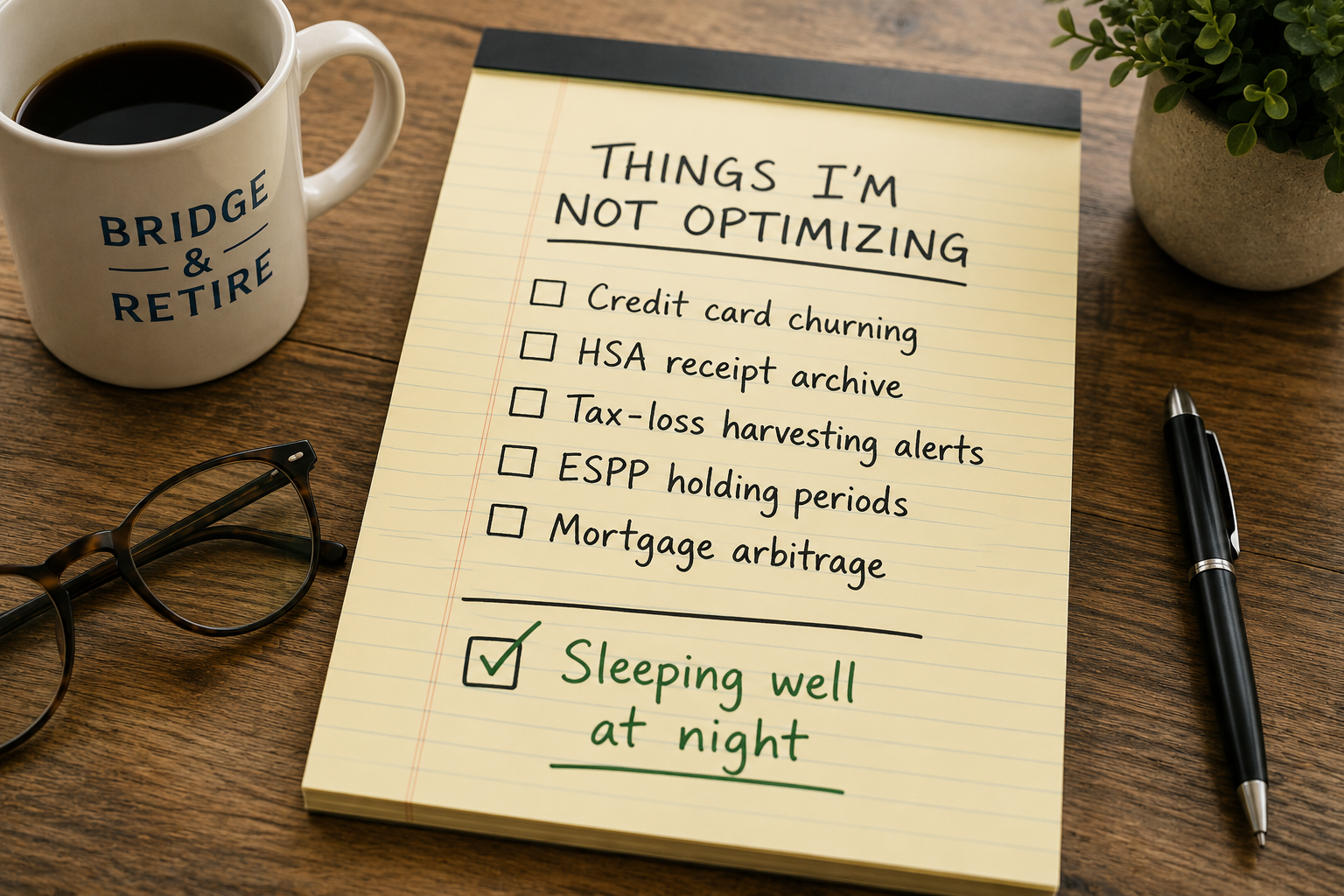

In a recent post, I wrote about how people pursuing early retirement constantly face a choice between two competing financial philosophies: Optimization (maximizing every single dollar based on mathematical analysis) and SWAN (Sleep Well At Night), which means prioritizing psychological comfort and peace of mind.
Balance is definitely required. If an investment strategy makes perfect sense on paper but keeps you awake staring at the ceiling at 2:00 a.m., it’s a bad strategy for you. Sleeping well isn’t just about what you choose to do with your portfolio; it’s also about what you consciously choose not to do.
In the personal finance and FIRE communities, optimization is often treated like a competitive sport. There is an endless supply of spreadsheets, calculators, and strategies designed to help you squeeze every last dollar out of your investments and through tax savings. At some point, everyone has to decide where they draw the line with optimization. I am the first to admit that the choices I make aren’t all mathematically “logical” on paper. If you run the numbers, I am leaving money on the table.
But I haven’t pursued Financial Independence to pinch every penny; I did it for my own present and future happiness and sanity. Because ultimately, happiness and sanity are what FIRE is supposed to be about. If a financial strategy gives you an extra fraction of a percent in returns but costs you your peace of mind or creates a logistical chore out of your weekends, you aren’t winning; you’re working a second job you didn’t apply for.
In the interest of transparency, here are five examples of things I consciously choose not to optimize, ordered from the least serious daily hassles to the biggest financial trade-offs. Some of these are simply about avoiding administrative headaches. Others involve giving up real money in exchange for peace of mind.
5. Credit Card Churning and Point Maximization
I’ll admit I’ve gone down some internet rabbit holes to find out how people are going on elaborate “free” trips using travel rewards. I understand that some people open 10 or more new credit cards every year, route all their daily spending to hit minimum sign-up bonuses, and track rotating categories.
For me, it sounds like a constant, nagging mental load. Tracking renewal deadlines to cancel cards before a hefty annual fee hits, or worrying about letting monthly “coupon-book” statement credits expire because I forgot to use them, sounds exhausting. Instead, I’ve stuck to a simple 2% cash-back card so I don’t have to think about whether Amex or Chase is running a special 5X points promotion at Walmart this month.
4. Banking Lifetime HSA Receipts
The FIRE community loves HSAs for their “triple tax advantage.” And so do I! I’ve written a couple of posts about HSAs and even built a calculator showing their power.
FIRE aficionados also know that the absolute peak-efficiency play for a Health Savings Account (HSA) is to pay all medical expenses out of pocket, digitally archive every receipt from a doctor’s visit or pharmacy, and let the HSA compound completely untouched. Then, decades later, you can do massive tax-free reimbursements when it becomes optimal to cash out.
But managing a multi-decade digital filing cabinet of old pharmacy receipts feels like a logistical nightmare. This one is purely about hassle rather than risk, although there has been some discussion in Congress about closing the banked-receipts loophole. For now, I tend to save in my HSA, periodically reimburse myself as I go, and move on with my life.
3. Micromanaged Portfolio Rebalancing and Tax-Loss Harvesting
For tax-loss harvesting, the standard advice is to check your brokerage accounts regularly so you can harvest losses when they occur. I don’t tend to bother with that level of regular monitoring. Instead, I check my taxable brokerage account at the end of the year to look for any losses.
Because I invest primarily in broad-market index funds rather than individual stocks, I rarely have isolated winners and losers anyway. Most years, the market as a whole either went up or down.
Beyond the hassle of regular monitoring, I am a big believer in Charlie Munger’s philosophy of “sitting on your ass” investing. There is a classic investing adage often shared by long-term investors (sometimes credited to Nobel Laureate Eugene Fama): “Your portfolio is like a bar of soap. The more you handle it, the smaller it gets.”
Constantly logging in to fix minor variances introduces tracking errors, tax drag, and the behavioral risk of tinkering at exactly the wrong time. Setting wide rebalancing bands (like 5% or 10%) and checking things just once a year keeps my hands off the soap.
2. Holding ESPP Shares for Tax-Timing Perfection
Employee Stock Purchase Programs allow you to buy your employer’s stock at a discount. If you hold your company stock for a full year after the purchase date, you can often pay taxes at the long-term capital gains rate, saving a few percentage points.
When I previously had access to an employee stock purchase plan, I always sold the stock the first day I could, even though it triggered short-term capital gains. My feeling was that I already received 100% of my salary and livelihood from my employer, and keeping additional investments in the stock doubled down on single-company risk.
I chose immediate diversification over tax optimization, and if I made investment recommendations here (I don’t!), I’d encourage people to avoid letting the tax tail wag the dog.
1. Paying Off the Mortgage Early
Now we’re getting to a hot-button FIRE topic.
This almost feels like a confession.
My name is George, and a few years ago I decided to pay off my mortgage early, even though the math said I probably should have invested the money in the stock market instead.
If your mortgage interest rate is comparatively low, like mine was, keeping that cash invested in the market will usually come out ahead. Any spreadsheet using “normal” long-term market returns will tell you that you should hang onto that debt for as long as humanly possible.
Why did I make the decision? Because the idea of having no mortgage was incredibly appealing.
Lowering my baseline expenses provided a psychological buffer that a brokerage account balance simply couldn’t match. And honestly, it felt amazing when I got the reconveyance in the mail. I don’t think I’ve ever been so excited to receive a recorded document.
For me, knowing my housing is completely secure is the ultimate sleep-well-at-night dividend.
Whew… it feels good to get all of that off my chest.
In a future post, I’ll share my top five list of optimizations that I absolutely think are worth the effort.