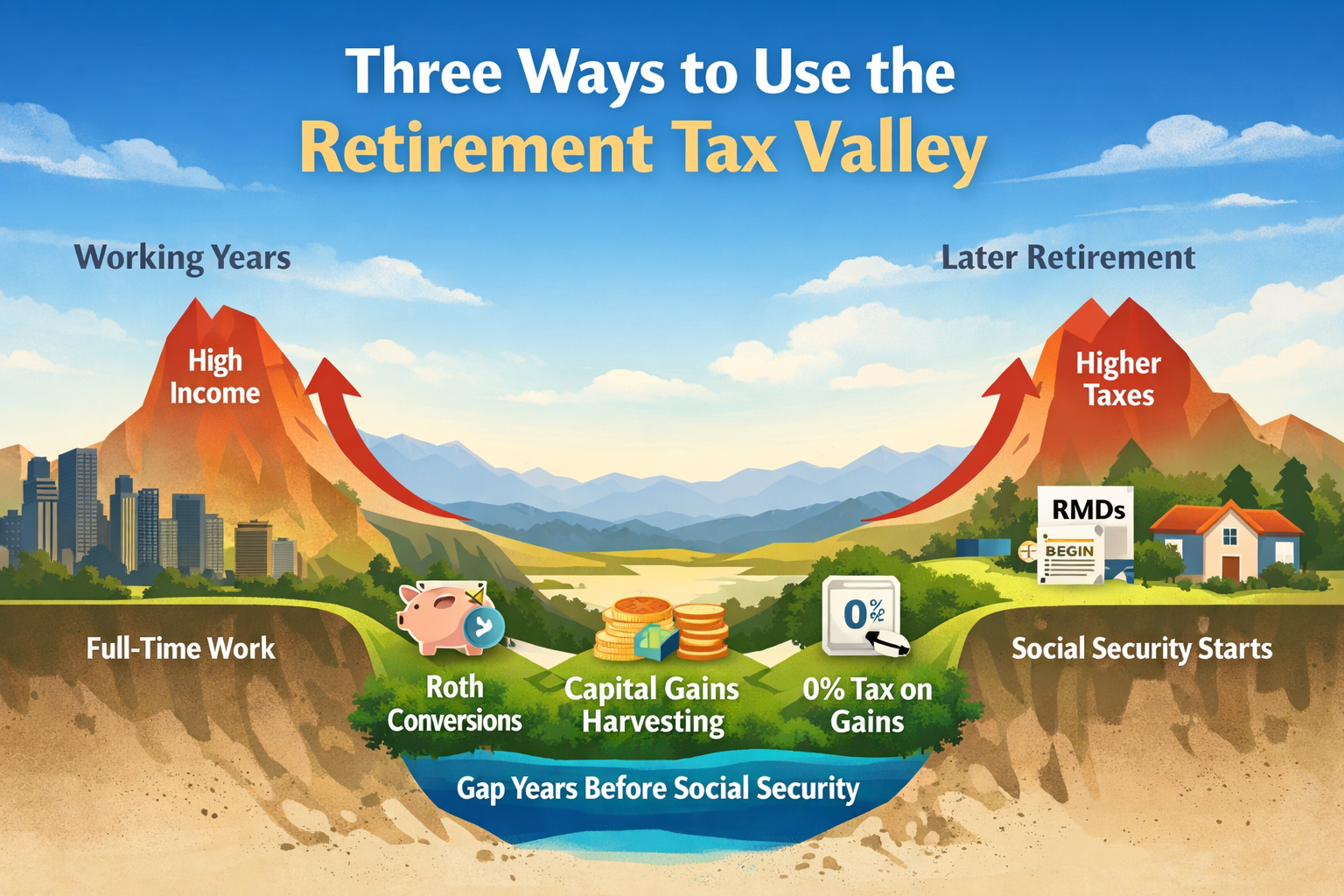

In prior posts I’ve written about the advantage of tax diversification, meaning that you have a mix of traditional pre-tax, after-tax (Roth), and brokerage accounts. The upshot of tax diversification for early retirement is that you get to control how and when your income is recognized.
As a great thinker once said, “With great power comes great responsibility.” For early retirement that means that since you’re in control of your income, you have to make smart choices, because a large misplaced trade or poorly timed withdrawal can inadvertently impact your healthcare costs or tax plan for the year.
To run a successful drawdown strategy, you should not wait until your taxes are due in April. The real planning season occurs in the final quarter of the year.
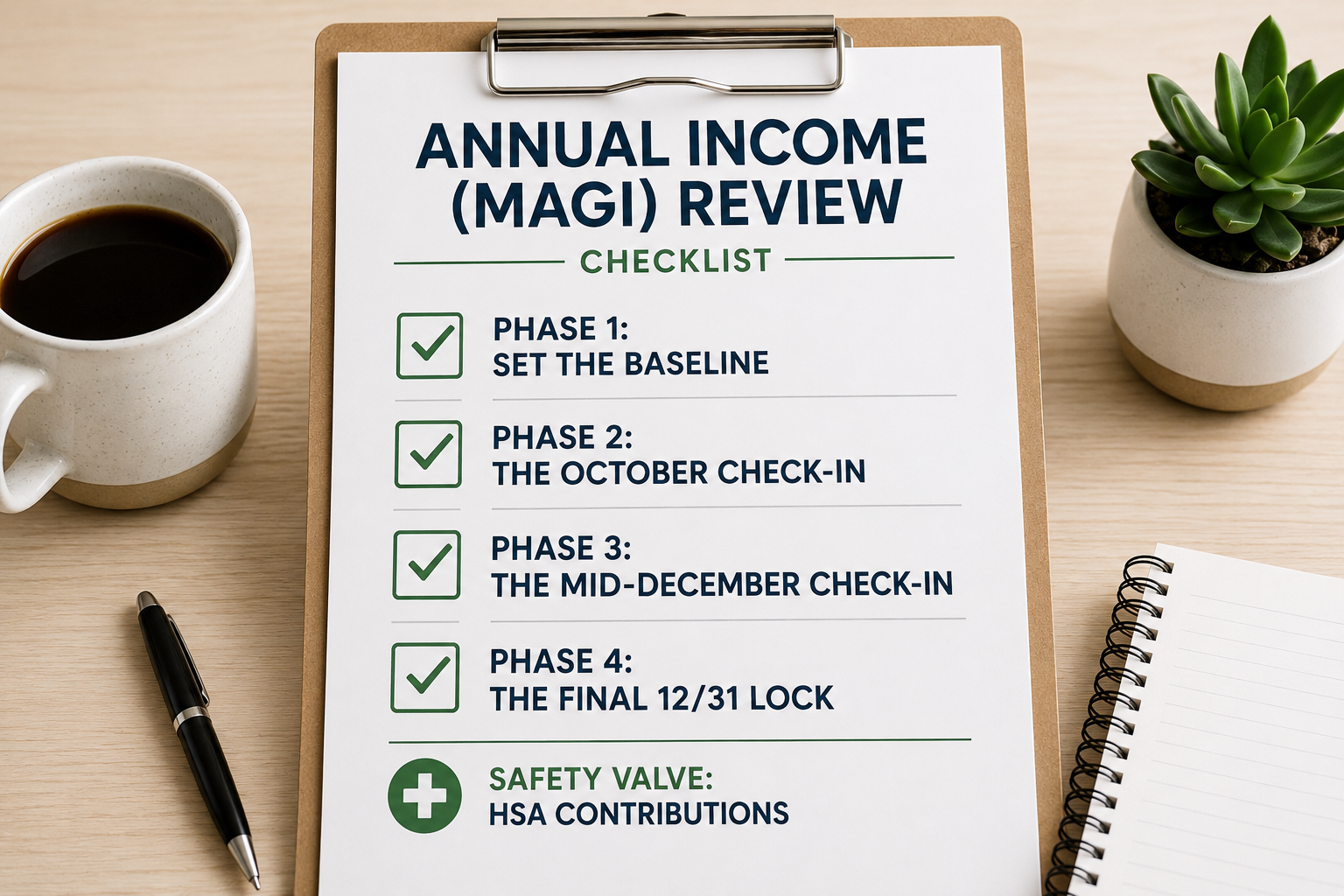
Use this chronological, phase-by-phase checklist to map out your target numbers, balance your portfolio, and hit your income goals with precision.
Phase 1: Set the Baseline (January – September)
The foundational work happens early. Before making any mid-year adjustments, establish your guardrails.
☐ Identify your target income ceiling: This could be staying within a specific tax bracket boundary or under the hard 400% Federal Poverty Level (FPL) health insurance subsidy cutoff.
☐ Estimate your standard living expenses: Project the actual cash needed to fund your lifestyle for the year. Remember, total cash spent does not equal reportable income; pulling from cash savings or taxable brokerage basis gives you spending power without inflating your taxable income.
☐ Monitor routine portfolio activity: Keep a running tally of any early-year asset sales, part-time work, or fixed income streams that have already locked in baseline reportable income.
Phase 2: The October Check-In (October 1 – October 31)
October is the official start of your planning season. This is where you gather your actual data and measure your remaining space.
☐ Calculate unchangeable baseline income: Log into your accounts and tally all locked-in income sources year-to-date. This includes interest from high-yield savings accounts, real estate income, and realized capital gains.
☐ Review projected year-end interest income: High-yield savings accounts, CDs, Treasury bills, and money market funds often generate more interest than expected. Estimate the remainder of the year’s interest income so it doesn’t become a surprise source of MAGI.
☐ Estimate upcoming qualified distributions: Look up the historical payment schedules for your index funds and ETFs. Most pay out their primary dividends and capital gains distributions in mid-December. If your holdings are relatively stable, you can estimate these numbers based on last year’s totals to prevent a late-year surprise.
☐ Calculate your available runway: Subtract your baseline income and estimated December distributions from your target income ceiling (from Phase 1). The remaining amount is your open runway for realizing any extra income to meet your annual income plan.
Example: If your target ceiling is $84,600 and your estimated baseline income is $55,000, you have $29,600 of open runway to utilize.
Phase 3: The Mid-December Check-In (December 1 – December 15)
With your exact runway calculated, look for ways to optimize your investments.
☐ Review final mutual fund distribution updates: In early December, fund companies publish their official estimated year-end capital gains distributions. Check your specific holdings and update your baseline math.
☐ Harvest tax losses defensively: Scan your taxable brokerage account for underperforming assets. Deliberately selling positions at a loss allows you to offset capital gains and lower your taxable income.
☐ Fill the remaining runway offensively: Intentionally generate income up to your target ceiling using the most valuable long-term tool for your strategy:
- Roth Conversions: Move a specific dollar amount from pre-tax traditional IRAs into tax-free Roth IRAs to fill up lower tax brackets.
- Capital Gains Harvesting: Sell appreciated shares in your taxable account to permanently reset your cost basis at the 0% long-term capital gains tax rate.
Leave a safety buffer: Regardless of which tool you use, do not fill your runway down to the exact dollar. Leaving a $2,000 to $4,000 buffer creates a cushion against unexpected final dividend adjustments, especially if you are closely managing an ACA cliff threshold.
Phase 4: The Final 12/31 Lock (December 16 – December 31)
The final two weeks of the year are about verifying your execution before the calendar closes.
☐ Confirm transaction settlements: Double-check that your Roth conversions or capital gains harvesting trades settled for the amounts you intended.
☐ Verify final dividend postings: Scan your investment accounts after mid-month distribution dates pass to ensure all actual year-end dividends match your estimates.
☐ Execute a last-minute course correction: If a late dividend pushes you closer to your ceiling than anticipated, you have until December 31 to execute additional tax-loss harvesting to pull your numbers back safely under the line.
The Post-December Safety Valve: HSA Contributions
If the clock strikes midnight on December 31 and you discover that a surprise distribution or a mathematical error pushed you slightly over your targeted MAGI ceiling, you have one final retroactive tool.
☐ Deploy prior-year HSA contributions (if eligible): If you are enrolled in an HSA-qualified high-deductible health plan, you have until the April 15 tax filing deadline to make your contribution for the previous calendar year. Because an HSA contribution is an above-the-line deduction, it retroactively reduces your Adjusted Gross Income and MAGI. If you find yourself $1,500 over an ACA cliff in February, funding your HSA can pull your final reportable income back below the threshold and potentially preserve valuable premium subsidies.
Planning Ahead
The biggest mistake retirees make is treating tax planning as something that happens when they prepare their return in April. By the time your accountant receives your documents in March, most of your tax-saving opportunities are already gone.
A successful retirement drawdown strategy is really an annual income management process. Throughout the year, you’re monitoring where your income is coming from, measuring it against your target, and making intentional adjustments before December 31. The reward for that effort can be substantial: lower taxes, larger ACA subsidies, more efficient Roth conversions, and greater long-term flexibility.
A simple MAGI review in October and December can help ensure that every dollar of income serves a purpose rather than appearing by accident.