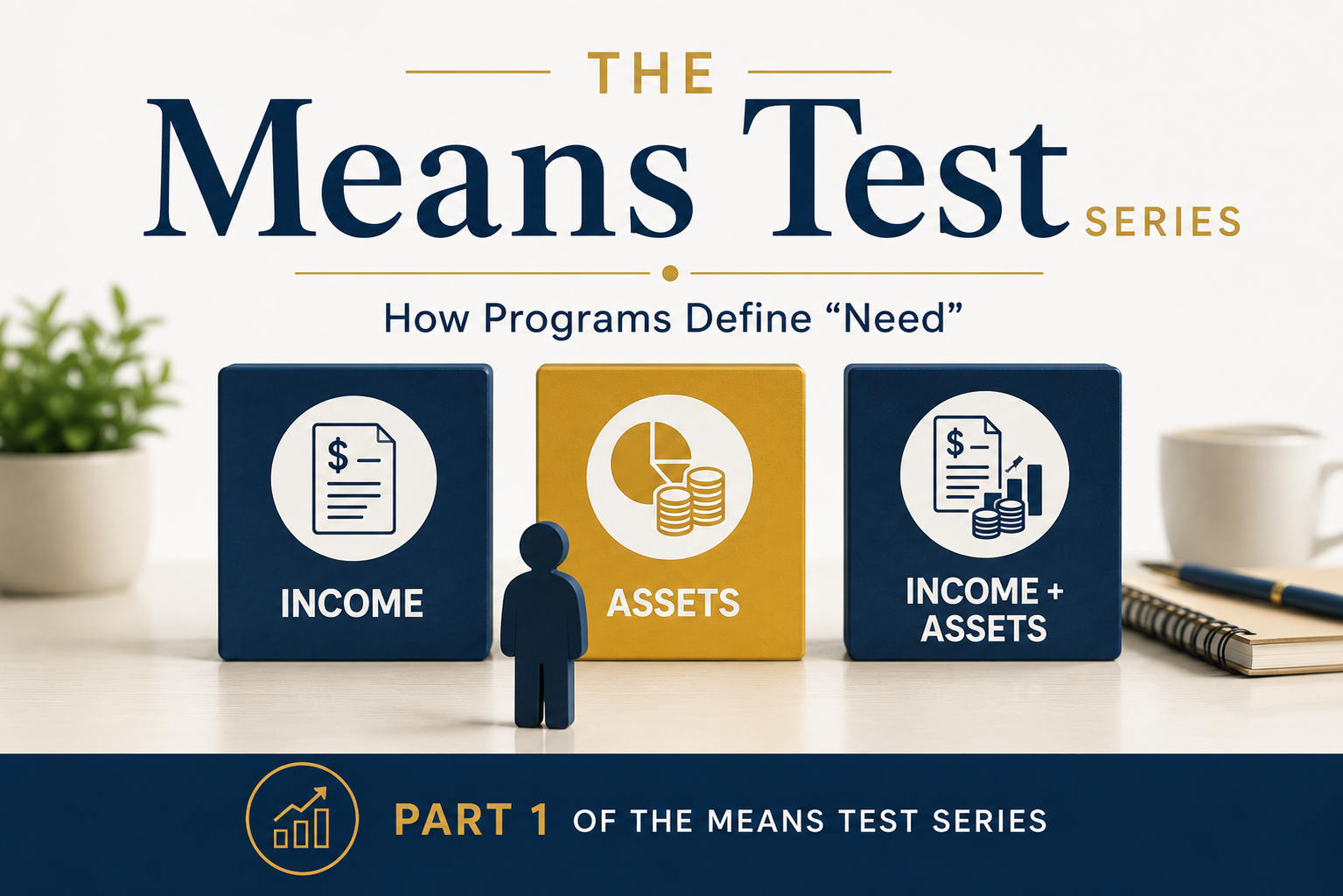

Part 1 of The Means Test: How Early Retirees Qualify for Benefits, and Where to Draw the Line
In the United States much of our social policy and our safety net are mediated through our tax code. And when you think about our history as the flagship capitalistic economy in the world, that makes sense. Our tax system uses deductions and credits to incentivize people to make choices, and it’s a short step from there to using income itself as the gatekeeper for who gets help and who doesn’t.
This is such an ingrained part of our system that Americans don’t always think about it. What are some examples? How about the Child Tax Credit, Earned Income Tax Credit, college tax credits (American Opportunity Credit & Lifetime Learning Credit), or the mortgage interest tax deduction? All of these have qualification limits and are intended to incentivize or reward behaviors like having children or going to college.
Every means-tested program in this country is trying to answer the same question.
Does this household actually need help?
That’s a difficult question to answer, and so each program picks a proxy, usually income, sometimes assets, sometimes both, to answer it. Often, the proxy becomes the whole test, and at that point the real question underneath (does this person need help?) disappears from view.
That gap between the proxy and the question is what this series is all about. We’re going to get into the Affordable Care Act (ACA), FAFSA, Medicaid, and eventually where smart planning blurs into more ethically challenged practices up to and including outright fraud.
However, none of that detail will make sense until you know one thing first: not every program is measuring the same thing.
Two basic gatekeeping models
Some programs are income-tested. They look at your income, usually for the current or prior year using your tax return. For income-based programs, if your reportable income comes in low enough, you qualify, and it doesn’t matter whether you’ve got three million dollars sitting in a brokerage account. Unless, of course, your three million is kicking off taxable income that will show up on your annual tax return.
Other programs are asset-tested. These look at what you currently hold: cash, investments, sometimes property, and that’s how they draw a line. Cross it and you’re out, even if this year’s income is close to zero. And a fair number of programs run both income and asset tests at once, which means clearing an income bar isn’t enough on its own.
For most of us, we carry around a fuzzier idea of “need” than any of this, something like a blend of income and net worth that a well-meaning social worker or caseworker eyeballs and weighs together. In that world, the caseworker probably waves off discounted healthcare for the decamillionaire who keeps their taxable income low by bunching income and selling stocks every other year.
That’s not really how it works for most programs, which have to follow objective standards. And that actually makes sense; you don’t want a caseworker who is having a bad day deciding you don’t qualify for a program for some arbitrary or discriminatory purpose.
Which model (income, assets, or both) a given program uses is the single biggest factor determining whether an early retiree with a large portfolio and a carefully constructed tax return qualifies, and it’s worth knowing before you ever fill out an application for assistance.
Where each model shows up
Income-driven tests show up all over the place in healthcare. ACA subsidies you get from purchasing insurance through health exchanges and Medicaid’s expansion programs both run on income tests using Modified Adjusted Gross Income (MAGI), full stop. There’s no asset test, so a household with a seven-figure net worth and a MAGI under the eligibility range qualifies exactly the same as a household with nothing saved at all.
Now I’ve heard some bloggers and podcasters decry how FIRE households are “taking advantage” of the ACA because they have large asset balances and low-ish incomes.
I think that view ignores history. Congress intentionally eliminated asset testing for the ACA and aligned Medicaid programs to reduce administrative costs and simplify the enrollment process. This isn’t some loophole that early retirees are exploiting; the elimination of asset tests was intentionally made by Congress to open up access. The goal was to increase the number of people buying insurance, and this was a market-based approach to incentivize it. You might recall that there was a carrot and a stick approach, with a penalty applied to people who did not buy insurance. The penalty was later zeroed out by Congress in 2017, though the tax credits remained.
History lesson aside, older Medicaid pathways work differently, because they predate this approach. Coverage tied to age, blindness, disability, or long-term care still runs through what’s often called the aged/blind/disabled track, and it kept the older model going: an income test and an asset test, together. Those asset ceilings tend to be tight by design, and they vary quite a bit state to state.
Supplemental Security Income (SSI) is probably the tightest asset-tested program still standing. Its resource limit hasn’t moved since the last millennium and is capped at $3,000 for a couple. Sadly, that means a disabled person has to sell off everything they own before they qualify for federal disability payments.
College aid formulas like FAFSA are a good example of mixed evaluations that look at both income and assets. However, since its most recent overhaul, FAFSA leans more heavily on income for most families, and it makes one exclusion total and explicit along the way. Qualified retirement accounts (401(k), 403(b), traditional and Roth IRAs, SEP and SIMPLE plans, pensions) don’t show up anywhere on the form.
But to complicate matters, most private colleges rely on a different form altogether called the CSS Profile. We’ll go deeper into college savings in Part 4, and you can read a previous post here: Saving for College When You’re Planning Early Retirement.
Assets are not one-size-fits-all
A point mentioned above deserves more than a passing mention.
Not all assets are evaluated the same. The same dollar in a 401(k) or an IRA is often invisible or not evaluated at all by some asset tests. The idea is that some programs don’t want a family’s choice to save for retirement to cost it financial aid or benefits eligibility.
It’s also worth noting that where you hold an asset doesn’t just change whether it counts for an asset test, it also changes whether it ever shows up as income in the first place. If you sell a winning stock out of a taxable account, that gain lands on your tax return that year. But money growing inside an IRA, 401(k), or a 529 doesn’t touch your MAGI at all. That’s the piece that turns “where should I hold this?” from a tax question into an eligibility question too.
Everything that follows in this series is going to name a specific program and walk through how it applies a means test. We’re not going too deep into ethics and I’ll avoid overt moralizing, but we’re also going to discuss some strategies that stretch or sometimes outright break rules.
Part 2 starts with the cleanest example of a pure income test there is: the ACA marketplace, where MAGI is the primary qualifier that matters. We’ll also see that a lot of what people think they know about the program is either out of date or not based in facts.