
Part 2 of The Means Test: How Early Retirees Qualify for Benefits, and Where to Draw the Line
Part 1 of this series laid out the two means-testing models for tax credits and other programs relevant for early retirees: income-tested, asset-tested, or both. The Affordable Care Act (ACA) is one of the purest examples of the income-based approach, and now we’ll go deeper into how ACA benefits work.
I’ve written about ACA subsidies on this blog before, but always as a piece of a bigger strategy like Roth conversions or withdrawal sequencing. This time I want to slow down and explain the program itself, because I keep running into the same handful of misconceptions, and they mostly trace back to people not quite understanding how the program works.
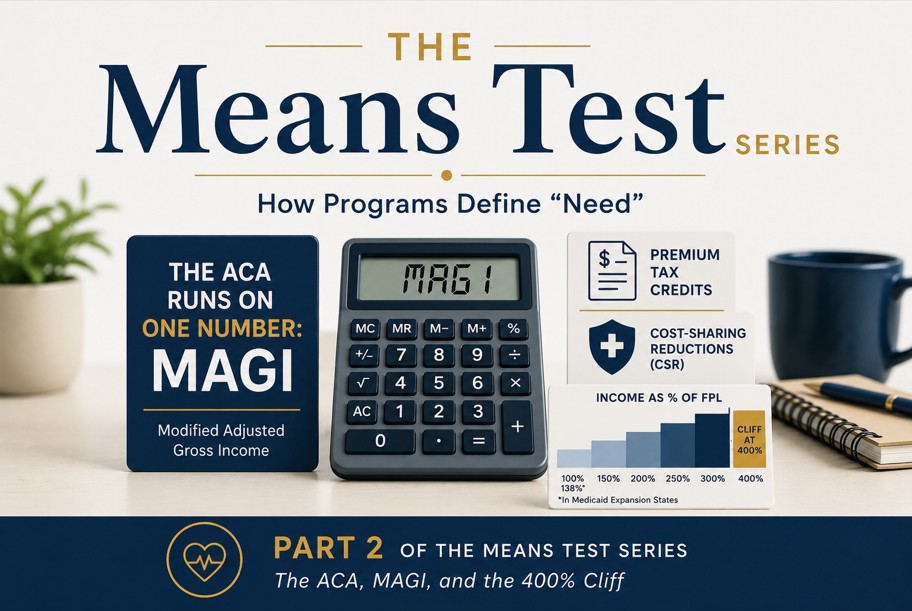
The ACA marketplace runs on one number: Modified Adjusted Gross Income, or MAGI. It was designed to ignore participants’ net worth, savings, 401(k) balances, and other assets entirely.
Premium Tax Credits and the Federal Poverty Line
The ACA provides subsidies through refundable tax credits known as premium tax credits. Premium tax credits are available to people who meet certain income and eligibility requirements, such as immigration status and not having access to employer-offered insurance. The threshold that matters most is the federal poverty line, or FPL, expressed as a percentage.
Premium tax credits run from 100% of FPL up to 400% of FPL, at least as the ACA was originally written. Fall below 100% and you’re generally expected to be on Medicaid. Go above 400% and, historically, you got nothing.
Worth a quick aside: there used to be a federal tax penalty for not carrying insurance, but a 2017 tax law zeroed it out, and it’s been zero every year since. A handful of states didn’t let that go. California, Massachusetts, New Jersey, Rhode Island, and DC still run their own individual mandates with their own penalties, so if you live in one of those places, factor that in.
States that expanded Medicaid (like Washington, where I live) complicate the FPL window a little. The marketplace subsidy population there doesn’t start at 100%; it starts at 138%, since everyone below that line gets routed to Medicaid instead. So depending on where you live, the window you’re actually planning around is either 100% to 400% FPL or 138% to 400% FPL.
Either way, that 400% ceiling is the number causing the most trouble lately, and it’s worth its own section.
Here’s what 400% of FPL means in dollar terms for 2026:
The Cliff, and What It Actually Costs You
Most benefit and tax credit programs phase out. Earn a bit more and you get a little less help, tapering gradually to zero. The ACA subsidy at 400% of FPL doesn’t work that way. One dollar under the line and you get a subsidy. One dollar over and you get nothing. That’s what people call a subsidy cliff.
From 2021 through 2025, pandemic-era legislation temporarily removed the cliff altogether, capping what anyone paid for a benchmark plan at 8.5% of income no matter how high their income climbed. That expired at the end of 2025, and as of this year the original cliff is back. If you got used to planning around the smoothed-out version, this is the year that assumption stops holding.
To make this concrete, take a 55-year-old Seattle couple shopping for a Bronze HSA plan, priced against the numbers from my health insurance cost post. At $84,000 in MAGI, just under the $84,600 line for a two-person household, that couple owes $19,532 in gross premium and gets a $16,548 tax credit, leaving a net premium of $2,984.
Push their MAGI to $84,700, just $700 higher, and the credit disappears entirely. Same plan, same age, same household. The bill jumps from $2,984 to $19,532. That’s a $16,548 swing triggered by $700 of extra income. Put differently, that extra $700 of income creates a loss of $16,548 in benefits. That’s an effective marginal rate of more than 2,300%, which helps explain why so many early retirees pay close attention to their MAGI.
You can argue the merits of letting the pandemic-era enhanced subsidies expire, but I’ve been frustrated by media coverage that implies the ACA itself was gutted or went away. That’s not accurate. The ACA is back to its pre-pandemic rules, cliff and all.
What “Affordable” Was Supposed to Mean
If the ACA was designed to make healthcare affordable, what exactly does “affordable” mean?
For 2026, the IRS set the required contribution percentage at 9.96% of income, up from 9.02% the year before. That figure is the ceiling employers have to stay under for their coverage to count as affordable, and it’s also the basis for the ACA’s own applicable percentage table. The underlying idea is that nobody should have to spend more than roughly a tenth of their income on health insurance.
Stated plainly, that’s not an unreasonable target. It’s close to what a lot of people already spend on housing as a share of income, and health insurance is arguably just as basic a need. The IRS’s own applicable percentage table shows the credit was built to phase in gradually, right up to the cliff.
| Income as % of FPL | Required Contribution (% of Income) |
| 133% to 150% | 3.14% to 4.19% |
| 150% to 200% | 4.19% to 6.60% |
| 200% to 250% | 6.60% to 8.44% |
| 250% to 300% | 8.44% to 9.96% |
| 300% to 400% | 9.96% |
| Over 400% | No cap. Full premium, no credit. |
Every band up to 400% is a slow climb toward that 9.96% ceiling. If we go back to the Seattle couple, at $84,000 of income, their $2,984 net premium is 3.6% of income, comfortably under the 9.96% standard. At $84,700, their $19,532 premium is 23% of income for that $700 increase in earnings.
Another Cost-Sharing Cutoff
There’s another MAGI cutoff hiding inside the ACA, and it gets less attention than the 400% cliff even though it can matter more for how much you actually pay when you get sick.
Cost-sharing reductions, or CSR, lower your deductible, copays, and out-of-pocket maximum, but only if your MAGI falls at or below 250% of FPL and you’re enrolled in a Silver plan. Bronze, Gold, and Platinum shoppers don’t receive CSR at any income level.
Why? That’s too much in the weeds to explain here, but you can read all about “silver loading” in the policy brief Explaining Cost-Sharing Reductions and Silver Loading in ACA Marketplaces.
The reduction happens in three steps:
| Income as % of FPL | Silver Plan Actuarial Value | Individual Out-of-Pocket Max (2026) |
| 100% to 150% | 94% | roughly $3,500 |
| 150% to 200% | 87% | roughly $3,500 |
| 200% to 250% | 73% | roughly $9,600 |
| Over 250% | 70% (standard Silver) | $10,600 |
A standard Silver plan covers about 70% of costs on average. Below 150% of FPL, CSR pushes that same plan up to 94% actuarial value, which is close to Platinum-level coverage at Silver premiums. That’s the most generous piece of the entire ACA structure, and it disappears in chunks rather than all at once until it disappears completely at 250%.
Two things make this one worth knowing separately from the premium tax credit cliff. First, it’s a much lower income line, 250% of FPL instead of 400%, so it bites earlier in a Roth conversion or capital gains harvesting plan than the subsidy cliff does. Second, it only rewards you for picking a Silver plan. An early retiree who defaults to Bronze for the lower premium without checking their MAGI against the CSR threshold first can leave real money on the table.
Now that we’ve covered the mechanics of how the ACA evaluates your income and provides corresponding tax credits and insurance benefits, let’s turn to a moral question.
Is This Fair?
Here’s the question that comes up most, usually phrased a little defensively: isn’t taking a subsidy or manufacturing a low MAGI just gaming the system? After all, many people pursuing FIRE are millionaires. Why should they get benefits intended for low-income people?
Rather than answer directly, I’d ask a question of my own: are ACA subsidies any different from the tax benefit we provide for employer-provided insurance?
For example, consider a household in the 24% federal bracket with an employer plan worth $22,000 a year. That exclusion is worth roughly $5,280 in avoided federal income tax alone before you even get into the payroll tax savings, since employer premiums also escape Social Security and Medicare tax on both the employee and employer side. The self-employed get a version of the same deal through the self-employed health insurance deduction; no income limit attached there either.
In my view, a retired household holding MAGI low enough to capture a premium tax credit is landing in a similar place through a different tax door. In both cases, the tax code is subsidizing the cost of health insurance. Employer coverage and the self-employed deduction do it through an income exclusion available to anyone with the right kind of job or business. The ACA subsidy does it through a credit tied explicitly to being below a certain income.
If anything, that’s the more targeted version of the same basic idea.
That doesn’t settle every question about fairness, and Part 6 of this series takes the harder version of that question head-on. But the comparison is worth having in your head before you get there, because “employer coverage is just normal, ACA subsidies are gaming it” isn’t an accurate description of what’s actually happening in either case.
In Part 3, we’ll examine what happens when your income drops low enough to qualify for Medicaid, including how Medicaid fits into the broader early-retirement planning landscape, especially for people planning for lean early retirements.