
I don’t know anyone pursuing financial independence whose retirement goal is, “Someday I hope to qualify for Medicaid.” Yet for a surprising number of early retirees, Medicaid ends up as one of the available healthcare options.
Our last post in this series walked through how the Affordable Care Act (ACA) Marketplace runs on income tests, specifically a household’s modified adjusted gross income (MAGI). Medicaid runs on a similar income-based test, but if you keep your MAGI low enough and live in one of the 41 “expansion states,” you leave the marketplace entirely and become eligible for Medicaid.
In Washington where I live, Medicaid is now called “Apple Health.” Other states have come up with similar fun branding. I can’t decide whether I like HUSKY Health (Connecticut) or BadgerCare Plus (Wisconsin) best. My birthplace of Oregon calls it the Oregon Health Plan, which completely lacks any creativity and needs to do better!
For an early retiree who has spent years optimizing MAGI for tax purposes, landing on Medicaid, no matter what you call it, can feel like an odd finish line. You can build a withdrawal strategy to keep taxable income low, and the reward for doing it well is landing in the same program that covers households literally living in poverty.
How the Eligibility Line Works
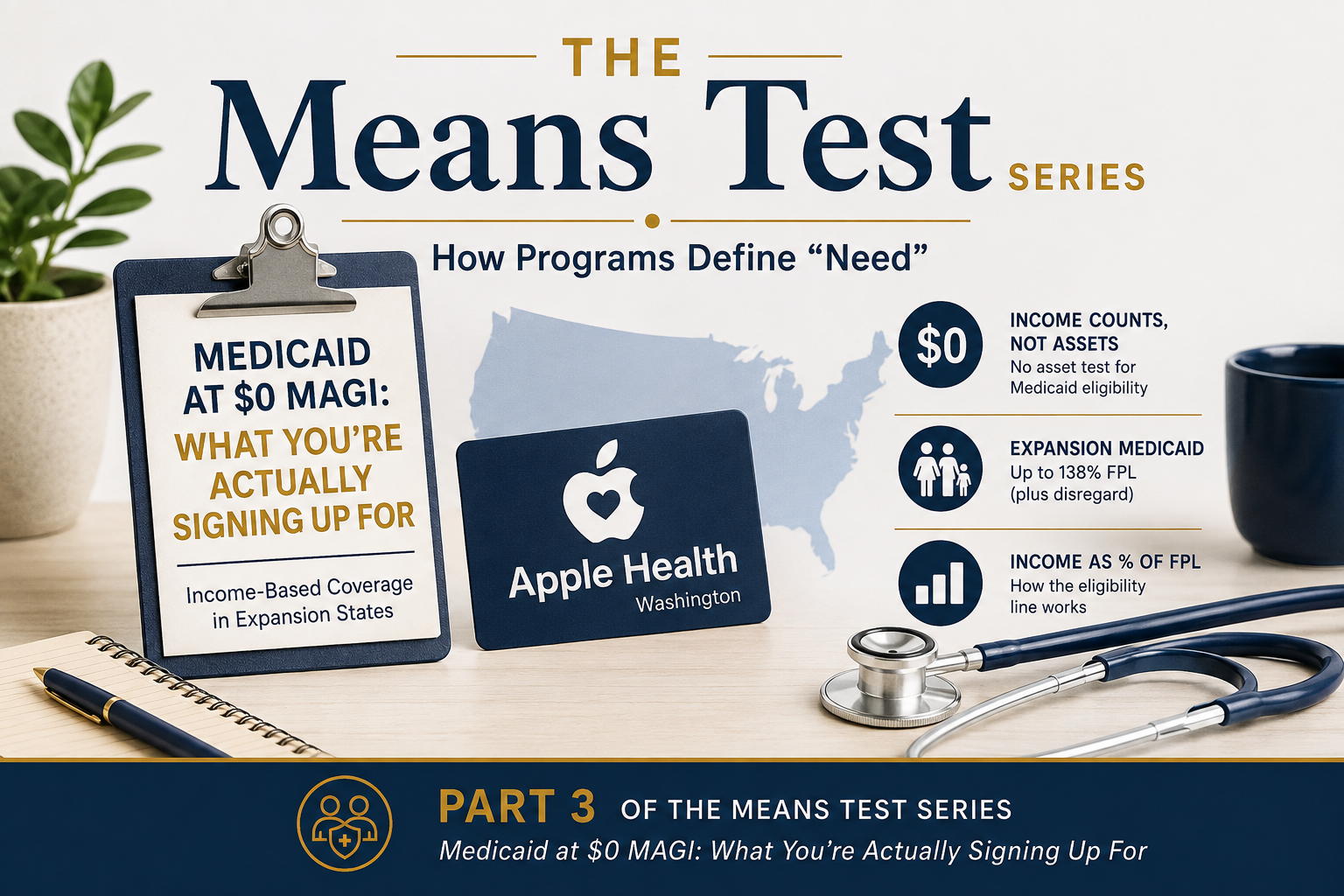
Medicaid expansion, the version most working-age adults qualify through, uses the exact same MAGI-based rules as the ACA marketplace. No asset test attaches to it. A household could hold several million dollars in a brokerage account and still qualify, as long as the income showing up on the tax return stays under the threshold.
For Washington, like other Medicaid expansion states, that threshold is 138% of the federal poverty line, and the state adds a small income disregard on top of it. For 2026, a single adult qualifies with monthly income at or below roughly $1,850, and a family of four qualifies at or below roughly $3,820 a month. Annualized, that’s about $22,000 for one person and $45,850 for a family of four.
Notice what’s missing from that description. There’s no reference to home equity, retirement account balances, or how much you have sitting in a taxable brokerage. These rules means a retiree with a paid-off house and a seven-figure portfolio can end up on the same program as someone with no assets at all. Whether that outcome sits right with you is a separate question, and one that Part 6 of this series takes on directly. Mechanically, though, it’s how the rules are written.
Engineering a Low MAGI, On Purpose or By Accident
Here’s where the mechanics get more interesting for anyone who’s spent time thinking about withdrawal sequencing. $45,850 for a family of four doesn’t sound like much to live on, and for most households it isn’t. But MAGI measures realized taxable income, not spending, and those two numbers can drift a long way apart depending on the source of your withdrawals.
For example, some people live off their taxable brokerage account, selling shares where a good portion of the proceeds represents what they originally put in (basis) rather than gains. If you sell $60,000 of stock to fund your spending and your cost basis is $30,000, only $30,000 of income appears on your tax return. Roth conversion ladders can produce even lower taxable income because withdrawals of prior conversions become tax-free after the five-year waiting period.
This means someone living off a Roth ladder and brokerage account can have a seven-figure net worth and still post a MAGI near zero without doing anything that looks like fraud or even aggressive tax planning. It simply falls out of how the tax code defines income. In practice, most financially independent retirees do not actively aim for Medicaid-level income. Maintaining some taxable income often allows them to harvest capital gains, perform Roth conversions, and make use of lower tax brackets that would otherwise go unused.
If you’re doing this intentionally to land under the Medicaid line, or even just under the ACA subsidy cliff, you should always ask yourself what you’re giving up to get there. Every year you spend at a very low MAGI is a year you didn’t use the low tax brackets to convert traditional balances to Roth, and that headroom doesn’t roll forward into next year the way an unused contribution limit might.
If you’re carrying a substantial 401(k) or traditional IRA balance, deferring income this aggressively risks postponing the tax bill rather than eliminating it, pushing income into a future year where it is stacked on top of Social Security and required minimum distributions. A string of $0 MAGI years followed by a decade of forced six-figure RMDs is not a win just because the early years felt efficient and got you “free” healthcare via Medicaid.
For LeanFIRE households, the calculus can look different and will more frequently lean (pun intended) toward chasing a low MAGI. If your traditional balances are modest to begin with, there isn’t much deferred tax bill to kick down the road, and the near-term value of free healthcare or a full premium tax credit can outweigh a Roth conversion opportunity.
CHIP and How It Flows for Kids
If you’re retiring early with children still at home, there’s a second layer worth knowing about. Every state runs some version of the Children’s Health Insurance Program (CHIP), where children qualify at higher MAGI thresholds than their parents do, sometimes through Medicaid directly and sometimes through a separate CHIP program layered on top.
Washington is a fairly typical example of how that layering works. Kids qualify for free coverage through Medicaid up to 215% of FPL with no premium attached. Above that, a CHIP tier picks up the slack up to 317% of FPL, with a modest monthly premium. Other states draw these lines in different places, and a handful run CHIP as a fully separate program with its own name and rules rather than folding it into Medicaid the way Washington does, so it’s worth checking your own state’s thresholds.
This means a household’s income can sit well above the adult Medicaid threshold and the kids can still stay covered through CHIP at little or no cost. That’s often a wider window than most people assume, especially for very early retirees pricing out healthcare for a long retirement with children still at home.
The Case for Taking Medicaid
Let’s set the “fairness” question aside for a moment and look at what Medicaid coverage actually provides, because on pure benefit terms there are some real advantages.
There istypically no coinsurance and no deductible in the way marketplace plans structure them. Services are covered without many of the cost-sharing hurdles that come with commercial insurance. Depending on the state, dental coverage can be included. For a retiree whose entire strategy depends on avoiding a catastrophic, plan-derailing medical bill, that’s about as complete a backstop as exists in the American system.
The Case Against It
The tradeoffs are real, and they’re worth thinking through.
Medicaid networks run much narrower than commercial insurance, and in some counties meaningfully so.Finding a specialist who accepts Medicaid can take longer and involve more driving than a marketplace plan would require. Coverage isn’t always universally free of cost sharing either. About two dozen expansion states charge some combination of copays or premiums, usually a few dollars per service, and federal law caps the total at 5% of household income regardless of what a state charges.
Starting in October 2028, that cap gets a little less forgiving. States will be required, rather than merely permitted, to charge expansion adults between 100% and 138% of FPL up to $35 per service.Separately, beginning in 2027, and sooner in states that move early, able-bodied adults without dependents will face new work requirements under the 2025 federal budget reconciliation law. Many enrollees will need to complete 80 hours per month of work, school, or community engagement and document that participation regularly.
And then there’s the harder one to shake. Medicaid, unlike the ACA subsidy or Medicare, was specifically built as a program for poor and disabled households to access healthcare. Claiming a premium tax credit runs through the same tax code mechanism that subsidizes employer insurance for everyone, a comparison I made in Part 2. That distinction is worth carrying into Part 6’s discussion of fairness because it’s a genuinely different position than the ACA subsidy question.
An Aside on Nursing Care
There’s a second Medicaid track worth flagging here, separate from the MAGI-based expansion coverage this post has focused on.
Long-term nursing home care runs through Medicaid too, but through an entirely different door, one with a hard asset test attached. In most states, a single applicant has to spend down countable assets to around $2,000 before nursing home Medicaid kicks in. Married couples get more room through the Community Spouse Resource Allowance, which lets the non-applicant spouse retain up to roughly $162,660 in 2026, but the spouse entering care is still held to that same $2,000 ceiling.This allowance also provides an exclusion for the primary home if the spouse continues to live there.
Nursing home care through Medicaid also typically applies a five-year look-back period to asset transfers. If you give assets away or sell them below market value within that window, Medicaid will impose a penalty period before coverage starts, calculated against the local cost of care.
Finding high-quality nursing homes that accept Medicaid can also be challenging for families.
That’s a much less forgiving system than the MAGI-only test that governs expansion Medicaid or the marketplace, and it’s the reason elder law and long-term care insurance exist as their own planning specialty. It’s a good reminder that “Medicaid” isn’t one program with one set of rules. The version that covers a healthy 50-year-old on a low-MAGI year and the version that eventually pays for a nursing home bed for a 70 year old are governed by completely different eligibility tests, and conflating them could lead to costly mistakes.
Medicaid Estate Recovery
There’s one final downside worth mentioning: Medicaid estate recovery. Depending on the state, Medicaid may seek reimbursement from a deceased enrollee’s estate for benefits paid after age 55.
In the long-term care context, this often matters less because applicants have already spent down most countable assets before qualifying. For Medicaid enrollees with substantial assets that were never subject to an asset test, however, estate recovery can come as an unpleasant surprise.
States have considerable latitude in how aggressively they pursue recovery. Some focus primarily on long-term care expenses, while others seek repayment for a broader range of Medicaid services. Because the rules vary significantly by state, anyone considering a Medicaid-based healthcare strategy should understand how their state handles estate recovery before assuming that “free” healthcare comes with no strings attached.
More Information Here: After People on Medicaid Die, Some States Aggressively Seek Repayment From Their Estates — KFF Health News
Looking Ahead
In Part 4, we leave healthcare behind and turn to College Savings, where a very different set of asset and income rules decide how much financial aid a family gets offered, and where some of the same optimization questions show up in a college admissions context instead of a health insurance one.