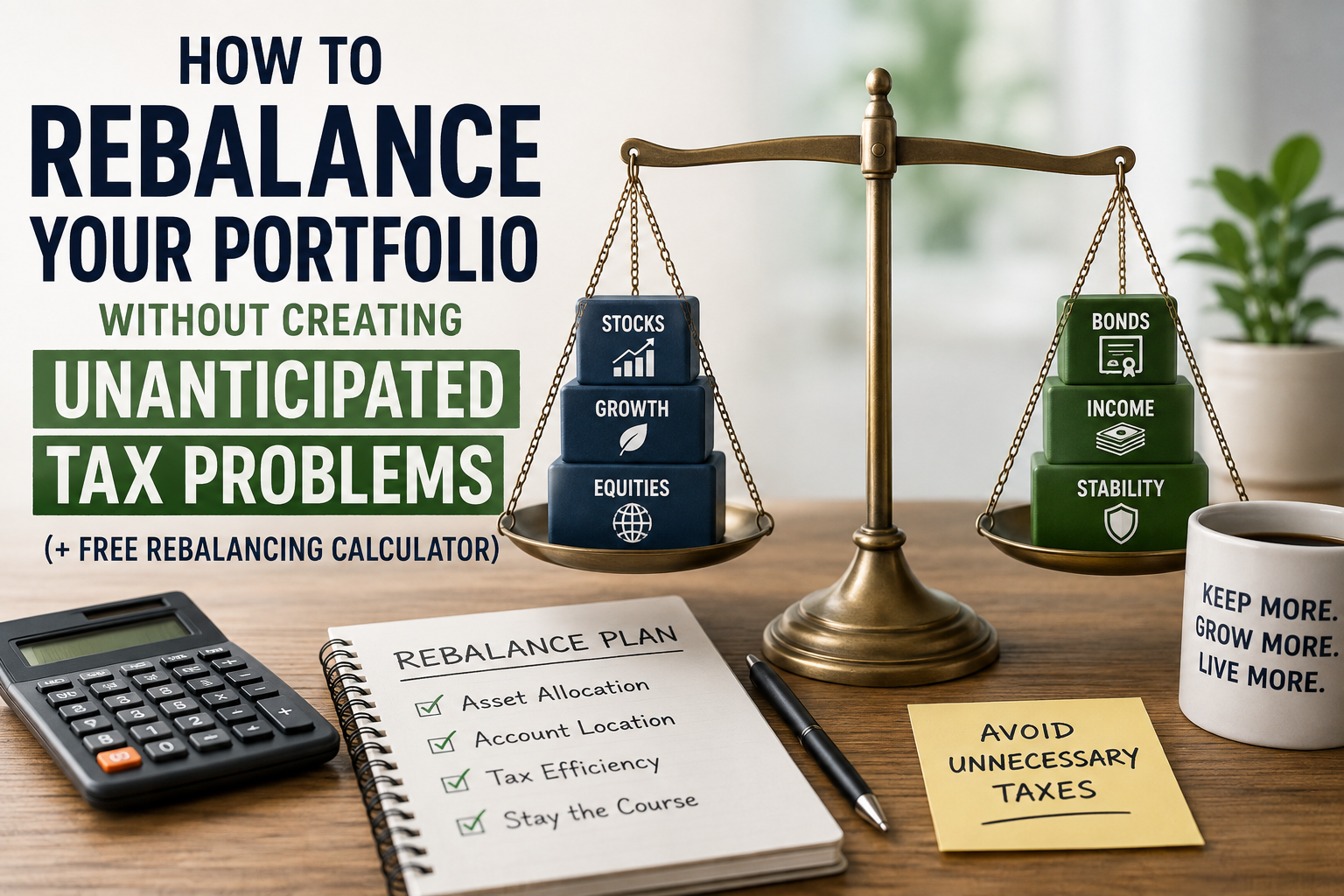

Rebalancing your portfolio sounds simple in theory. If the portion allocated to stocks drifts above your target, you sell stocks and buy bonds (or other assets) until the allocation lines back up. Clean, simple, and easy to execute, right?
In practice, real-life portfolios are rarely so simple, especially once you factor in taxes.
Most investors hold assets across a mix of taxable accounts, traditional (aka pre-tax) retirement accounts, and Roth accounts. Positions have different cost bases, and some carry significant unrealized gains. A straightforward rebalance can quickly turn into an unnecessary tax event.
For many people, the question is more complicated than whether they need to rebalance. They also have to decide where to rebalance, and which accounts to use to get there.
With a bit of experience, most people settle into a rebalancing cadence. But often that learning comes after making a costly (and avoidable) sale in a taxable account and getting a surprise on April 15th.
This post and the corresponding rebalancing calculator are designed to provide a framework to help you avoid those mistakes. More importantly, it should help you set clear rules for when and how you rebalance.
Start with Allocation, Then Consider Location
Asset allocation is still the starting point. I’m not a financial advisor, and I’m certainly not your financial advisor, so I’m not going to suggest your optimal mix. Your allocation, including stocks, bonds, cash, and other assets, defines the risk profile of your portfolio and determines when action is required.
A simple allocation might be 60% stocks and 40% bonds. Many people get more granular. For example, 5% cash, 40% large cap U.S. stocks, 20% international stocks, and 35% bonds. The only rule I’ll insist on is that it has to total 100%. And if you’re going to invest in crypto that’s cool, but please don’t try to sell me on it.
The basic idea is that when your portfolio inevitably drifts meaningfully from target, it’s time to rebalance. That requires defining two things: your targets and what counts as meaningful drift.
You also need to consider asset location and tax efficiency. I’ve covered this in other posts, but at a high level:
- Bonds are typically best held in pre-tax accounts, where ordinary income is deferred
- Growth-oriented stocks fit well in Roth accounts, where gains compound tax-free
- Taxable accounts often hold stocks, benefiting from long-term capital gains treatment
In early retirement, many people also hold cash in taxable accounts because it is most accessible. After age 59½, that constraint matters less.
Once this structure is in place, rebalancing becomes more directed:
- If bonds are underweight, start with pre-tax accounts
- If equities need rebalancing, start with your Roth account
You are not rebuilding the portfolio each time. You are adjusting within an existing structure.
Other Portfolio Considerations
It’s important to define your framework in advance so you don’t react emotionally to market moves. You don’t want to rewrite your rules after your growth stocks surge and you start to feel like a stock-picking genius. That kind of confidence can lead to doubling down at exactly the wrong time. On the other hand, you don’t want to panic rebalance after a downturn. That’s why I recommend everyone has a written investment policy statement.
Taxes are the other major constraint. For most investors, that means avoiding the sale of appreciated positions in taxable accounts solely for rebalancing. If a position has a large unrealized gain, selling it to correct drift can create a tax cost that outweighs the benefit.
A more efficient approach is to:
- Redirect new contributions if you are still accumulating
- Rebalance within tax-advantaged accounts
- Allow some temporary drift within a margin, such as +/- 5%
The key is consistency. Without that constraint, the default “sell what is high, buy what is low” approach tends to win out, even when it is not tax-efficient.
A Practical Example
Let’s walk through an example.
Greg is a disciplined investor. He has a target allocation, a clear asset location strategy, and a rule about what he will not sell:
| Asset Class | Target | Preferred Location |
|---|---|---|
| 💵 Cash | 5% | Taxable (spending reserve) |
| 📈 Domestic Large Cap | 35% | Taxable or Roth |
| 📈 Domestic Small Cap | 5% | Taxable or Roth |
| 🌎 International | 15% | Taxable or Roth |
| 🛡️ Bonds | 40% | Traditional / Pre-Tax |
After a strong run in equities, Greg’s $2.25M portfolio looks like this:
| Asset Class | Taxable | Pre-Tax | Roth | Total | Current % | Goal % |
|---|---|---|---|---|---|---|
| 💵 Cash | $50,000 | $0 | $0 | $50,000 | 2.2% | 5.0% |
| 📈 Domestic Large Cap | $500,000 | $0 | $500,000 | $1,000,000 | 44.4% | 35.0% |
| 📈 Domestic Small Cap | $0 | $0 | $100,000 | $100,000 | 4.4% | 5.0% |
| 🌎 International | $100,000 | $0 | $200,000 | $300,000 | 13.3% | 15.0% |
| 🛡️ Bonds | $0 | $800,000 | $0 | $800,000 | 35.6% | 40.0% |
| TOTAL | $650,000 | $800,000 | $800,000 | $2,250,000 |
Domestic large cap has drifted to 44.4%, about nine percentage points over target. Bonds are modestly underweight. The textbook answer is to sell equities and buy bonds.
Here is where Greg’s investing guidelines come into play:
His $500,000 taxable large cap position has significant embedded gains. Selling it would generate a capital gains tax bill. So instead of touching the taxable account, Greg sells $150,000 of large cap in his Roth. There are no tax consequences, and he uses the proceeds to buy small cap and international in the Roth, both underweight.
The taxable account stays exactly as it is.
After the rebalance, large cap is still slightly above target. But the portfolio is much closer overall, the gains remain intact, and Greg did not hand the IRS a check just to make the spreadsheet look cleaner.
Rebalancing Dashboard (Before Trades)
| Asset Class | Current % | Target % | Drift | Action |
|---|---|---|---|---|
| 💵 Cash | 2.2% | 5.0% | -2.8% | ✓ Within Tolerance |
| 📈 Domestic Large Cap | 44.4% | 35.0% | +9.4% | ⬇ Rebalance |
| 📈 Domestic Small Cap | 4.4% | 5.0% | -0.6% | ✓ Within Tolerance |
| 🌎 International | 13.3% | 15.0% | -1.7% | ✓ Within Tolerance |
| 🛡️ Bonds | 35.6% | 40.0% | -4.4% | ✓ Within Tolerance |
Rebalancing Dashboard (AFTER Trades)
| Asset Class | Taxable | Pre-Tax | Roth | New Total | New % | Target % |
|---|---|---|---|---|---|---|
| Cash / Equivalents | $50,000 | $0 | $0 | $50,000 | 2.2% | 5.0% |
| Domestic Large Cap | $500,000 | $0 | $350,000 | $850,000 | 37.8% | 35.0% |
| Domestic Small Cap | $0 | $0 | $112,500 | $112,500 | 5.0% | 5.0% |
| International | $100,000 | $0 | $337,500 | $437,500 | 19.4% | 15.0% |
| Bonds | $0 | $800,000 | $0 | $800,000 | 35.6% | 40.0% |
| TOTAL | $650,000 | $800,000 | $800,000 | $2,250,000 |
The Behavioral Advantage of a Process
Re-balancing decisions are often made at the worst time, after strong performance or a market crash, when the urge to “fix” things is highest. A defined process removes that pressure.
If you have:
- A target allocation
- A clear asset location strategy
- A rule against realizing unnecessary taxable gains
Then most decisions become mechanical.Your goal should be consistency and tax efficiency over time. Small, incremental adjustments tend to outperform infrequent, perfectly balanced and often taxable resets.
Applying This to Your Own Portfolio
With a framework in place, the questions get simpler:
Where is the drift?
Which accounts can absorb it without tax consequences?
Which positions are effectively off-limits due to embedded gains?
Most of the time, that narrows your options quickly.
As you get more advanced, you might also set some guidelines for tax efficiency within your accounts. The table below shows some options.
| Roth | Taxable | |
| Maximum Bonds | Ex. 10%: Bonds preferably stay out of Roth because growth assets benefit most from tax-free compounding. | Ex. 20%: Bonds generate ordinary income; cap taxable bond exposure to limit annual tax drag. |
| Minimum Equities | Ex. 90%: Roth is best for highest-growth assets, enforce a minimum equity allocation in Roth | Ex. 80%: Taxable accounts favor equities (LTCG rates); set a minimum equity allocation |
Are you ready to get started building your rebalancing plan? I created a tool to walk through exactly this process. It started as a personal spreadsheet. I wanted something that would reflect the decisions I would actually make, not just show the drift.
The interactive version maps your allocation across taxable, pre-tax, and Roth accounts, applies your rules, and shows what the trades look like once taxes are considered.
It will not tell you what to trade. But it will show what actually needs to change and what you can safely leave alone.