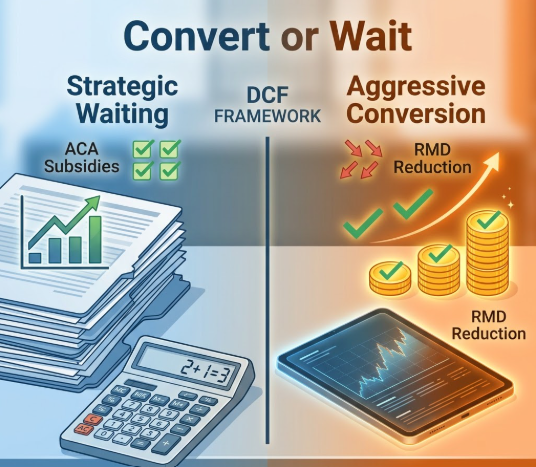

Part 1: When Should You Do Roth Conversions and Why do Most Calculators Get the Analysis Wrong?
There is no shortage of Roth conversion calculators on the internet. Type in your balance, your tax rate, and your expected future rate, and they hand you a number with the quiet confidence of someone who has never heard of the time value of money.
The time value of money (TVM) is the idea that a dollar today is worth more than a dollar in the future. Every dollar left untouched today has the potential to compound, generating returns on top of returns. At the same time, inflation steadily erodes purchasing power, meaning future dollars don’t buy what today’s dollars do.
The same logic applies to your Roth conversion. A dollar saved in 2045 is not the same as a dollar spent in 2026, and a lot of calculators pretend otherwise. Even those that apply an inflation adjustment aren’t really accounting for the lost opportunity cost of your capital correctly.
What the Analysis Needs to Include
The basic logic of a Roth conversion is not that complicated. You pay taxes now, move money into an account that grows tax-free, and pull it out tax-free later. If your future tax rate is higher than your current rate, converting looks like a win. A complete analysis needs three things that most tools either miss or handle poorly.
First, every dollar figure needs to be discounted back to the same point in time. Paying $22,000 in taxes today is not the same as saving $22,000 in taxes in 30 years.
I think a useful framework is a discounted cash flow (DCF) analysis. If that acronym just made you involuntarily recall a finance class you did not enjoy, I apologize!
We are going to use it anyway, because it is the best way to compare dollars paid today against dollars saved decades from now. The finance nerds in the audience are nodding. Everyone else: stay with me!
The second key piece of the analysis is that you can’t just use your marginal tax rate in the analysis; you have to include the value of tax credits that are given up as a result of Roth conversions. For early retirees buying insurance on the Affordable Care Act (ACA) exchange, Roth conversions raise taxable income and can eliminate thousands of dollars in annual health insurance subsidies. That cost belongs on the ledger alongside the taxes.
Third, a proper analysis needs to account for what happens to your Required Minimum Distributions (RMDs). If you leave a large traditional IRA untouched for many years, the IRS will mandate withdrawals that can be costly because they push you into a much higher tax bracket. Roth conversions reduce your pre-tax balance and reduce those future RMDs. The tax savings on those reduced RMDs are a core benefit of converting, and they need to be part of the calculation. But for early retirees those savings will not be realized until well into the future, so they need to be discounted.
So we’ve got our DCF framework! You add up the benefits and subtract the costs, and discount them all to present day, resulting in what we call a Net Present Value (NPV) calculation. Wait, was that a yawn I heard from the back of the class? Stay with me; it’s going to be worth it.
Setting the Baseline
Before comparing conversion strategies, we need to establish our base case: doing nothing. In that scenario you retire, collect every ACA subsidy available to you, let the traditional account grow, and take RMDs as required. That baseline has an NPV of zero.
Every strategy gets evaluated against that base case. There are costs and benefits outlined in the table below. As I mentioned, all of the benefits and costs need to be discounted back to present day dollars.
| Costs of Conversion | Benefits of Conversion |
| Income taxes paid on conversion | Reduced future taxes on future Roth distributions |
| Loss of ACA Credits | Reduced IRMAA (if applicable) |
A Tale of Two Strategies
Meet Sarah and Tom. They retired at 55 with $2,000,000 in traditional 401k accounts, modest taxable income, and a plan to start RMDs at 75. They plan to draw $60,000 per year for living expenses before RMDs begin, funded by penalty-free early withdrawals under the Rule of 55, which is a provision that allows employees who separate from service at 55 or older to withdraw from their 401(k) without the usual 10% early withdrawal penalty.
If they never convert a dollar, their traditional account keeps growing through their early retirement years. By age 75, the balance has reached about $5.1 million. Their first RMD is $207,620. By age 85 it has grown to $375,032 per year, all of it taxable as ordinary income. That is the problem Roth conversions are trying to solve.
We’re going to look at two options and compare the NPVs. Both strategies involve converting $100,000 per year for five years. The only difference is timing.
One more thing worth noting before we get to the numbers: even though Sarah and Tom are in the 22% marginal federal bracket, their actual tax cost on each $100,000 conversion is lower than you might expect. Because part of each conversion fills up the remaining room in the 12% bracket, the blended effective rate on the conversion works out to about 15.2%, not 22%.
Strategy A: Convert aggressively now, ages 55 to 59
Sarah and Tom convert $100,000 per year for five years. Thanks to the bracket math described above, this costs them about $15,155 in annual federal taxes, which is a blended rate of 15.2% rather than the full 22% marginal rate.
More importantly, the conversions push their income above the ACA subsidy cliff, eliminating their $20,000 annual ACA subsidy. Discounting those five years of costs back to age 55 at a 5% discount rate: $152,203 in present value costs.
| COSTS | |
| Total Federal Tax on Conversions (nominal) | $75,775 |
| Total ACA Credits Lost (nominal) | $100,000 |
| PV of Tax Costs (discounted to today) | $65,613 |
| PV of ACA Credits Lost (discounted to today) | $86,590 |
| TOTAL PRESENT VALUE OF COSTS | $152,203 |
Now let’s look at the benefits. The conversions reduce Sarah and Tom’s RMD at age 75 from $207,620 down to $138,608, saving them $15,183 in federal taxes for the year. By age 85 the annual reduction in taxes is $27,765. Those are real tax savings, year after year.
The present value of those RMD tax savings discounted back to age 55: $124,551.
| BENEFITS | |
| Expected Years of RMDs | 20 |
| Total RMD Tax Savings (nominal) | $550,148 |
| Present Value of RMD Tax Savings (discounted, year-by-year) | $124,551 |
BENEFITS – COSTS = NEGATIVE $27,652
Converting early does reduce RMDs substantially. The problem is that the ACA subsidies lost during the conversion years tip the balance negative. You pay $152,203 in present value costs to get $124,551 in present value benefits.
Strategy B: Convert at 65 to 69, after Medicare kicks in
In this scenario, Sarah and Tom wait. They collect their full ACA subsidies through age 64, then start converting at 65. Same tax rate, same conversion amounts. No subsidy cliff because Medicare has started. They also keep their income below the first IRMAA threshold (roughly $212,000 for MFJ in 2025), avoiding Medicare surcharges entirely.
| COSTS | |
| Total Federal Tax on Conversions (nominal) | $75,775 |
| Total ACA Credits Lost (nominal) | $0 |
| PV of Tax Costs (discounted to today) | $40,281 |
| PV of ACA Credits Lost (discounted to today) | $0 |
| TOTAL PRESENT VALUE OF COSTS | $40,281 |
The conversions still reduce RMDs, though less dramatically than Strategy A because the converted dollars have fewer years to compound.
| BENEFITS | |
| Total RMD Tax Savings (nominal) | $279,667 |
| PV of RMD Tax Savings (discounted, year-by-year) | $63,315 |
BENEFITS – COSTS = POSITIVE $23,034.
The Verdict
| Strategy A (Convert at 55) | Strategy B (Convert at 65) | |
| Total Federal Tax on Conversions (nominal) | $75,775 | $75,775 |
| Total ACA Credits Lost (nominal) | $100,000 | $0 |
| PV of Tax Costs | $65,613 | $40,281 |
| PV of ACA Credits Lost | $86,590 | $0 |
| TOTAL PV OF COSTS | $152,203 | $40,281 |
| Total RMD Tax Savings (nominal) | $550,148 | $279,667 |
| PV of RMD Tax Savings | $124,551 | $63,315 |
| NET PRESENT VALUE | ($27,652) | $23,034 |
What the Numbers Tell Us
The results here are more nuanced than a simple “wait always wins” conclusion. The do-nothing baseline has an NPV of zero. Strategy A is negative. Strategy B is modestly positive.
At a 22%-to-22% conversion rate with meaningful ACA exposure, the honest answer is that neither strategy is dramatically better than doing nothing from a pure NPV perspective. Strategy A’s result is negative because the ACA loss is up front. Strategy B is positive, but only because the conversion costs are paid ten years out and discounted substantially.
What this tells you is that the rate differential matters enormously, and that is exactly what the next post (Part 2) is about. There are future cases where your assumptions can swing the NPV even more positively.
The Bottom Line
If nothing else, I hope you’ve found the framework useful. There are a lot of Roth Conversion calculators online, but many are black boxes that don’t share their assumptions, or make incorrect ones. I find it supremely disappointing that some of the paid services completely ignored ACA subsidies!
When you’re thinking about a Roth conversion, I hope you’ll consider this framework: isolate the costs and the benefits, and discount them back to present day. In Part 2 we will talk more about assumptions and in Part 3 we’ll share a spreadsheet tool you can use to do this analysis yourself.