
Part 1 of this series outlined the honest math: sometimes Roth conversions pay off, and sometimes waiting is the better option. We also walked through how a discounted cash flow (DCF) analysis evaluates costs and benefits to account for the time value of money and generate a true Net Present Value (NPV).
The example in Part 1 rested on one specific assumption: converting at 22% tax rates today versus taking withdrawals at the same 22% rate in the future. Change that assumption, and the whole picture shifts.
The Bracket Arbitrage: Converting at 12% to Avoid 22% Later
I’ve written previous posts (Tax Preparation Is No Longer the Hard Part) about why tax planning is so important for early retirees. One of the main reasons is that early retirees often find themselves in temporarily low tax brackets. In our initial example we were looking at a scenario where Sarah & Tom were evaluating conversions and future withdrawals in the same 22% bracket.
But what if we flip the assumption? What happens if Sarah and Tom convert today at 12% to avoid withdrawals at 22% later? Every dollar converted saves 10 cents in future taxes. That is genuine tax arbitrage, and it moves the NPV substantially.
For a married couple filing jointly in 2026, the 12% bracket tops out at around $94,300. If Sarah and Tom’s ordinary retirement income keeps them well below that ceiling, they have room to convert at 12% before crossing into 22% territory. A $100,000 conversion would push most couples into the 22% bracket, so the realistic option is more like $50,000 to $65,000 per year, enough to fill the 12% bracket without crossing the line.
Converting within the 12% bracket also keeps Sarah and Tom’s income well clear of the first Medicare IRMAA surcharge threshold (roughly $218,000 for married couples filing jointly). That allows them to avoid both higher tax brackets and Medicare premium penalties simultaneously.
At a 10 percentage point rate advantage, $300,000 in total conversions yields $30,000 in gross tax savings before factoring in any Required Minimum Distribution (RMD) reductions. Add the long-term RMD tax relief, and the NPV turns comfortably positive even after accounting for lost ACA subsidies.
This is the scenario where the conventional wisdom, convert early and aggressively, is actually right.
The Future Tax Rate Question: What If 22% Is the Low End?
We also have to ask what happens if future tax rates rise across the board. Federal deficits remain high, and rates today are historically low by post WWII standards. While current federal rates were made permanent in recent tax legislation, “permanent” in tax law simply means “not currently set to expire.” It takes very little imagination to think of a scenario where marginal rates sit higher 20 years from now, driven by rate hikes, reduced deductions, or higher taxation of Social Security benefits.
If Sarah and Tom face a future effective rate of 28% or 32% instead of 22%, the NPV for both conversion strategies improves. A 22%-to-32% conversion creates a 10 percentage point rate advantage, which matches the math of the 12%-to-22% scenario, just arriving there from a different direction.
Consider the compounding impact: $300,000 in annual RMDs at age 85 taxed at 32% creates a $96,000 annual tax bill. At a 22% rate, that bill drops to $66,000. That $30,000 annual gap across 15 or 20 years of retirement dwarfs the static figures in our Part 1 baseline.
When evaluating future tax uncertainty, a sensitivity analysis shows how much a shift in tax rates or investment returns changes the outcome.
What the Sensitivity Table Shows
The sensitivity table shows NPV across a range of future tax rates and investment returns. Both axes shift the NPV, but the future tax rate axis moves it more.
The images below show the sensitivity table for both strategies.
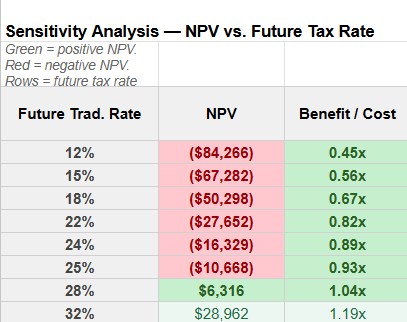
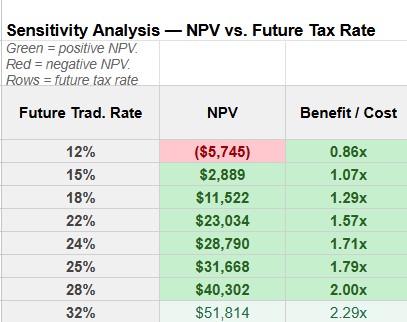
The key insight from the table: at equal tax rates, both strategies are marginal at best. But if you have any reason to believe future rates will be higher than today, the case for converting, and converting earlier, strengthens considerably. The sensitivity table makes that visible in a way a single NPV number cannot quite capture.
The Decision Framework
| Your Situation | Recommended Approach |
| Similar current and future rates, meaningful ACA eligibility | Wait. Converting early eliminates ACA credits. |
| 12% bracket available today, future rate likely 22%+ | Convert early up to the 12% ceiling. The rate arbitrage outweighs lost ACA subsidies while avoiding IRMAA surcharges. |
| Future tax rates expected to rise overall | Both conversion strategies improve. Model your plan against 28% to 32% future brackets. |
| Very large traditional IRA balances ($2M+) | Future RMDs create severe tax spikes. Early conversions make sense even with ACA trade-offs. |
| Already enrolled in Medicare | Convert now. You eliminate the ACA subsidy cliff and avoid waiting, provided you manage IRMAA thresholds. |
The Bottom Line
At equal tax rates with meaningful ACA exposure, neither early nor late conversion is dramatically compelling compared to doing nothing. Early conversion has the potential to create a negative net present value due to the loss of ACA credits.
The math changes when rates are unequal, either because you can access a lower bracket today, or because you have reason to believe future rates are higher than current rates.
The difference between current and future tax rates is the most powerful variable in this decision. When you have a favorable rate differential and can manage ACA exposure, most people should convert early and aggressively. When rates are expected to be similar, waiting until later when you’re not going to lose valuable ACA credits can be a better choice.
In Part 3, I will walk through the spreadsheet I built to model all of this, and show how to use it for your own situation.