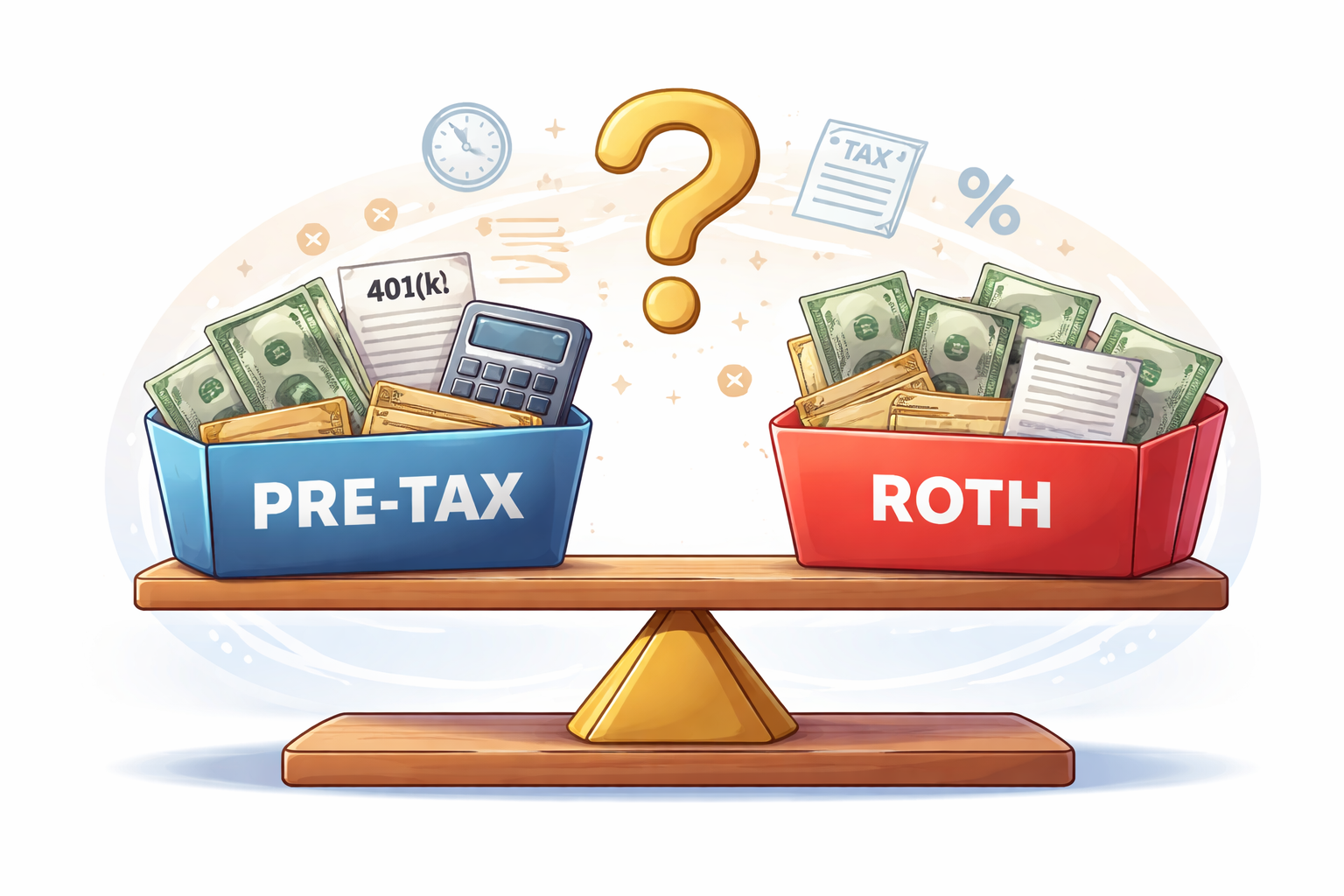

One of the most common questions in retirement planning is whether to save in pre-tax accounts such as a Traditional 401(k) or IRA, or post-tax Roth Accounts. The standard guidance is straightforward: choose Roth if you expect higher taxes in retirement, and Traditional if you expect lower taxes.
That answer is intuitive but not especially useful. Applying it requires forecasting future income, future tax law, Social Security taxation, withdrawal strategies decades from now, and how all of those variables interact with shifting tax brackets and healthcare costs.
Rather than trying to predict an unknowable future, I think it’s more productive to focus on what can be controlled: how your tax situation evolves over time and how different account types create flexibility within that evolution.
Starting assumptions (my biases)
Before outlining the framework, it is worth stating a few of my underlying assumptions.
First, tax diversification matters more than precise optimization. A mix of pre-tax, Roth, and taxable accounts generally provides more resilience than attempting to concentrate savings based on a single view of the future. Over long time horizons, flexibility tends to outperform precision. I’m focused on pre-tax vs. Roth in this post, but health savings accounts, 529s, and taxable brokerage accounts have their place in tax diversification also.
My second assumption is that current tax rates are relatively low in a historical context. That does not guarantee they will rise, but persistent federal budget deficits and spending pressures suggest that higher taxes are at least plausible.
Third, for many households, peak tax years occur just before retirement, not during it. The final working years often combine maximum earnings, dual incomes, and peak savings rates, producing the highest marginal tax rates of a lifetime.
These assumptions shape the conclusions that follow. Even if you disagree with them, I think the broader framework still applies.
Comparing tax rates is only a starting point
The conventional Roth versus Traditional framework assumes a comparison between today’s marginal tax rate and a future one. In practice, that requires making at least two predictions: your future income and our government’s future tax policy.
In the face of that uncertainty, decisions often default to intuition. Some assume taxes will rise and go all-in on Roth contributions. Others prioritize the immediate deduction and favor pre-tax accounts. Still others split contributions without a clear rationale.
The tax lifecycle
A more useful lens is to view taxation across a lifecycle rather than as a single decision point. During peak earning years, marginal tax rates are typically highest. This is the phase where pre-tax contributions are especially valuable because they reduce income taxed at the highest rates you are likely to face.
The transition into retirement introduces a different dynamic. Income often declines, and more importantly, becomes more controllable. This creates opportunities to deliberately realize income at lower rates. Roth conversions and strategic withdrawals become central tools during this phase.
Here’s what this looks like in practice.
Imagine a household earning $260,000 in their peak working years, firmly in the 24% bracket. They prioritize pre-tax contributions and reduce their taxable income each year at that rate.
They retire at 60 and delay Social Security. For several years, their taxable income drops to $40,000–$60,000 as they live off of their brokerage account. During that window, they begin converting portions of their Traditional accounts to Roth, filling up the 12% brackets intentionally.
In effect, they deferred taxes at 24% and later recognized that income at 12%.
By the time required minimum distributions begin, a meaningful portion of their savings has already been moved into Roth accounts, reducing future tax pressure and increasing flexibility. This is the lifecycle in action: high-rate deferral, low-rate recognition, and increasing control over time.
Later, in the distribution phase, flexibility will narrow again. Required minimum distributions begin, Social Security income becomes a factor, and pensions (for those who still have them) add fixed income streams. At this stage, Roth accounts provide value for their flexibility.
Where the framework is clearest: the edge cases
While much of this discussion involves tradeoffs, some situations are relatively unambiguous.
For early-career workers or students with low-income, marginal tax rates are sometimes at an obvious lifetime minimum. In these cases, Roth contributions are the clear choice; the cost of paying taxes today is low, and the benefit of tax-free compounding is maximized over time.
For example, a 22-year-old earning $45,000 and contributing $7,500 to a Roth IRA may only be paying 12% on those contributions today. Locking in that rate in exchange for decades of tax-free growth is, in most cases, a favorable trade.
At the other end of the spectrum, the calculus shifts. In the 35% and 37% brackets, pre-tax contributions become highly compelling. Deferring income taxed at those rates is hard to beat. A Roth account still has a role for tax diversification, but at very high tax rates most people should default to pre-tax savings.
The middle brackets, roughly 22% and 24%, are where the framework matters most. Here, the decision is less about choosing one account type and more about managing tradeoffs: splitting contributions, filling brackets intentionally, and preserving flexibility.
Take a concrete case: someone earning $80,000, placing them in the 22% bracket. Instead of choosing entirely Roth or entirely pre-tax, they might contribute enough pre-tax to bring their taxable income down to the top of the 12% bracket, and direct the rest to Roth.
In practice, that could mean shifting $15,000–$20,000 of income out of the 22% bracket while still building Roth exposure. You can see that the result is not a single “correct” answer, but a deliberate use of multiple brackets within the same year.
Why tax brackets matter more than they appear
I find there is also still a persistent misunderstanding of how tax brackets work: moving into a higher bracket does not mean all income is taxed at that rate. Only the marginal dollar is.
Suppose you are in the 24% marginal tax bracket and contribute $10,000 to a Traditional 401(k). That contribution saves you $2,400 in taxes today.
Now fast forward to retirement. If you are able to withdraw that same $10,000 at an effective tax rate of 12%, you would pay $1,200 in taxes.
You deferred taxes at 24% and paid them at 12%. That is the core advantage of pre-tax contributions.
The Roth version flips the equation. You pay the $2,400 today in exchange for avoiding taxes later. The decision is not about which system is better in the abstract, but which marginal dollars you choose to tax now versus later.
This distinction is important. Pre-tax contributions reduce income at the highest marginal rate in the current year. In contrast, when you are making Roth contributions you are accepting taxation at today’s marginal rate in exchange for future tax-free withdrawals.
Good news! The decision is no longer either/or
In practice, many savers are no longer forced into a binary choice. Employer plans often allow contributions to be split between Roth and Traditional. Some plans also permit after-tax contributions that can later be converted to Roth (aka backdoor or mega backdoor Roth).
General Rules of Thumb
Even within this complexity, there are some good general rules of thumb:
- In lower-income years, Roth contributions and conversions are more attractive
- In higher-income years, pre-tax contributions tend to dominate
- In middle-income years, strategy and flexibility matter most
Your current bracket is often the most informative signal available.
Final thoughts
If you’re thinking about Roth vs. Traditional Savings, the good news is you’re probably already a big saver who will do well regardless of the choice. If it helps to take some of the pressure of the choice, the goal is not to optimize perfectly for today or to correctly predict future tax rates. Instead you should be trying to take advantage of low rates when they appear, avoid overcommitting at high rates, and preserving flexibility when your situation changes.
In practice, that means using pre-tax accounts for deferral in high-income years, Roth accounts for optionality in lower-income years, and taxable accounts for liquidity and control throughout.
The future is uncertain. Your ability to respond to it does not have to be.