
When you read personal finance articles or scroll retirement forums, the advice on savings follows a rigid hierarchy. In fact it’s often referred to as THE savings order of operations. It goes something like this: save enough to get your employer 401(k) match, build an emergency fund, fill your your HSA account, then your remaining tax advantaged accounts. Only after every single bit of tax-advantaged space is filled to the brim are you allowed to look at a boring, standard taxable brokerage account.
On paper, this makes perfect sense. Tax-advantaged accounts like IRAs and 401(k)s eliminate annual “tax drag” and are a smart way to accumulate wealth.
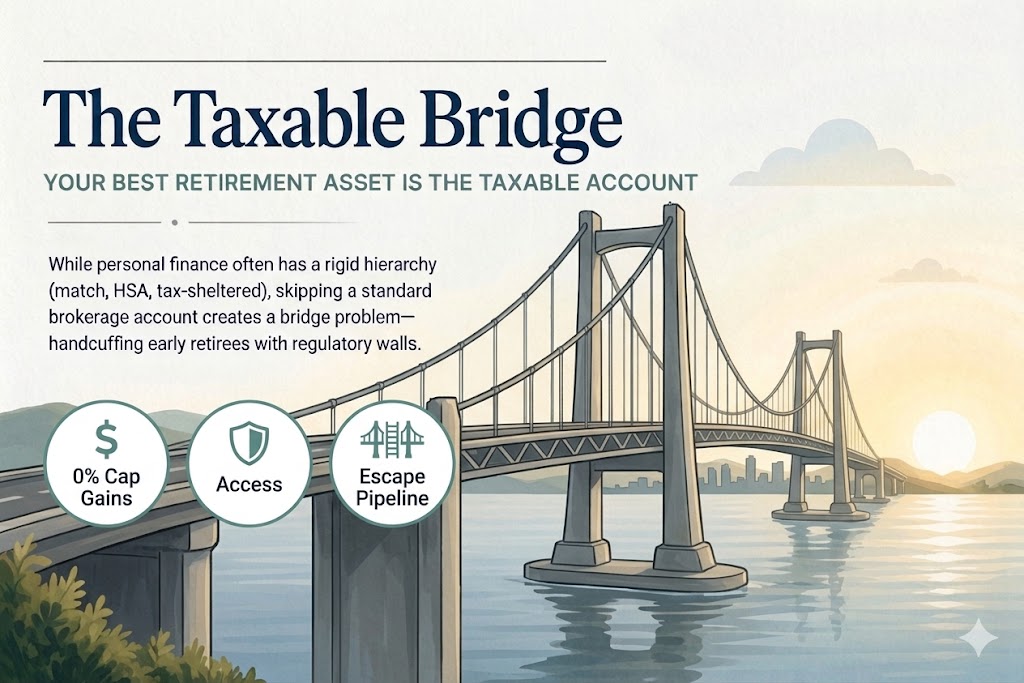
In the real world, prioritizing tax-advantaged retirement accounts to the total exclusion of taxable accounts introduces a potential vulnerability. It is called the bridge problem, and it happens when savers realize they are rich on paper, but handcuffed by the calendar.
The Millionaire’s Desert Island
I recently published a series of posts called The Middle Class Trap that looked at a couple who managed to save a phenomenal $2.5 million. By any reasonable standard, they won the game, but they weren’t sure they had enough saved to retire.
Why? Because most of what they had saved was locked inside tax-deferred retirement accounts.
It is a modern financial parable: they were like a sailor stranded on a raft in the middle of the ocean, surrounded by water, yet dying of thirst. The wealth is right there, mockingly visible on their smartphone screen, but they can’t drink from it until age 59½ without getting hit by the IRS version of saltwater: the 10% early withdrawal penalty.
If your goal is to transition out of full-time work at 45, 52, 55, or even 57, you have to build a financial bridge to carry your household expenses over to the age 59½ finish line. Without a robust taxable account, savers trying to fund an early retirement face an uncomfortable dilemma: work longer than they want to, or execute some more complex IRS maneuvers to withdraw their funds early.
The Power of the 0% Capital Gains Bracket
The irony of avoiding taxable brokerage accounts out of tax fear is that, for many retirees, the taxable account can be highly tax-efficient. How?
The tax code provides an incredibly generous feature for long-term capital gains: the 0% tax bracket. For a married couple, you can realize a surprisingly amount of long-term capital gains each year and pay exactly 0% in federal income taxes.
Let’s look at some numbers to see how this works in practice. Consider a couple who decides to retire early at age 55 and needs $100,000 per year to live comfortably.
If they fund that $100,000 entirely by selling investments in a taxable brokerage account, they aren’t actually realizing $100,000 of taxable income. A significant portion of every single sale is simply the return of their original basis—the money they already invested.
The Math: Return of Basis + 0% Gains
Imagine this couple invested $50,000 years ago, and it has doubled to $100,000. When they sell that $100,000 chunk to live on:
- $50,000 is the return of their original investment (completely tax-free).
- $50,000 is the long-term capital gain.
Because their total capital gain ($50,000) falls comfortably below the top of the federal 0% long-term capital gains threshold (assuming they don’t have other significant ordinary income stacking underneath it), they pay exactly $0 in federal income tax on their $100,000 distribution.
They have successfully funded a six-figure lifestyle with a 0% tax rate, all while keeping their traditional pre-tax accounts untouched, allowing those buckets to compound undisturbed for later in life.
What if You are “Too Late” to the Taxable Game?
If you are reading this at age 50 or 55 with a large pre-tax retirement account and a near-zero taxable brokerage, don’t panic. You aren’t actually stuck on the raft, and you don’t have to start drinking saltwater.
While having a taxable brokerage account acts as a powerful grease for the wheels, you have highly effective escape hatches to solve the bridge problem even if you are starting late.
1. Strategic Roth Conversions & The 5-Year Ladder
You can methodically move money from your Traditional IRA to a Roth IRA. You pay income tax on the conversion today, but five years later, you can withdraw the converted amount completely penalty-free, regardless of your age. By setting up a pipeline of these conversions annually, you create a rolling “ladder” of penalty-free cash.
2. Substantially Equal Periodic Payments (SEPP / Rule 72(t))
The IRS allows you to pull money out of an IRA at any age penalty-free, provided you commit to a strict schedule. Under Rule 72(t), you calculate a series of equal payments based on your life expectancy, and you must take those exact distributions for at least five years or until you turn 59½ (whichever is longer). It requires careful execution, and is inflexible, but can work if you have reliable expenses and are committed to the withdrawals.
3. The Rule of 55
If you leave your job in or after the calendar year you turn 55, you can take penalty-free distributions from your current employer’s 401(k) plan. The catch is that the money must stay in that active 401(k)—if you roll it over to an IRA, the option disappears.
The Value of Flexibility
True financial planning is about managing for lifestyle flexibility, not just minimizing a current-year tax calculation.
While tax-sheltered retirement accounts are phenomenal wealth builders, they always come with structural strings attached. Balancing them with a robust taxable brokerage account gives you the ultimate asset: liquidity. Wealth isn’t very comforting if it’s locked behind a regulatory wall, and building a taxable bridge ensures you have the freedom to access your money when you decide to step away from the clock.