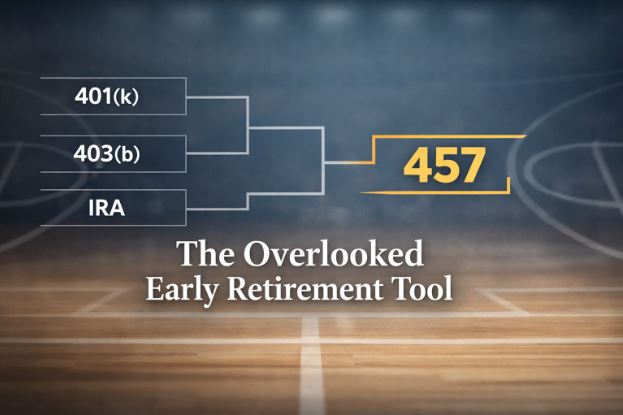

If you want to retire before 59½, one of the most useful accounts you can have is also one of the least talked about: the governmental 457(b). Many public employees have access to a 457 and never look at it because they don’t understand how it differs from 401(k) or 403(b) plans.
Here is why it deserves attention.
Cheat code #1: Penalty-free withdrawals after you leave your job
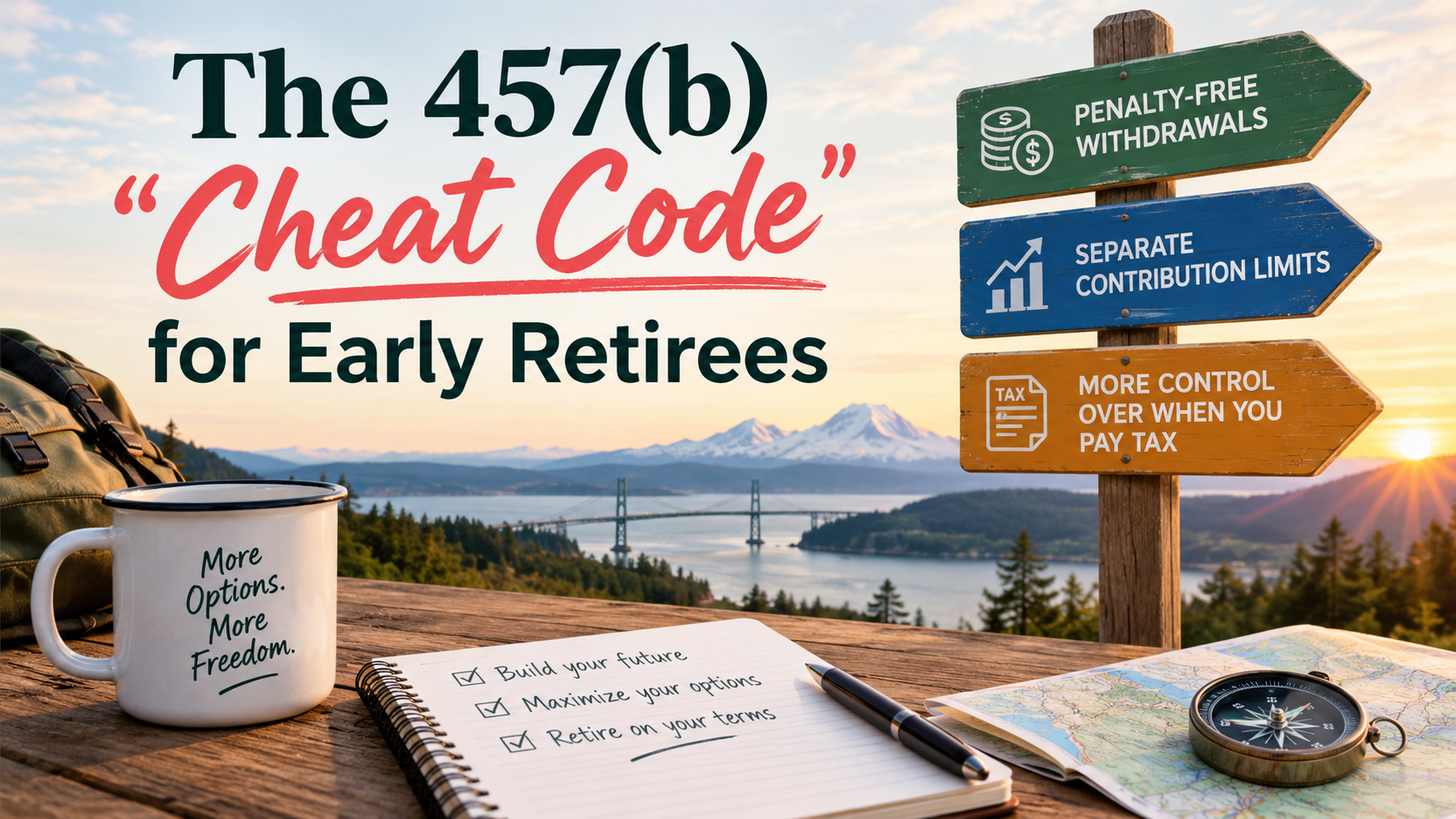
This is the headline feature. With a governmental 457(b), once you separate from service you can withdraw money at any age without the 10% early withdrawal penalty. You still owe ordinary income tax on pre-tax dollars, but the penalty doesn’t apply.
Compare that to 401(k)s, 403(b)s, and traditional IRAs, which generally charge a 10% penalty before 59½. The usual workarounds, such as 72(t) distributions, require a fixed payment schedule that is hard to change once you start. A 457(b) lets you take what you need, when you need it.
For someone retiring in their 40s or 50s, that makes a 457 the natural bridge account for the years before your other accounts open up.
Cheat code #2: A separate contribution limit
The 457(b) limit is separate from the limit on 401(k) and 403(b) plans. If your employer offers both, you can contribute the maximum to each in the same year. At the 2026 limits, that is $24,500 to the 403(b) or 401(k) and another $24,500 to the 457(b), or $49,000 in total before any catch-up contributions.
Many people leave this on the table simply because they don’t know the limits are independent. Most plans also offer special catch-up provisions in the years just before normal retirement age, which can raise the ceiling further.
Cheat code #3: More control over when you pay tax
Pre-tax contributions reduce your taxable income during your working years, which for many public employees are also their peak earning years. In early retirement, you can draw from the account when your income, and your tax bracket, may be lower. Many plans also offer a Roth 457(b) option, which adds another way to shape your future tax picture.
Know which kind of 457(b) you have
Not all 457(b) plans are created equal. There are two types: governmental and non-governmental plans, and they come with some significant differences.
Governmental 457(b) plans are offered by states, counties, cities, school districts, public utilities, and similar public employers. Assets are held in trust for employees and are generally protected from the employer’s creditors. You can usually roll the balance into an IRA, 401(k), 403(b), or another governmental 457. Withdrawals after separation are penalty-free.
Non-governmental 457(b) plans are typically offered by certain nonprofits, including large hospital or private university systems. Assets usually remain the employer’s property and are exposed to its creditors. Distribution schedules may be locked in ahead of time, and rollovers are generally limited to other non-governmental 457 plans. These plans can still be useful, but they carry more risk and less flexibility.
Watch out for the Rollover Trap
The 457(b) penalty exemption only stays in place if you keep the funds in the account. The minute you roll the money into an IRA, it becomes IRA money, and the usual 10% penalty before 59½ applies again. If you plan to use your 457(b) as a bridge, you should leave at least the amount you expect to need until age 59 ½, rather than rolling everything over at separation.
Other things to check
Investment options and fees vary by plan. Some plans offer low-cost index funds, while others have limited menus or high expenses. If your employer offers multiple providers, compare fees carefully.
Also look at the plan’s distribution rules, including how withdrawals work after separation, whether you can take partial withdrawals, and whether Roth contributions are available.
Who should pay attention?
- Public employees who may retire before 59½
- High savers who are already maxing out a 403(b) or 401(k)
- Anyone who wants a flexible, tax-aware bridge to cover early retirement years
- Pension-eligible employees who want extra liquidity before their pension starts
The Bottom Line
If you work for a government employer, make sure you’re not passing up your 457(b). It’s the closest thing early retirement has to a cheat code. Nonprofit employee? Check whether you have a 457(b) too, but read the fine print first, since not all plans work the same way.