
Managing the path to early retirement involves navigating a lot of uncertainty. One of the biggest areas of anxiety for early retirees is answering the question “What am I going to do for healthcare?”
The good news is that unlike the pre-Affordable Care Act (ACA) days, early retirement is no longer a healthcare desert. You don’t have to stay at a soul-crushing job just for the group policy. But if you aren’t careful, an oversight or income spike can turn a manageable expense into a big financial surprise.
Here are the top 10 healthcare and tax surprises to watch for as you plan early retirement:
10. The Sticker Price Fallacy
If you go to a provider’s website and see a $2,400 monthly premium for a Silver plan, don’t immediately panic. For people able to manage on a more modest income, generally below 400% of the federal poverty level (see inset), the “sticker” price of insurance is often irrelevant. What matters is your Net Premium after the Premium Tax Credit. For a typical early retiree with a controlled income, the ACA credit does the heavy lifting, often dropping that scary four-figure monthly bill down to something resembling a car payment.
9. The Age-Grading “Birthday Tax”
Health Insurance premiums are pegged to your age. A plan that costs $500 a month at age 55 will naturally climb every year, often peaking between ages 60 and 64. When you’re doing your long-term spending plan, you shouldn’t just assume inflation, you have to also account for age-grading. This is particularly important if you are not receiving ACA subsidies where the premiums are capped at a percentage of your adjusted gross income or AGI.
8. Non-Compliant “Off-Market” Traps
Shopping for an “off-market” healthcare plan is a bit of a Wild West. While you can buy legitimate ACA-compliant plans directly from insurers, there is a whole world of “alternative” plans, like short-term medical or health-sharing ministries that aren’t required to cover pre-existing conditions. Some people might like the lower costs and are not bothered by medical underwriting, but just make sure you know what you’re buying.
7. The “New Job” Subsidy Sabotage
It’s a common scenario: your child graduates from college and lands a full-time job in July. While the law lets them stay on your insurance until 26, the subsidy rules are different. The moment your child (or spouse) is offered “affordable” insurance at their new job, the tax credit for their portion of your plan usually evaporates. If you don’t update the ACA Marketplace immediately, you’ll likely face a “clawback” on your tax return for every month they were eligible for their own employer’s coverage, even if they never enrolled in it.
6. The “Double Cliff” (Losing CSRs)
Most people know about premium subsidies, but Silver plans often come with Cost-Sharing Reductions (CSRs). These lower your actual deductibles and co-pays. However, CSRs are on a hair-trigger. If your income crosses 250% of the Federal Poverty Level (FPL), those benefits can vanish instantly. It’s a double hit: you pay more for the plan, and then you pay more when you actually go to the doctor.
5. Network “Borders” for Travelers
If your bridge years involve traveling the country or visiting family in another state for extended periods, check your plan’s “portability.” Many affordable plans only cover emergencies once you leave your home county. If you’re living the nomadic life, prioritizing a PPO or a plan with a national network prevents a simple out-of-state specialist visit from becoming a full-price disaster. The same issue can emerge if you have a college student on a marketplace plan who wants to access healthcare in another location.
4. The Max Out-of-Pocket Liquidity Gap
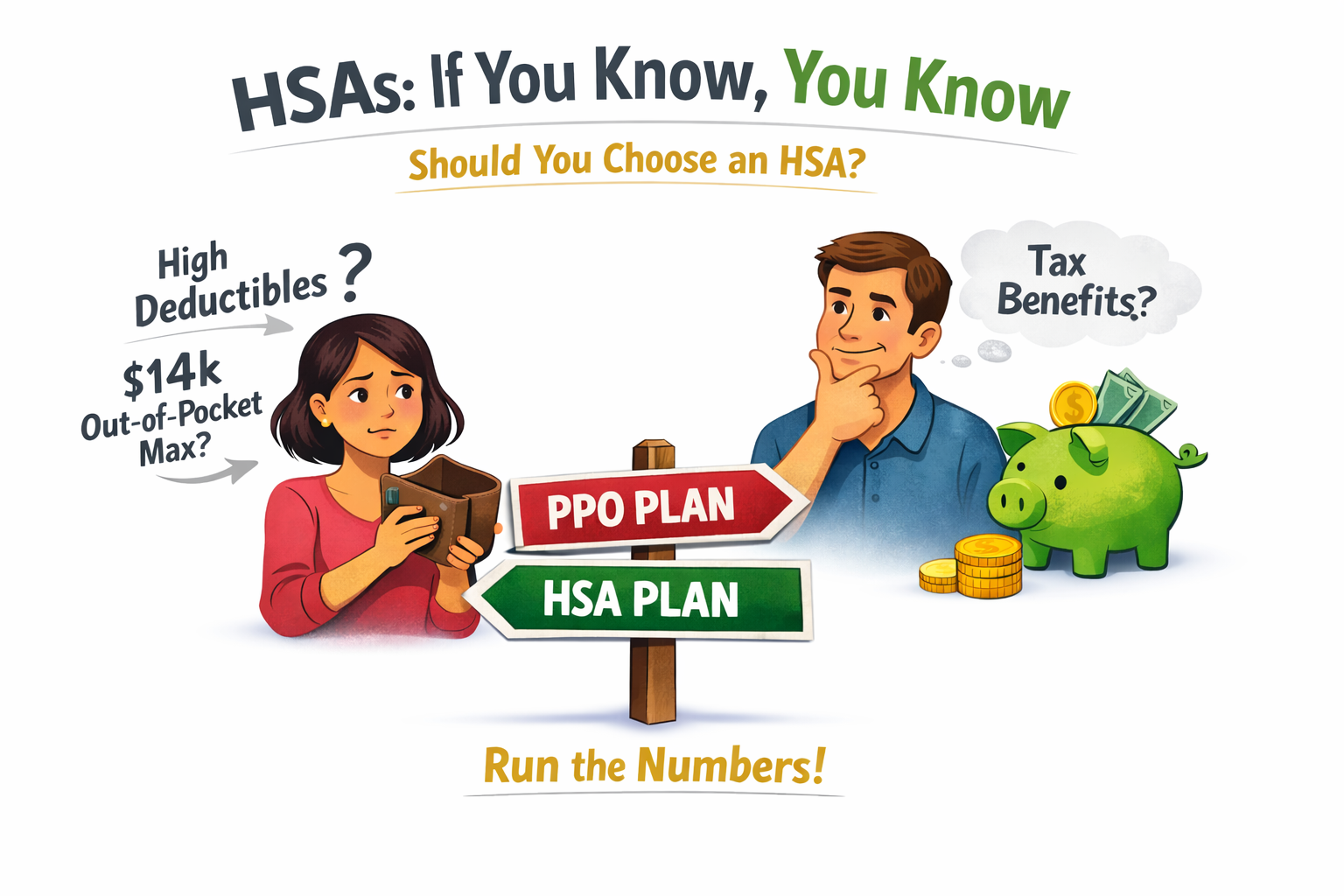
Your healthcare budget is more than your monthly premium. You need to account for copays and deductibles up to your annual maximum out-of-pocket (MOOP). For many plans, the MOOP can be more than $10,000 for an individual. Your healthcare strategy isn’t complete until you have accounted for some out of pocket costs in your budget.
3. The COBRA Illusion
Leaving a job often comes with a COBRA offer to continue your existing insurance plan. It feels safe and familiar, but COBRA can come with serious sticker shock. Many employees aren’t aware how much their employers actually contribute to healthcare costs. If you’re curious, check last year’s W-2 Box 12; code “DD” shows the total cost of your coverage. That’s roughly what COBRA will cost you annually, plus a small administrative fee of up to 2%.
COBRA can be a good choice for people leaving mid-year and who may have already exhausted their deductible. However, you should still shop around for other plans, especially through the ACA.
2. Fearing the IRMAA “Monster”
The Income-Related Monthly Adjustment Amount (IRMAA) is a surcharge for Medicare Part B and D if your income is high. People fear it, but it’s often manageable in the lowest tiers. These surcharges have a two-year lookback, which means IRMAA looks at your tax return when you are 63 when calculating whether it applies for the year when you turn 65. In 2026, the tiers for married couples don’t start until you’re over $218,000 in MAGI.
| 2026 Tier (MFJ) | MAGI Range | Monthly Part B IRMAA Surcharge | Monthly Part D IRMAA Surcharge |
| Standard | $218,000 or less | $0 | $0 |
| Tier 1 | $218,001 – $274,000 | $80.20 | $14.50 |
| Tier 2 | $274,001 – $342,000 | $202.90 | $37.50 |
| Tier 3 | $342,001-$410,000 | $324.60 | $60.40 |
| Tier 4 | $410,001-749,999 | $446.30 | $83.30 |
| Tier 5 | $750,000+ | $486.00 | $91.00 |
As the table shows, IRMAA charges in the lower tiers and relatively modest. The tax savings from a strategic Roth conversion often far outweigh an extra $94 or even $240 per month in premiums. Don’t let the IRMAA “monster” stop you from doing smart tax planning.
1. The 400% FPL “Hard Cliff” (And the HSA Emergency Brake)
As of 2026, the “subsidy cliff” is back. Earn $1 over 400% of the FPL, and you lose your entire subsidy. For a couple in their early 60s, that single dollar could cost $20,000 or more in lost tax credits.
What happens if you accidentally find yourself over the income limit? Sometimes life happens, like a surprise capital gain or a missed calculation.
This is where the Health Savings Account (HSA) becomes a great safety valve. You have until the tax filing deadline (April 15th of the following year) to make a prior-year HSA contribution. If you find yourself $2,000 over the cliff in February, a $2,000 HSA contribution can pull your MAGI back under the line and save your entire subsidy after the year is already over.
Healthcare in early retirement isn’t a mystery, but it does require careful planning, and occasionally a bit of arithmetic. By avoiding these 10 surprises, I think you’ll find that your bridge stays solid all the way to Medicare.