

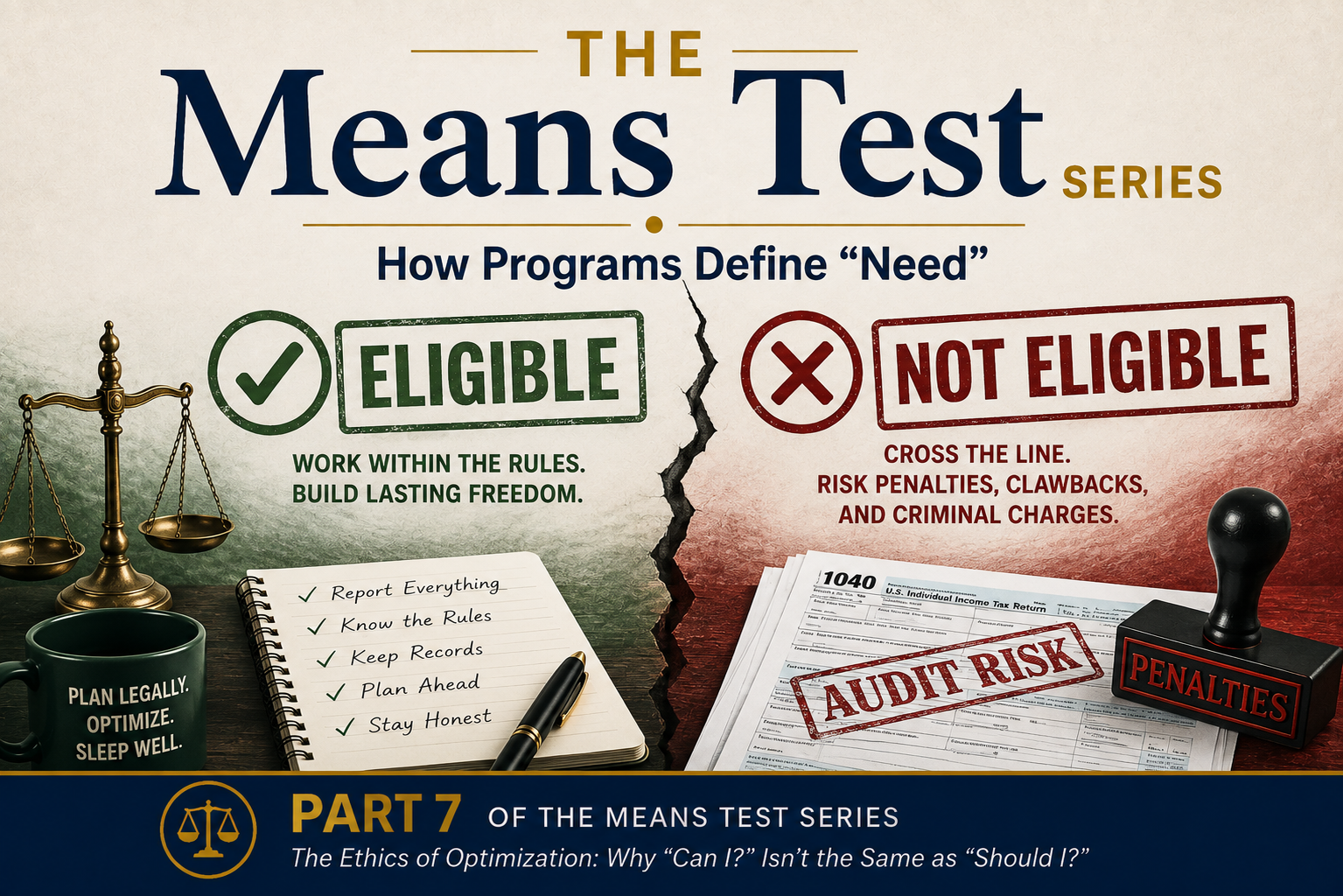
Part 7 of The Means Test: How Early Retirees Qualify for Benefits, and Where to Draw the Line
Let’s be clear from the start: this post is not a manual for cheating on your taxes, hiding assets, or gaming application portals.
In some financial forums on tax planning, there is a dangerous narrative that quietly circulates: the cynical assumption that “everyone is doing it,” or that public systems are so bureaucratic that a little administrative cheating is just part of the game.
I think that mindset is a trap.
There is a world of difference between legitimate, tax-code-compliant optimization (like timing capital gains, tax loss harvesting, or managing taxable withdrawals) and misrepresentation or outright tax evasion. Public assistance programs, federal aid formulas, and tax exemptions are built on objective definitions. When you cross those boundaries, you aren’t being a clever strategist; you are stepping into civil fraud, mandatory clawbacks, administrative bans, and potential criminal liability.
To understand where the legal lines are drawn, we need to look at the specific areas where early retirees might be tempted to bend the rules, why and how those shortcuts backfire, and what legitimate planning looks like instead.
The Perjury Standard: What You Sign Matters
Whether you are completing a FAFSA form for your child’s college aid, applying for state Medicaid, or claiming ACA health insurance subsidies, every application ends with the same legal threshold: a signature under penalty of perjury.
Under federal and state law, signing a document containing statements you know to be false is a crime. Agencies do not merely rely on your tax return. Administrative bodies, state departments of social services, and the Department of Education possess broad audit powers. They can subpoena bank records, inspect property deeds, review brokerage transaction histories, and cross-reference state databases.
When discrepancies surface, the legal system evaluates your actions based on whether a misrepresentation was “willful.” Claiming you simply misunderstood a clear question about liquid assets or business ownership rarely holds up.
Here are five financial red lines that I believe are simply not worth crossing.
Red Line 1: Playing the “Audit Lottery” with Shady Expenses vs. Real Pre-Tax Deductions
The Temptation
When you exit traditional employment and transition to a 1099 side hustle, consulting gig, or small business, a low IRS audit rate creates a dangerous temptation: playing the audit lottery. In the tax world, “playing the audit lottery” refers to taking a tax position that you know is illegal, aggressive, or unsupported by law, simply because the statistical probability of getting audited is low.
Some early retirees attempt to aggressively drive down their Adjusted Gross Income (AGI) for ACA health insurance subsidies or tax reduction by writing off personal living expenses as business deductions. This includes claiming personal vehicle mileage, home utility bills, family vacations disguised as “business retreats,” or everyday groceries as business expenses on Schedule C. The logic usually sounds like: “The IRS doesn’t have the staff to check every receipt, so why not push the line?”
The Legal Boundary
Falsifying business expenses directly violates Section 162 of the Internal Revenue Code, which requires expenses to be both “ordinary and necessary” to the trade or business. If audited, the IRS requires strict record-keeping and receipts. Many people fail to understand that you, the taxpayer, carry the legal burden of proof to substantiate that an expenditure qualifies as a deduction.
Disallowed expenses result in immediate back-tax assessments, statutory interest, a 20% accuracy-related negligence penalty, and, if the IRS determines there was an intentional pattern of fabrication, a 75% civil tax fraud penalty or criminal prosecution.
The Better Idea: Maximize Legitimate Tax-Deferred Savings
Instead of fabricating deductions, you should use the powerful, explicit tax shields Congress designed for self-employed individuals:
- Solo 401(k) / SEP-IRA: You can contribute both as the “employee” and the “employer” into a Solo 401(k) from your legitimate net business earnings. Pre-tax contributions directly reduce your AGI on Form 1040, shielding your income and lowering your MAGI for ACA subsidies without fabricating a single expense.
- Legitimate Direct Expenses: Track and deduct genuine operational costs (software subscriptions, professional insurance, dedicated home office square footage) using strict, contemporary accounting logs.
Red Line 2: Faking “Real Estate Professional Status” (REPS) vs. Material Participation Rules
The Temptation
Early retirees who purchase rental properties often hit a major tax wall: rental activities are defined by default as “passive,” meaning rental paper losses (like depreciation) can generally only offset passive income, not ordinary or portfolio income.
To bypass this limit and reduce taxable income, some early retirees claim Real Estate Professional Status (REPS). The temptation is to fake or inflate hours to meet the IRS threshold, assuming the IRS won’t verify whether they actually spent 750 hours a year managing a handful of single-family rentals.
The Legal Boundary
REPS is one of the most heavily litigated areas of the tax code. Taxpayers lose the vast majority of disputed REPS cases because they fail to maintain contemporaneous records supporting their claimed hours.
To qualify legally, you must meet two criteria:
- More than half of the personal services you perform in trades or businesses during the year must be performed in real property trades or businesses.
- You must perform more than 750 hours of services during the tax year in real property trades or businesses in which you materially participate.
The IRS routinely rejects REPS claims backed by “ballpark estimates” or retroactively fabricated hour logs. When REPS status is stripped during an audit, years of back losses are disallowed instantly, triggering massive tax bills, substantial understatement penalties, and interest.
The Better Idea: Real Material Participation or the Short-Term Rental Rule
If you want to use real estate tax benefits legally, structure your investments to fit statutory exceptions:
- The Short-Term Rental (STR) Exception: Properties with an average guest stay of seven days or less are not automatically classified as passive rental activities under Treasury regulations. If you materially participate (for example, spend more than 100 hours on the property and more than anyone else), you can use non-passive losses against other income without needing to hit the 750-hour REPS threshold.
- The $25,000 Passive Loss Allowance: If your MAGI is under $100,000, the tax code explicitly allows you to deduct up to $25,000 of passive real estate losses against ordinary income if you actively participate in managing the property.
Red Line 3: Offshore Asset Hiding vs. Global Tax Compliance (FATCA/FBAR)
The Temptation
Some in the FIRE community explore international living, slow travel, or offshore banking to lower their cost of living. A common myth persists that holding funds in foreign bank accounts, offshore trusts, or international entities hides those assets from the IRS, FAFSA, or state welfare systems.
The temptation is to simply leave offshore interest, foreign dividends, or foreign accounts off federal reporting forms, assuming U.S. agencies have no visibility past national borders.
The Legal Boundary
The United States taxes its citizens and permanent residents on their worldwide income, regardless of where they live or where the money is deposited. Under the Foreign Account Tax Compliance Act (FATCA) and the Foreign Bank and Financial Accounts (FBAR) framework, international banks worldwide automatically report financial account data of U.S. citizens directly to the IRS.
Failing to file an FBAR (FinCEN Form 114) for foreign accounts exceeding $10,000 carries non-willful civil penalties up to $10,000 per violation. If the failure is deemed willful, the civil penalty jumps to 50% of the account balance per year or $100,000, whichever is greater, alongside potential federal criminal prosecution.
The Better Idea: Foreign Earned Income Exclusion & Foreign Tax Credits
Instead of hiding foreign assets, use the tax law built specifically for expats and global nomads:
- Foreign Earned Income Exclusion (FEIE): Qualifying U.S. citizens living abroad can exclude a substantial amount of foreign earned income from U.S. federal income tax.
- Foreign Tax Credit (FTC): If you pay income taxes to a foreign government, Form 1116 allows you to claim a dollar-for-dollar tax credit against your U.S. tax liability on that same income, preventing double taxation legally.
Red Line 4: FAFSA Asset “Shifting” vs. Legitimate College Savings
The Temptation
Under federal financial aid formulas, parent-owned taxable brokerage accounts, high-yield savings, and real estate (beyond a primary residence) are assessed as reportable assets. Because these assets reduce need-based aid eligibility, some early retirees are tempted to execute last-minute “asset hides” before filing the FAFSA.
Attempts to hide assets can include transferring cash into a relative’s bank account with an informal agreement to transfer it back later, or improperly claiming that a taxable portfolio qualifies under a business asset exemption.
The Legal Boundary
Transferring funds to a third party while retaining beneficial control or ownership is fraudulent conveyance. FAFSA asks for the value of your assets as of the date you sign the form. Hiding accounts or falsely claiming assets belong to someone else violates the Higher Education Act and the Financial Aid Fraud Prevention Act, carrying federal fines up to $20,000 and potential prison time.
The Better Idea: Proactive 529 and Exempt Asset Structuring
Instead of hiding assets, use the statutory exclusions Congress explicitly built into the financial aid framework:
- Parent-Owned 529 Plans: Parent-owned 529 accounts receive highly favorable treatment under FAFSA. These accounts are assessed at a maximum rate of 5.64% of the asset value (compared to up to 20% for assets held directly in a child’s name).
- Grandparent-Owned 529 Plans: Grandparent-owned 529 plans are exempt from FAFSA asset reporting under the FAFSA Simplification Act. Furthermore, distributions from grandparent-owned 529 plans no longer count as untaxed student income on federal aid calculations. This allows grandparents to directly fund college expenses without reducing a student’s eligibility for need-based federal aid. (Note: While fully exempt on the FAFSA, these accounts may still be factored in by private colleges that use the CSS Profile for institutional aid.)
- Exempt Asset Categories: Money held in qualified retirement accounts (IRAs, 401(k)s, 403(b)s) and primary home equity are excluded from federal FAFSA calculations. Paying down your primary mortgage or maximizing tax-deferred retirement accounts years before college age legitimately reduces your reportable asset base without violating a single rule.
Red Line 5: Medicaid Asset Transfers vs. Long-Term Care Insurance
The Temptation
Long-term care in a nursing facility or assisted living community can easily cost $8,000 to $12,000 per month. To protect a multi-million-dollar estate for their heirs, some families attempt to qualify for Long-Term Care Medicaid by gifting taxable brokerage assets or property deeds to their adult children right before applying for care, attempting to instantly drop below state liquid asset limits.
The Legal Boundary
States enforce a mandatory 5-Year (60-Month) Medicaid Look-Back Period for long-term care benefits. Every financial transaction, bank transfer, and property deed change made in the 60 months prior to application is scrutinized.
If you gifted assets or sold property for less than Fair Market Value during that window, Medicaid applies an explicit penalty period of ineligibility, leaving the family directly responsible for private-pay bills. Furthermore, under state Medicaid Estate Recovery Programs (MERP), states are legally required to pursue post-death estate assets to recover costs paid on behalf of beneficiaries.
The Better Idea: Long-Term Care Insurance and Asset Protection Planning
Rather than attempting last-minute asset transfers that trigger fraud penalties, prepare for healthcare risks decades in advance:
- Long-Term Care Insurance provides dedicated coverage to pay for home healthcare, assisted living, or nursing home stays if you become unable to perform activities of daily living.
- Medicaid Asset Protection Trusts (MAPTs): if estate preservation is a core goal, establishing irrevocable trusts must be done far in advance, well outside the five-year look-back window, with the guidance of a qualified elder law attorney.
What Happens When You Cross the Line?
When administrative agencies or tax authorities identify deliberate misrepresentation, the consequences include steep penalties:
- Mandatory Recapture: You must repay subsidies, benefits, or tax credits received, typically with compounding statutory interest and penalties.
- Administrative Disqualification: Being formally barred from participating in federal or state assistance programs for periods ranging from one to ten years, or permanently.
- Civil Damages & Negligence Penalties: Fines under state False Claims Acts, alongside IRS accuracy-related penalties (20%) or civil fraud penalties (75%).
- Criminal Prosecution: Cases involving significant dollar amounts or willful falsification are referred to state attorneys general or federal prosecutors for grand larceny, welfare fraud, or tax fraud.
The 5-Point Legal Sanity Checklist
Before you sign any application or execute an aggressive income-timing strategy, run your plan through these five questions:
- Did I report all sources of real worldwide income? (Including cash earnings, 1099 side hustles, or foreign accounts?)
- Am I using an explicit statutory rule or a “loophole” from a sketchy online forum? (Is your strategy documented in IRS publications and state statutes, or does it rely on playing the audit lottery?)
- Have I retained control over assets I claim to have given away? (If you still control the bank account, real estate, or portfolio, it is still your asset.)
- Does my application match my actual bank statements? (If an auditor looked at your checking account records today, would your application answers make sense?)
- Am I willing to explain this strategy under penalty of perjury in an audit?
Legal financial planning is about arranging your affairs to take full advantage of the laws as they are written. Bending facts, hiding assets, or playing the audit lottery isn’t smart optimization; it’s a huge risk that could destroy the very security financial independence is supposed to build.
In our next section of this series we’re going to revisit Ben & Leslie from our Middle Class Trap Series to see how they will navigate the world of means-tested programs and tax optimization.
Stay Tuned for Part 8!