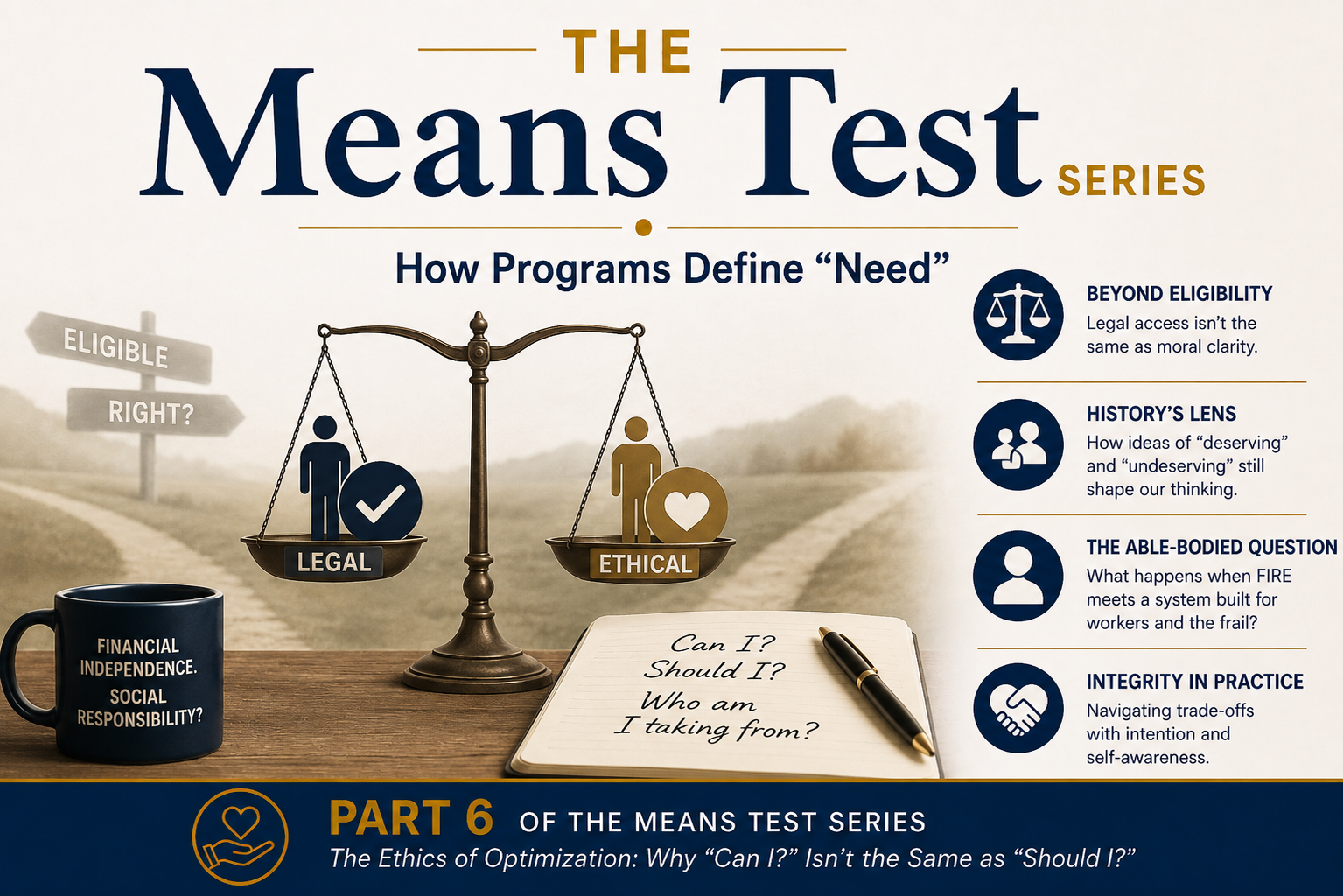

Part 6 of The Means Test: How Early Retirees Qualify for Benefits, and Where to Draw the Line
I’ll be honest: the main reason I started this series was to write this post about ethics, means-testing, and FIRE. Over the years, I’ve read countless online debates about early retirees and what kind of “subsidies” they should and shouldn’t take. On one side, critics accuse multimillionaires of gaming a tax and benefit system never designed for them. On the other side, FIRE advocates champion aggressive tax and benefit-claiming strategies that seem legal, but leave many people with an uneasy ethical feeling they can’t quite articulate.
Over the first five parts of this series, we mapped out how the safety net uses proxy variables like AGI, MAGI, and asset tests to determine eligibility. We saw how an early retiree with a million-dollar portfolio can legally qualify for ACA subsidies, FAFSA exemptions, SNAP benefits, and local property tax relief.
But running the numbers and hitting “eligible” on a software screen answers a legal question. It does not answer a moral one. Knowing that you can structure your finances to claim a benefit is fundamentally different from deciding that you should take the benefit.
Two Questions to Consider
When early retirees discuss public subsidies of any kind, gut reactions tend to collapse moral concerns into a single, vague feeling of discomfort. After all, the movement is called Financial INdependence, not financial DEpendence!
One way of evaluating this ethical issue is to answer two simple questions:
- Individual Permissibility: Do I have a right to access a benefit if I meet every requirement as written?
- Displacement: Does my choice to take this benefit directly deprive another household of help they need more?
Claiming a tax credit might “feel” cleaner than queuing up at the state benefit office, but feeling uncomfortable does not make an action wrong, just as feeling justified does not make an action harmless.
Where “Deserving” Comes From
Our discomfort with claiming public assistance does not come from a vacuum. It is built on a 400-year-old framework designed to answer one question: Who deserves help?
In the 1600s, England established the Elizabethan Poor Law, which split society into two rigid categories: the Impotent Poor (those physically unable to work) and the Able-Bodied Poor (those capable of labor). For the able-bodied, receiving aid was paired with mandatory work, strict oversight, and deliberate public stigma. By the 19th century, this became the principle of “less eligibility”, the rule that life on public aid must be visibly worse than the lowest-paid job, ensuring no able-bodied person would ever choose assistance over labor.
As historians like Michael Katz detail in The Undeserving Poor, this view of assistance directly informed American policy. Safety-net programs were purposefully designed with administrative friction, public stigma, and invasive monitoring to weed out the “undeserving.”
Furthermore, as legal scholars and historians have documented, this division was deeply racialized. Rules around welfare eligibility, moral character tests, and work requirements were routinely weaponized to exclude marginalized communities from public support.
Interestingly, the modern British welfare state was remade in the 1940s to explicitly break this cycle, shifting to universal benefits. The new system’s creator, William Beveridge, argued that means-testing inherently breeds stigma, creates poverty traps, and divides society into “payers” and “takers.” America, however, rejected Beveridge’s universalist model, choosing instead a heavily means-tested safety net built on a foundation of moral judgment.
Turning the Lens on Yourself
Here is the irony of the FIRE movement: for four centuries, history sorted poor people into “worthy” and “unworthy.” Today, early retirees are running that exact same sorting exercise on themselves.
When a FIRE retiree hesitates to claim SNAP or ACA subsidies, they are replaying this historical script. They are looking at their own financial situation and asking a simple question:
Am I a responsible citizen who successfully engineered a low-tax drawdown, or am I an able-bodied person extracting resources meant for the vulnerable?
The Able-Bodied Question
The FIRE community presents an interesting challenge to traditional social policy because early retirees represent the exact category the historical framework treated with the deepest suspicion: the voluntary, able-bodied non-worker.
In his influential 1986 work Beyond Entitlement, political scientist Lawrence Mead argued that public assistance must enforce reciprocal obligations. Mead’s work provided the blueprint for the sweeping 1996 welfare reform, leading directly to TANF’s WorkFirst requirements and the SNAP ABAWD (Able-Bodied Adults Without Dependents) 80-hour monthly work rules we examined in Part 5.
Under the Mead framework, society owes support only to those who work or are genuinely unable to do so. An early retiree who chooses to leave the workforce at age 40 disrupts this social contract. They are physically able to work, yet choose leisure or personal pursuits while managing their paper income down to qualify for public systems.
The Malibu Surfer Counterargument
However, there is a competing philosophical view.
In political philosophy, this tension is captured in the famous debate between philosophers John Rawls and Philippe Van Parijs over the “Malibu Surfer.”
Rawls argued in his theory of justice that individuals who choose to surf all day in Malibu instead of working should not be subsidized by society. Van Parijs countered with a radical defense of Universal Basic Income in his famous essay, “Why Surfers Should Be Fed.“ Van Parijs argued that true freedom (what he calls “real freedom”) requires giving every individual the means to pursue their own conception of the good life, even if that choice is spending their days riding waves. Under this view, society should not use the welfare system to enforce a work ethic.
FIRE as Self-Funded UBI
This debate hits home for the financial independence community: FIRE is essentially the Van Parijs surfer argument, self-funded through (mostly) private capital.
Early retirees believe deeply in the legitimacy of exiting the traditional labor market. They argue that an individual should have the freedom to trade income for time, step off the corporate treadmill, and live on their own terms.
Yet this creates an uncomfortable test of intellectual consistency:
If you believe that your own early exit from work is ethically legitimate, intellectual honesty pushes you toward believing that the Malibu surfer should be fed generally, meaning human freedom should not be tethered to traditional labor. Howver, the actual government safety net programs you might draw upon (from tax credits to cash assistance) were explicitly built on the opposite, Mead side of that debate.
When an early retiree accesses a means-tested program, they are using a system built on Mead’s moral framework to finance Van Parijs’s vision of freedom.
Tax Credits vs. Benefit Offices: A Moral Cop-Out?
Many early retirees draw a comfortable moral line between tax credits and benefit programs:
- Claiming a $15,000 ACA Premium Tax Credit on Form 1040? Of course! Savvy financial planning!
- Walking into a state office to claim $300/month in SNAP food benefits? Unthinkable!
Is this distinction real, or is it a psychological cop-out?
In The Submerged State, political scientist Suzanne Mettler demonstrates that the modern American welfare state operates through two distinct channels: visible social spending (direct benefits) and invisible tax expenditures (deductions, exclusions, and tax credits).
Mettler points out that tax-based welfare (like the employer health insurance exclusion, mortgage interest deductions, and ACA credits) disproportionately benefits middle- and upper-income households, yet is rarely perceived as “welfare.” These submerged policies obscure the role of government and exaggerate the role of the market. As a result, citizens are unaware not only of the benefits they receive, but of the massive advantages given to powerful interests, like insurance companies and the financial industry.
Still, if you really think about it, the difference between an ACA credit and an EBT card is largely a visibility artifact, not a fundamental moral difference.
The Anonymity Illusion: Government Portals vs. Food Banks
There is a related psychological boundary that reveals how much this comes down to optics rather than underlying need or any objective moral standard.
Many people feel completely comfortable applying for a tax credit or student financial aid program because the process is digital, nameless, and feels objective. Interacting with an algorithm or submitting a form through a web portal creates a comforting emotional distance. It feels no different to the applicant than applying for a passport or renewing a car registration.
At the same time, those same individuals would never dream of standing in line at a local food bank or soup kitchen. This feeling persists even though many charitable food pantries intentionally operate with open-door, no-questions-asked access rules. Many programs explicitly state that anyone who shows up and says they are hungry will be fed, requiring no tax returns, no bank statements, and no means tests whatsoever.
Statutorily and practically, an early retiree would actually face fewer rules and less paperwork at a local food bank than at the SNAP office. But the face-to-face social visibility of standing in a physical line forces an immediate confrontation with status, community standards, and personal vulnerability. The online government portal lets people take public assistance while shielding themselves from that human gaze. The embarrassment people feel standing in line for assistance is not just a personal insecurity; it is an emotional response stemming from a 400-year policy history.
Rationed vs. Entitlement
If the line between the tax code, the benefit office, and the charitable pantry is mostly a psychological illusion, where does a real ethical boundary sit?
It sits on the second question we introduced at the beginning: Displacement.
There is a big difference between capacity-constrained (rationed) programs and open-ended entitlement programs.
| Program Type | Funding Reality | Direct Ethical Impact | Examples |
| Capacity Constrained (Rationed) | Fixed funding allocations. Every spot claimed by a high-net-worth household directly removes a spot from someone else. | High Displacement: Zero-sum game where your gain is another’s direct loss. | HUD Section 8 Vouchers, Public Housing, LIHEAP Energy Grants, Local Subsidized Childcare Vouchers. |
| Open-Ended Entitlements | Statutory funding. Anyone who meets the legal criteria receives the benefit; funding scales automatically with enrollment. | Zero Direct Displacement: Your participation does not shrink the pool for others. | ACA Premium Tax Credits, Medicaid Expansion, SNAP (in theory), Federal Student Aid (FAFSA). |
This distinction cuts straight across the tax-code and benefit-office divide:
If an early retiree manages their MAGI to secure a Section 8 housing voucher or a local LIHEAP heating grant, they are taking a finite resource off the table. If our FIRE person takes a voucher, a low-income family on a three-year waitlist stays on the street or in the cold. That is direct displacement.
If that same early retiree claims an ACA premium tax credit or uses Medicaid expansion, they are participating in an open-ended entitlement. Congress funds the ACA based on formulaic enrollment. Claiming an ACA credit does not take a credit away from a low-income neighbor down the street.
Two Practical Tests
One more set of ethical frameworks might help provide clarity:
1. The Universalizability Test (Kant’s Categorical Imperative)
Ask: What happens to the system if every single household in my exact financial position does what I am about to do?
If every household with $2 million in assets managed their paper income down to claim $0-premium healthcare, SNAP, and local property tax freezes, the those programs would collapse. Alternatively, legislatures would probably respond by imposing draconian asset and income documentation tests on everyone, including the truly destitute. If a strategy relies on the assumption that “most people won’t do this” to remain viable, it fails universalizability.
To me, Kant’s concept is intellectually interesting, but ultimately not a practical objection to FIRE strategies. We can worry all we want about the “what if” everyone became compulsive savers, but all the data shows we have the opposite problem. The average person saves too little, not too much. Before we spend time solving the hypothetical problem of over-saving, we should probably address the very real problem of millions of households reaching retirement with far too little set aside.
2. The Letter-vs.-Spirit Test
Ask: If the legislature that wrote this statute had a picture of my balance sheet on the wall, would they have drafted the rule this way?
As we saw in Part 1, Congress intentionally eliminated asset testing for the ACA to streamline enrollment and expand healthcare access, meaning high-asset, low-income participation aligns with the legislative mechanism. Conversely, local low-income property tax freezes were enacted to keep low-income seniors from losing their homes to gentrification, not to subsidize multimillionaires executing tactical Roth conversion years.
Zoom Out: Expressive and Political Effects
Let’s look at one final ethical consideration: the political erosion of the safety net.
In the ethics of tax avoidance literature, researchers highlight that widespread public perception of “system gaming” erodes social cohesion and voluntary compliance. The same principle applies to public benefits.
When high-net-worth households aggressively optimize for safety-net programs, the political fallout rarely harms the wealthy. Instead, news stories highlighting millionaires receiving food stamps or public assistance trigger swift political backlash. Legislators respond by adding burdensome paperwork, mandatory drug testing, or complex reporting rules.
The ultimate cost of that backlash is borne entirely by the genuinely poor, who are forced to navigate higher administrative barriers to get basic help.
Drawing Your Own Line
There is no single, universal verdict that dictates where every early retiree should draw their line. But after stripping away emotional noise and looking at the structural reality, early retirees can run their decisions through three practical questions:
- Is the program an open entitlement or a capacity-constrained resource? Are you directly displacing a family with no safety net? If the answer is capacity-constrained, you should probably opt out of the benefit.
- Is eligibility based on a deliberate policy choice or a reporting loophole? Did lawmakers intentionally remove asset tests, like in the ACA, or are you exploiting an unaddressed gap?
- Does participating require you to misrepresent your economic reality? Does it require aggressive mental gymnastics to complete the application under penalty of perjury?
The goal of financial independence is not merely to optimize every cell on a spreadsheet until your tax liability reaches absolute zero or you’ve claimed every available public subsidy. The goal is to build a life of autonomy, security, and peace of mind.
Understanding how society defines “need” allows you to navigate the rules intelligently, while ensuring that your personal optimization honors the broader social contract.
If this post left you feeling like I didn’t give you exact answers to the ethical questions, the next post explores Coloring Outside the Lines: What’s Clearly Not Allowed.