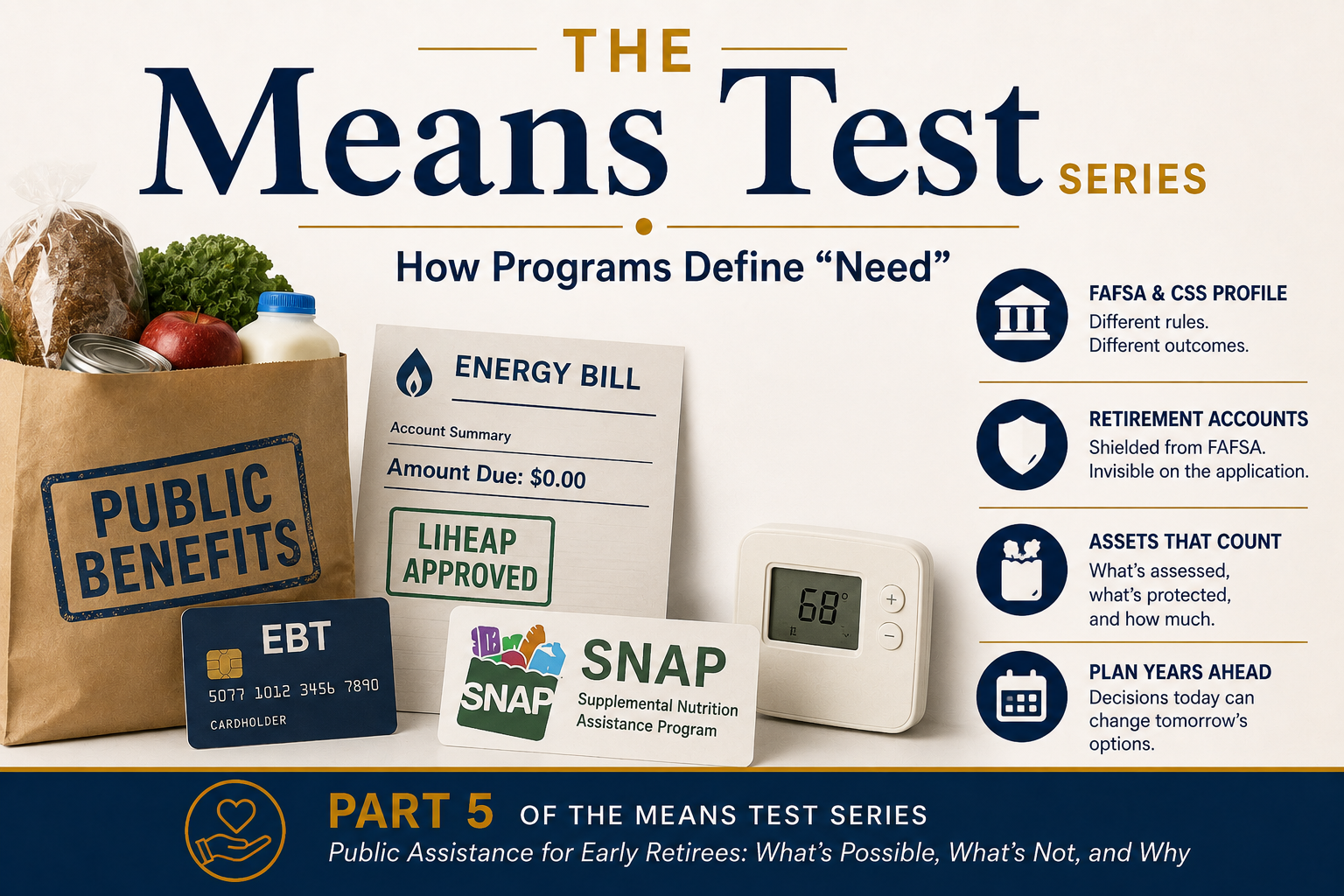

Part 5 of The Means Test: How Early Retirees Qualify for Benefits, and Where to Draw the Line
You can write an article about perfecting tax-loss harvesting, dialing in the 0% long-term capital gains bracket, or optimizing a $15,000/year ACA health insurance subsidy, and the FIRE community will nod in approval. Those moves are framed as savvy financial engineering.
But if you bring up public assistance programs like SNAP (food stamps), LIHEAP (home heating assistance), or low-income property tax exemptions, the conversation will quickly change. Examining safety-net programs in the context of early retirement can feel uncomfortable when the households involved are millionaires or multimillionaires.
Target Audience Reality Check
Let’s establish a key point upfront: traditional public assistance programs are largely irrelevant to typical FIRE households spending $80,000 to $150,000+ in taxable income. They apply almost exclusively to two scenarios:
- LeanFIRE households maintaining a low annual spend ($30,000–$45,000/year).
- Retirees engineering low-income by spending cash reserves, drawing down Roth basis or Roth Conversion Ladders.
The vast majority of financially independent retirees never apply for these programs, nor do they intend to.
Still, early retirement strategy sits along a fascinating moral spectrum. Many retirees comfortably claim thousands of dollars in ACA tax credits or state-level education grants without hesitation, but draw a hard, uncompromising line at EBT cards or energy assistance.
To evaluate where that boundary should sit, which is the explicit focus of Part 6, we are going to strip away knee jerk emotional reactions and examine the dispassionate mechanics of how these safety net programs operate.
Where the Door Is Actually Shut: TANF, SSI, and HUD
Before going any further, let’s set aside the idea that our social safety net is quietly propping up early retirees with large net worths. For the three largest cash and housing programs in the United States, the rich and middle class are completely blocked.
- Temporary Assistance for Needy Families (TANF): commonly and historically known as “welfare”, TANF is a categorical program for households with dependent children. Childless early retirees or couples without dependents do not qualify regardless of how low their reported income falls. Qualifying families face strict income limits, hard asset caps (typically $2,000 to $10,000), a 60-month lifetime benefit cap, and mandatory participation in work activity programs.
- Supplemental Security Income (SSI): SSI enforces a strict federal asset limit of $2,000 for individuals and $3,000 for couples, which is a threshold that hasn’t changed since 1989. It’s also worth noting the benefit caps out at $984 per month.
- HUD Housing Assistance (Section 8 & Public Housing): households are disqualified if their income exceeds 50% of Area Median Income (AMI) or if total net family assets exceed $105,000.
These core programs were engineered with both strict income and hard asset tests. They also carry the highest administrative burden and the least public sympathy. With those three off the table, we turn to the programs where an income-based safety net creates some edge cases that can apply to FIRE households.
How the Safety Net Defines “Poverty” (Income vs. Wealth)
The main point of tension between early retirement planning and public assistance stems from the fact that public policy was designed for cash-poor households with no assets, but some programs are written using income-based rules.
Safety net laws were built to protect families with zero liquid savings and no immediate earning power. They were not engineered around the expectation that a household could hold $1.5 million in tax-deferred accounts while generating $0 in taxable cash flow on paper.
Tax-Deferred Accounts as “Phantom Wealth”
Under some federal and state program guidelines, traditional 401(k)s, IRAs, and primary home equity are not evaluated as liquid, accessible cash until funds are actually drawn down. As a result, a household living off taxable cash buffers or principal withdrawals looks identical on paper to a household living below the Federal Poverty Level (FPL).
Broad-Based Categorical Eligibility (BBCE)
Under standard federal rules, the Supplemental Nutrition Assistance Program (SNAP) enforces a strict asset/resource limit (historically capped around $3,000). For anyone holding a taxable brokerage account, that will rule out eligibility.
However, state-level implementation introduced Broad-Based Categorical Eligibility (BBCE). BBCE allows states to automatically grant SNAP eligibility to households that qualify for or receive non-cash, TANF-funded services. By linking SNAP to these programs, many states bypass the traditional federal asset test entirely.
The State-by-State Patchwork
Because BBCE implementation is left to individual states, eligibility can vary widely:
- No-Asset-Test States (e.g., California, Oregon, New York): Under BBCE, asset tests are eliminated for standard households. Eligibility hinges strictly on gross and net income thresholds.
- Strict Asset Cap States (e.g., Idaho, Texas, Indiana): These states maintain hard liquid resource caps (often $2,500–$5,000), explicitly disallowing households with cash or brokerage reserves.
For a LeanFIRE household in a BBCE state drawing down tax-free cash or Roth principal, eligibility is calculated on gross monthly income minus standard deductions. If gross income falls below the state threshold (often 130%–200% of FPL), the system will approve food assistance, regardless of traditional IRA balances sitting in the background.
Local Relief: Low-Income Property Tax Exemptions
While SNAP is a federal food assistance program, one of the most substantial income-tested benefits flows at the county level through property tax relief, frozen valuation programs, and senior or disability exemptions. Counties frequently offer property tax deferrals or rate freezes designed to prevent fixed-income seniors and low-income families from being priced out of their homes by rising real estate values.
Unlike federal tax credits, local property tax statutes frequently write eligibility definitions strictly around federal AGI, state taxable income, or “combined disposable income.” Crucially, they often exclude retirement account balances and equity in the home itself from the eligibility calculation.
King County (Seattle) Property Tax Relief
- Age61
- Primary residenceSeattle, WA — $950,000 est.
- Portfolio assets$2,500,000 (IRA / brokerage)
- Income ceiling$84,000
- Realized taxable income$40,000
- Asset testNone
In a case study for my home state of Washington, we can look at King County, which is home to Seattle. Here, the senior and disabled property-tax exemption uses a threshold up to $84,000 in combined disposable income.
There is no general net worth test. A homeowner can hold a multimillion-dollar investment portfolio and substantial equity in a debt-free home, yet still qualify if their combined disposable income falls below the maximum. While Washington’s income calculation does add back certain non-taxable items (such as non-taxable Social Security benefits or municipal bond interest), pure principal withdrawals, Roth draws, and cash-reserve spending do not count toward that line item.
The result is a property-tax structure that evaluates income rather than net worth, freezing assessed home values and dramatically reducing tax liability for anyone who meets the age and income criteria. So in this case, a FIRE household could pay greatly reduced property taxes over a long retirement once they hit the age-based eligibility.
Utility Grants & Cascading Safety Nets
To reduce administrative burden, if you qualify for one program you can sometimes automatically qualify form more. For example, qualifying for Medicaid or SNAP can automatically qualify you for public utilities and federal communications grants:
- LIHEAP & Energy Relief: The Low-Income Home Energy Assistance Program (LIHEAP) provides federal grant funding to cover heating and cooling bills. In many jurisdictions, approval for SNAP or Medicaid automatically qualifies a household for LIHEAP grants.
- Secondary Subsidies: Entering the low-income administrative database can automatically unlock Lifeline broadband discounts, municipal utility rate reductions (water, sewer, trash), and federally funded weatherization grants.
Real-World Guardrails: Work Requirements & Administrative Friction
While eligibility rules may technically open these doors, there can be some operational considerations that deter early retirees from pursuing them. And in reality, the programs sometimes include enough hoops to dissuade anyone who is eligible from accessing assistance.
ABAWD Rules (Able-Bodied Adults Without Dependents)
For childless adults under age 65 who are not disabled, federal SNAP rules enforce strict work requirements. Beneficiaries are limited to 3 months of SNAP benefits within a 36-month period unless they document at least 80 hours per month of qualifying employment, volunteer work, or workforce training.
For an early retiree who intentionally left the traditional workforce, logging 20 hours a week of audited activity would seem to defeat the purpose of financial independence.
Unlike filing a tax return where optimization happens quietly through software, public assistance also requires navigating deliberate administrative friction:
- In-person or telephone caseworker interviews.
- Detailed submissions of bank statements, affidavits, and asset verification.
- Recertification cycles every 6 to 12 months with mandatory reporting of financial shifts.
For almost every financially independent household, the time penalty and invasive compliance audits will outweigh any marginal financial benefit.
Bridge to Part 6: Defining Your Own Ethical Boundary
Across the first five posts of this series, we’ve examined the mechanics: how tax benefits, healthcare subsidies, college aid formulas, and public safety nets evaluate income, assets, or a mix of both. An early retiree with a carefully engineered MAGI or wealth sheltered in tax-deferred accounts can legally qualify for programs built to serve people in financial need.
However, establishing that you can legally qualify does not answer whether you should.
Part 6 takes that question on directly: The Ethics of Optimization: Tax Credits, Safety Nets, and Social Contracts, where we will explore the different frameworks retirees use to draw their own moral lines.