
Part 4 of The Means Test: How Early Retirees Qualify for Benefits, and Where to Draw the Line
Part 2 of this series made the case that the Affordable Care Act (ACA) runs on one number: MAGI. If your tax return shows the right MAGI, you receive a premium tax credit, and you’re guaranteed to pay no more than 10% of your income on insurance premiums. Part 3 pushed that further and showed what happens at the floor, where a household reporting very low MAGI can qualify for Medicaid even if they have large balances sitting in their retirement or brokerage accounts.
Now we’re going to turn to college financial aid, which works differently in two crucial ways.
The first difference is when aid formulas measure a family’s income. The ACA and Medicaid measure current-year earnings. College financial aid looks back two years under what’s called the prior-prior year rule. By the time you fill out the financial aid application, the income year that determines your child’s financial aid has been locked in for at least a year.
The second difference is who does the measuring. With Medicaid or the ACA, the government is applying the qualification rules. For college financial aid, the government sets a baseline floor through the FAFSA, and then a few hundred private colleges each build their own proprietary rules on top of it through the CSS Profile. The same family can get vastly different aid packages from two different schools, even though both offers are calculated correctly according to each institution’s rules.
We’ll start with some background because even if you’re a young (or young at heart) early retiree, the terminology and rules have likely changed since you were in college.
Income vs. Assets in the Student Aid Index
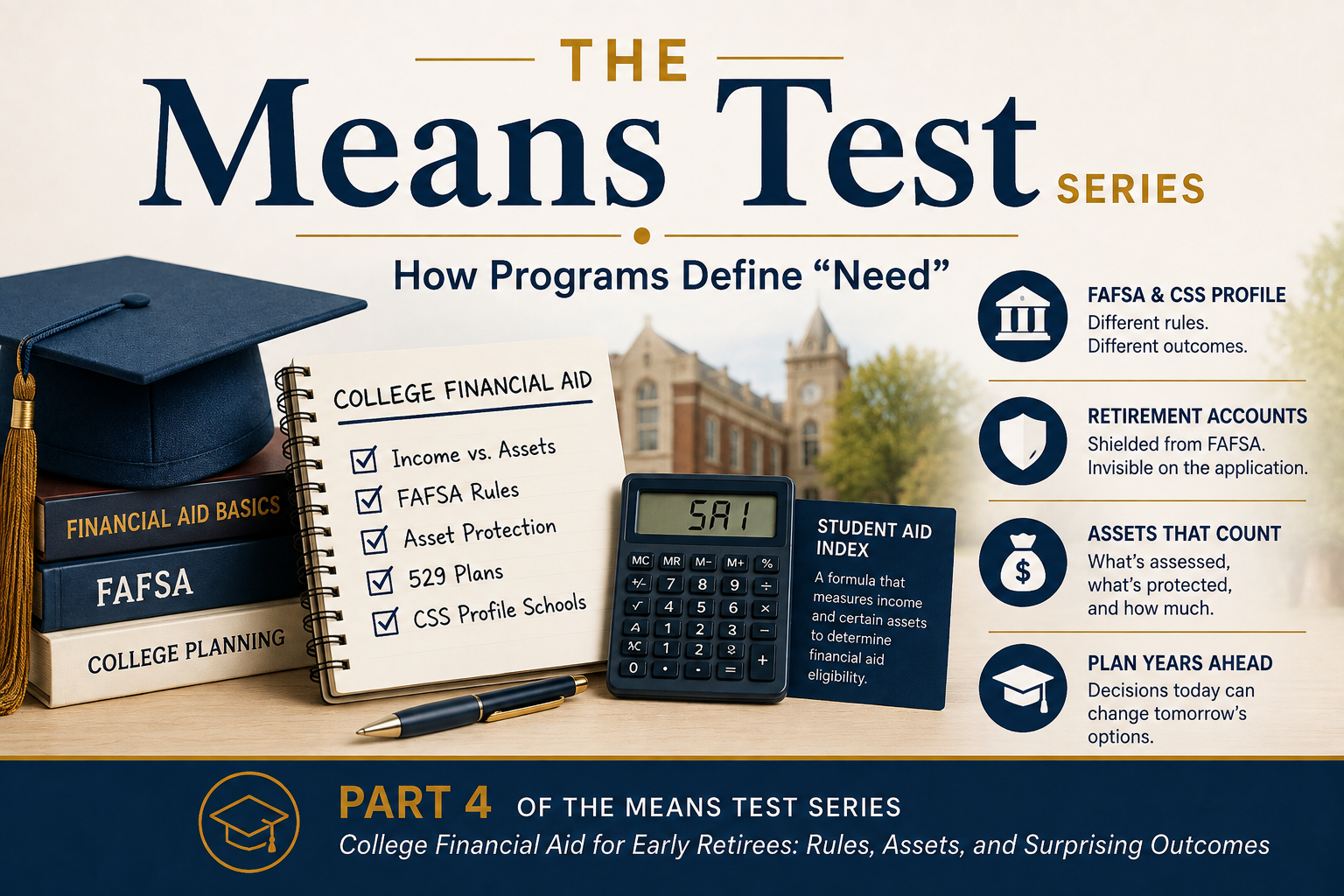
With the implementation of the FAFSA Simplification Act (enacted in 2020, phased in for the 2024–25 aid cycle), the familiar Expected Family Contribution (EFC) was replaced by the Student Aid Index (SAI). While the branding changed, the underlying mechanics for testing family wealth remain structurally intact.
When the Department of Education calculates your SAI, it splits your household financials into two distinct buckets:
- Income: Parent income is assessed on a sliding scale. After baseline allowances for basic living expenses, available parent income is assessed at rates ranging from 22% to 47%.
- Assets: Parent assets that are counted are assessed at a maximum rate of 5.64% of their net value above the Education Savings and Asset Protection Allowance.
At first glance, a 5.64% assessment rate on assets sounds modest. On a $1,000,000 taxable brokerage account, however, that assessment adds $56,400 per year directly to your child’s SAI. To protect your retirement plan while putting kids through school, you have to understand which assets are shielded, and which ones are fully visible and evaluated.
Protected Wealth: What FAFSA Ignores (And What It Counts)
The federal formula does not treat all wealth equally. As the table below shows, most retirement assets fall in the non-reportable category for FAFSA, as does your primary residence equity.
| Non-Reportable Assets (Shielded from FAFSA SAI) | Reportable Assets (Assessed up to 5.64%/yr) |
|---|---|
| Qualified Retirement Accounts (401k, 403b, IRA) | Taxable Brokerage Accounts (Stocks, ETFs, Bonds) |
| Primary Residence Equity | Cash, Checking, & Savings Balances |
| Cash Value of Life Insurance / Annuities | 529 College Savings Plans (Parent-Owned) |
| Qualified Small Businesses (<100 FTEs) & Farms | Real Estate Equity (Rental /Investment Prop) |
The most important shield for early retirees is the exclusion of qualified retirement accounts. The total value inside your Traditional IRA, Roth IRA, 401(k), 403(b), or 457(b) is completely invisible on the FAFSA. You could hold $5,000,000 inside a Traditional IRA, and the FAFSA asset questionnaire will register zero assets for that balance.
Conversely, any wealth stored in a taxable brokerage account, high-yield savings account, or real estate investment portfolio must be reported at its current market value on the day you submit the application.
The 529 College Savings Account
Parent-owned 529 accounts are treated as parent assets, subject to the 5.64% maximum assessment rate. Under current rules, 529s are only reported for the specific student completing the application (rather than aggregating accounts held for all siblings). Furthermore, qualified distributions from parent-owned 529s do not count as student income on subsequent FAFSA applications.
Grandparent-owned 529s are treated even more favorably. Under the old rules, grandparent distributions were treated as student income and could slash a student’s need-based aid by up to 50%. Under the newer rules, the value of a grandparent-owned 529 account does not need to be reported as an asset on the student’s FAFSA, and qualified distributions used for tuition or room and board are not counted as untaxed student income.
So if you’re following along so far, you might be asking: “Great, so college financial aid always follows both an income and an asset test.”
Almost always. But there’s an edge case worth walking through, especially if you’re planning to live lean.
FAFSA: the $60,000 Asset Exemption Cliff
For early retirees living on a modest taxable income, there is one way to avoid reporting assets through the FAFSA Asset Reporting Exemption (which replaced the old Simplified Needs Test).
If your household meets specific criteria, you are completely exempt from reporting any assets on the FAFSA. Your taxable brokerage accounts, high-yield savings, and 529 plans simply drop out of the equation.
To qualify for this exemption, a family must meet two distinct criteria:
- Income Threshold: The parents’ Adjusted Gross Income (AGI) on the evaluated tax return must be less than $60,000.
- Tax Schedule Test: The parents must either not file a Schedule A, B, C, D, E, F, or H, OR if they do file a Schedule C, their net business income/loss must not exceed $10,000 in absolute value. (Alternative pathways exist if someone in the household received a means-tested federal benefit like SNAP or SSI, or if a parent was a dislocated worker.)
The FAFSA $60,000 Asset Exemption Test
Filed Schedule A, B, C, D, E, F, or H?
(SAI asset contribution = $0)
Why This Is a “Cliff” for Early Retirees
This $60,000 rule creates a binary cliff.
Imagine an early retiree family with a $1.5 million taxable brokerage account. They manage their cash flow tightly to keep their AGI at $58,000. They pass the exemption criteria. The FAFSA bypasses asset reporting entirely. Their asset assessment is $0.
However, even if an early retiree manages to keep their AGI strictly below $60,000, the Tax Schedule Test presents a significant hurdle. Most FIRE portfolios depend on generating income or cash flow through a few standard mechanisms:
- Dividend-paying ETFs or index funds (Schedule B)
- Realized capital gains from selling taxable assets to fund living expenses (Schedule D)
- Rental property income or partnership distributions (Schedule E)
Under current tax reporting rules, if your tax return includes a Schedule A (Itemized Deductions), Schedule B (Interest and Dividend income over $1,500), Schedule D (Capital Gains), or Schedule E (Supplemental Income), you fail the tax schedule test.
Once you fail that test, the $60,000 asset exemption vanishes, even if your total AGI is $20,000. You are forced straight into the full asset reporting workflow.
The Two-Year Lookback Window
Compounding this challenge is FAFSA’s Prior-Prior Year (PPY) income rule. The financial aid application for a student entering college in the Fall of 2026 relies on your 2024 tax return.
If you decide in early 2026 to “turn off” taxable capital gains or restructure your portfolio to pass the FAFSA test, you are already two years too late for that freshman year application. Higher education financial aid planning requires a minimum two-to-three-year runway before the first tuition bill ever arrives.
I can see a case where a FIRE-minded family plans way ahead, structures their taxable accounts to throw off minimal interest and dividends, and builds a Roth ladder for living expenses to meet the FAFSA Asset Reporting Exemption. But to me this seems very much like an edge case. On top of that, there’s the fact that this reporting loophole only applies for federal financial aid and schools that accept FAFSA only.
Given that caveat, now is a good time to turn to how most competitive private schools evaluate student financial need.
CSS Profile Schools: A Completely Different Rulebook
If your child applies to highly selective private colleges, you will almost certainly be required to complete the CSS Profile (administered by the College Board).
The CSS Profile does not play by FAFSA rules. Institutional aid officers using the CSS Profile are intentionally looking for indicators of wealth and their formulas look much deeper than FAFSA:
- Primary Home Equity: Unlike FAFSA, the CSS Profile routinely counts the equity in your primary residence as a reportable asset (though some institutions cap home equity at 1.2x to 2x of your income).
- Small Business & Farm Equity: Full equity value is routinely assessed regardless of employee count.
- Annuities & Non-Qualified Assets: Additional illiquid or sheltered non-retirement accounts are re-examined.
While you can structure a portfolio to optimize for federal FAFSA formulas, institutional aid at CSS Profile schools is ultimately awarded at the discretion of the financial aid office. A household drawing a $60,000 MAGI out of a $3,000,000 net worth will rarely receive need-based institutional grants from top-tier private universities once home equity and total financial assets are reviewed.
If you’re looking for some real-life Financial Aid Scenarios, Check out a recent post where I compared 4 College Net Price Calculators:
Where This Leaves the Early Retiree
FAFSA’s rules illustrate a broader truth about safety net policy: government programs evaluate need through radically different lenses. While higher education formulas focus on liquid wealth in brokerage accounts, other systems care almost exclusively about line 11 of your Form 1040.
This creates a bizarre paradox for the early retiree. A household with a multimillion-dollar portfolio, if structured primarily inside tax-deferred accounts, can look virtually identical on paper to a household living below the federal poverty line.
And higher education isn’t the only place where these lines get blurry.
In Part 5, we take a look at the rest of the social safety net: SNAP (food assistance), LIHEAP energy grants, and other local exemptions like property taxes. We’ll examine how these programs handle retirement assets vs. taxable accounts, where the subtle work/income requirements sit, and what happens when the tax code’s definition of “low income” collides with actual public policy. This might seem like a diversion for an early retirement blog to focus on “welfare” programs, but it is important to have this foundation in place before we start talking about ethics in Part 6.